Support WBUR
Charlie Kirk shooting sparks reflection, worry among Massachusetts campuses
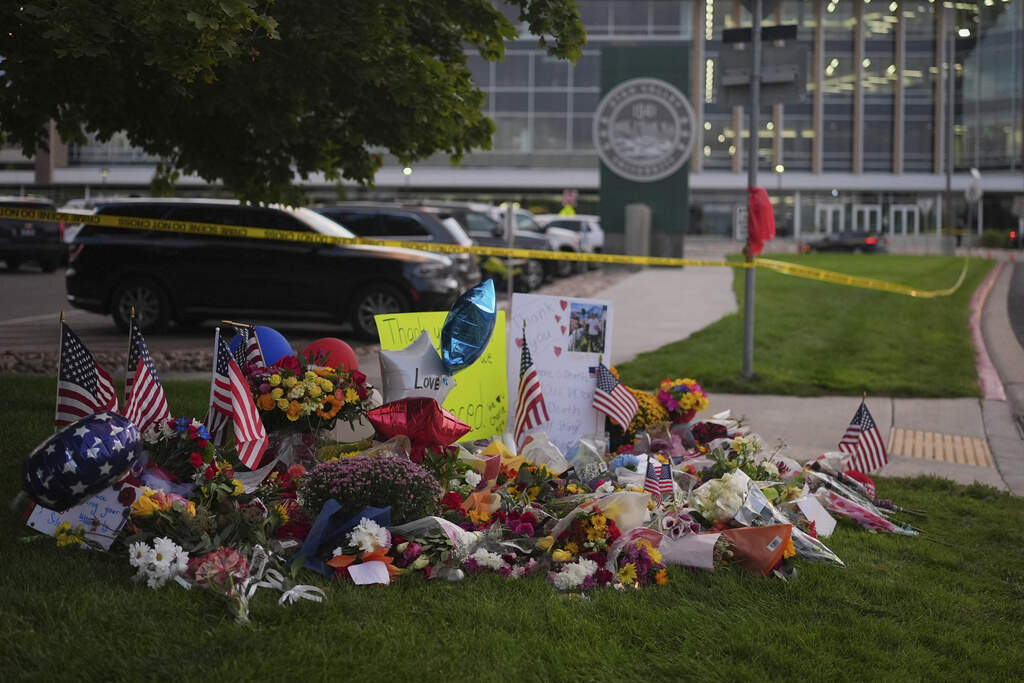
The fatal shooting of 31-year-old right-wing activist Charlie Kirk at Utah Valley University has shaken college students and administrators across Massachusetts.
Kirk, a commentator and founder of the conservative group Turning Point USA, was shot and killed Wednesday while speaking on an outdoor stage in front of a large crowd. Authorities announced Friday that a 22-year-old man is in custody.
Some Massachusetts college administrators and faculty said they hope this moment will allow people to unite across campus divides. But some conservative students said they don't feel safe.
"Colleges and universities should be places for peaceful and open dialogue without fear or threat of physical danger,” Wellesley College President Paula Johnson said in a statement. “This can be a time to come together across political and partisan divides; and our colleges and universities should help model this for our country."
Meanwhile, Harvard Kennedy School Professor Tarek Masoud said he hopes this tragedy will act as a "wake up call" to spur open dialogue and civil disagreement.
“Observing how badly things can get out of hand will cause people again to kind of take a step back, lower the temperature and realize that we actually need to be having more of these dialogues,” he said.
But some conservative students fear for their safety after Wednesday's shooting.
“I'm really terrified of what's happened, and I think a lot of people are too,” said Massachusetts Institute of Technology student Spencer Sindhusen, president of the school's College Republicans chapter.
Sindhusen said at first he thought the shooting wasn’t real.
“I was totally shocked,” said the junior, who saw the headline pop up during class. “You know, in the age of AI, I thought maybe it was a deepfake.”
But when Sindhusen read reporting from The New York Times and a Truth Social post from President Trump, he realized it was true.
“It was so sobering,” he said.
Sindhusen, who started a student group that promotes civic dialogue, said the shooting will likely curtail free speech.
"People are going to be afraid to speak up," he said. "This actually concerns me a lot about the future of our open dialogue culture. We're trying to engage in good faith conversations with people we disagree with, but then the other side might hate us."
In an email to the MIT community Friday, President Sally Kornbluth said that over the last week on campus she's seen two hand-drawn swastikas, a sign wishing harm on a "conservative non-profit," and multiple messages "celebrating violence."
"In the context of this week’s horrifying murder of Charlie Kirk at Utah Valley University, these manifestations of hatred towards others for their views, beliefs or identity are even more concerning," Kornbluth wrote.
She asked anyone with information about the incidents to report it to campus police. An MIT spokesperson said in a statement that "the safety of the people on our campus is always a top priority."
For other students like Jeb Allen, co-president of Amherst College Conservatives, Kirk's killing came as less of a shock.
“It just kind of embodies the insanity that’s taking place and normalized on these college campuses,” he said.
The junior said he received "schoolwide backlash" after writing an article against DEI policies for the Amherst student paper earlier this year. Allen recounted that episode in a 2025 National Review piece, in which he writes of how he received "a death threat" and was "stalked, socially isolated, encouraged to transfer."
"It just hit really close to home," Allen said. "Because it's like when you're a conservative at these institutions, this is what you get."
Republican clubs on several campuses said their members read messages online that they thought celebrated Kirk's death. These comments were "particularly upsetting," the group from Tufts University said in a statement.
Members of the Boston University College Republicans were frightened by these reactions, said chapter President Zac Segal.
“Being a conservative in a more liberal area, you know, when people are celebrating the death of a conservative figure — that makes you feel scared,” Segal said.
Wednesday’s shooting compelled the BU College Republicans to pen an open letter to University President Melissa Gilliam, citing "hostility” on campus towards conservative students and asking for "appropriate security" at their events.
A spokesperson for the university said he expects Gilliam to reply to the letter and emphasized that the school takes all necessary precautions to ensure safety for the BU community and campus guests. (Boston University owns WBUR's broadcast license. WBUR is editorially independent.)
Other local colleges also maintain they have robust security measures in place for campus events.
Northeastern University requires pre-registration and checks IDs and bags at the door to enhance safety, according to Vice President for Communications Renata Nyul. The school also works with local law enforcement when necessary, she said.
“The university also has a thorough vetting process for external speakers, which helps to ensure a diversity of viewpoints and a safe environment in which to discuss them,” Nyul said in a statement.
A spokesperson for Harvard Kennedy School said the campus is accustomed to hosting high-profile figures.
"We regularly work with campus security, Harvard university police, local, and other law enforcement agencies to ensure that our events can proceed safely and securely for event participants and guests,” he said.
Kirk was scheduled to appear at Dartmouth College for a debate with progressive commentator Hasan Piker later this month. The Dartmouth Political Union, the group set to host the event, issued a statement Wednesday saying it was “horrified and heartbroken” over Kirk’s death.
“Now, more than ever, it’s important that despite our differences we can see the humanity in those across the aisle,” the student-led group said. “Political violence will never be the answer to political disagreement. When we disagree, we must engage in discourse.”