Support WBUR
How Michelle Wu became the only real candidate for Boston mayor
Editor's Note: This is an excerpt from WBUR's politics newsletter, Mass. Politics. If you like what you read and want it in your inbox, sign up here.
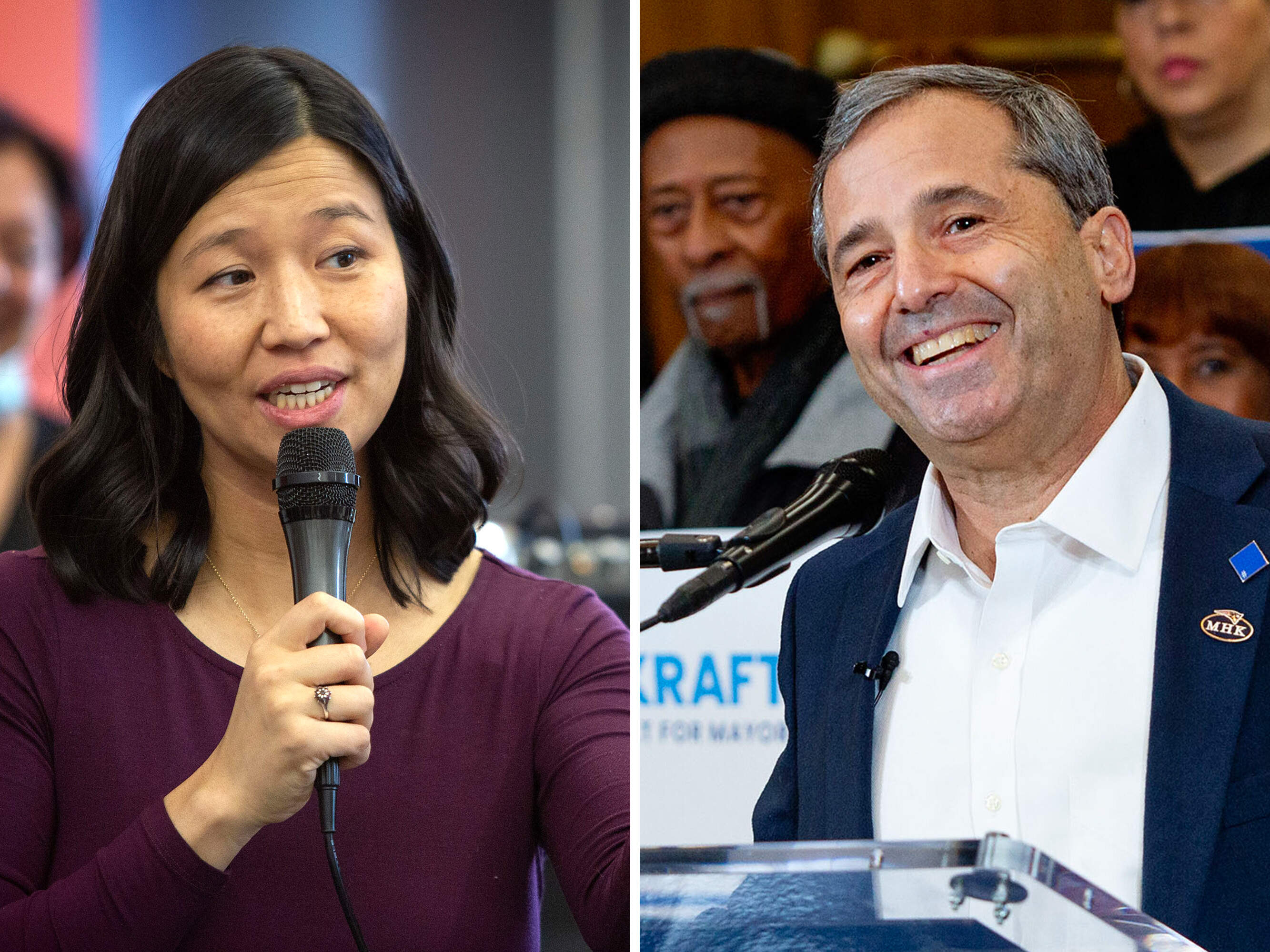
Josh Kraft hoped to be the first person in over 75 years to unseat an incumbent Boston mayor. Instead, he made a different kind of history: the first Boston mayoral candidate to drop out after advancing to the general election since the city began holding preliminary elections in 1951.
It was a remarkable turn, after the son of New England Patriots owner Robert Kraft poured millions of dollars into his own campaign. What was shaping up to be Boston’s most expensive mayoral race ever now sees Mayor Michelle Wu sailing toward a second term unopposed.
Here’s a breakdown of what happened, and what’s next:
Starting with the crushing…
Going into the Sept. 9 preliminary election, no one — not even Kraft — thought he was headed for a victory. A poll the previous week by Emerson College found him trailing by a whopping 50 points. So the question was: Could Kraft narrow the gap?
The answer was no. Kraft finished second, behind Wu by 49 points. Still, on the night of the loss, he pledged to stay in the race.
Things changed quickly over the next 48 hours.
As I reported in this inside look at the Kraft campaign’s final days, the candidate called for an all-staff meeting the day after the preliminary, thanked everyone and asked his team to clean up the office. Afterwards, Kraft went into a conference room, alone, for a long phone call. Some within the campaign believed it was over, while others hoped he would stay in the race. Only days earlier, two senior advisers parted ways with Kraft, after trying to raise the prospect of a loss. That, according to people involved in the campaign, was a message Kraft was not ready to hear.
But on Thursday evening, Kraft released a long letter, saying he didn’t want to take part in any more “mudslinging,” and that he felt he could have more impact for Boston residents if he left the race. He said he’ll put $3 million that he'd committed to his campaign toward organizations tackling substance use, mental illness and homelessness at Mass & Cass.
Why — and how — did Kraft’s campaign collapse?
Local political observers say Kraft struggled to define his campaign and to distinguish himself from Wu, a fellow Democrat. He built early support among opponents of rebuilding White Stadium, foes of the mayor’s bike lane rollout, and neighbors around troubled Mass & Cass.
However, we’ve heard from Boston voters who disliked the negativity they saw in Kraft’s campaign ads — or ads from the super PAC that backed him. Critics also questioned his relationship to his family’s money and the first-time candidate’s understanding of the city. While he’d worked in Boston for decades as head of the Boys and Girls Clubs, he moved to Boston-proper only in 2023. At one forum, Kraft admitted he didn’t know what ward he lived in.
And finally there was his opponent. Kraft ran against Wu, a seasoned politician with five previous political campaigns under her belt, at a time when her profile was rising. She made defending Boston, its institutions and immigrant residents from the Trump administration a centerpiece of her campaign. When she was called before Congress in March, Boston got its back up and her popularity surged.
So, now what?
A little-known state law proved crucial in determining what happened after Kraft formally withdrew from the race. It says a candidate who advances past a preliminary election can withdraw from the ballot within six days.
And it allows the next-highest vote-getter to be placed on the ballot — but only if they got at least as many votes as the number of signatures required to appear on the preliminary ballot.
In this case, the third-place finisher was Hyde Park activist Domingos DaRosa. He needed 3,000 votes to meet the threshold, but fell about 600 short. DaRosa spent the weekend fanning out across the city with 20 volunteers, trying to collect enough signatures to request a recount. He told me he got the signatures to the city’s election department with just minutes to spare Monday evening. Even if he gets a recount in some neighborhoods, it’s unlikely the city will find 600 more votes for him.
This fall could be the first time since 1997 that Boston has had an unopposed mayoral contest going into the general election.
What does campaigning look like now that Wu’s effectively alone in the field? The mayor still faces a roster of challenges — from housing costs and Boston schools to Mass & Cass and a lawsuit from the Trump administration over immigration enforcement. And her ability to get things done will be determined in part by several down-ballot Boston City Council races that are heating up.
Over the next two months, we’ll continue to bring you stories in this newsletter about those issues and candidates. It’s not the race we were expecting, but that’s Boston politics for you.