Support WBUR
Review
Kathryn Bigelow's 'A House of Dynamite' is an electrifying nuclear thriller

It’s been a while since a movie gave me nightmares.
Kathryn Bigelow’s “A House of Dynamite” is a ruthlessly efficient little slice of nuclear terror, one of those meticulously researched, behind-the-scenes procedurals where everyone’s wearing a lanyard and speaking in acronyms and the sense of verisimilitude is so immersive that you don’t watch the movie so much as you feel like you’re eavesdropping on it. We begin on a day like any other in Washington, D.C., full of hustle-bustle and easygoing banter, watching characters stride purposefully through corridors of power while making idle chit-chat about the game last night. It’s all blessedly, boringly normal business as usual for the very last time. Then we receive word that an intercontinental ballistic missile of unknown origin is headed for Chicago.
Was it the Russians or the Chinese? Nobody thought North Korea had the capability to pull this off yet, but maybe they do? Or maybe the Russians or the Chinese just want us to think it was the North Koreans? Regardless of where it came from, the warhead is going to kill millions and forever alter the course of human history in a little more than 19 minutes, by which point we’d better have some sort of retaliation plan ready.
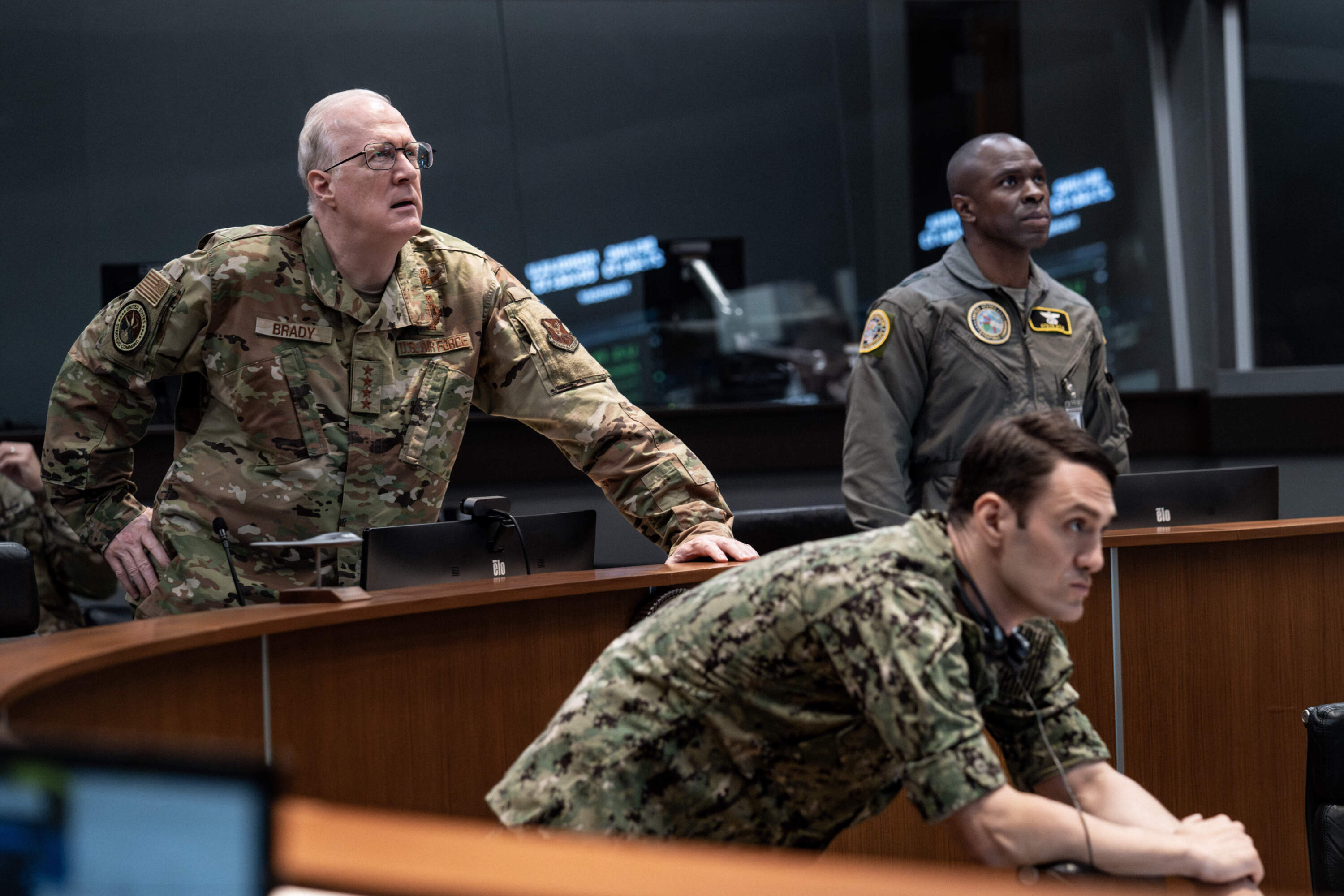
Nineteen minutes isn’t a very long time. I kept thinking about that during the movie. (It’s about as long as The Velvet Underground’s “Sister Ray,” depending on which version you’re listening to.) Working from a drum-tight screenplay by former head of NBC News Noah Oppenheim, Bigelow takes us through those 19 minutes three times, moving further up the chain of command with each iteration. The movie is built around a video conference call among the major players, and their conversation becomes like a mosaic that gets filled in with more pieces during each successive segment. Bigelow doesn’t stick strictly to the real-time structure, as each chapter ends up taking more like half an hour. Like I said, 19 minutes isn’t a very long time.
The first time through, we’re in the White House Situation Room with Rebecca Ferguson’s coolly competent, all-business duty officer who — like Jessica Chastain in Bigelow’s great “Zero Dark Thirty” — looks and sounds so much like the filmmaker herself that we assume she’s some sort of authorial stand-in. Second time around, we watch from U.S. Strategic Command with a bellicose general played by playwright Tracy Letts. The final go-round, we’re riding alongside POTUS himself (Idris Elba), who is doing a public appearance at a WNBA children’s clinic with Angel Reese when he gets the call every president dreads.
That dread is what you feel most while watching “A House of Dynamite.” On one hand, it’s an electrifying, white-knuckle thriller in which the best and brightest defenders of the most powerful nation in the world use all their sophisticated training and intelligence to try and forestall the inevitable. But it’s more a movie about the inevitable. When I think back on the picture, what lingers are the slow-dawning looks of horror on the actors’ faces as they steal glances at that doomsday clock counting down from 19 minutes. From her early, disreputable genre pictures like “Near Dark” and “Point Break” to more prestigious later offerings like “The Hurt Locker” and “Detroit,” Bigelow’s signature is her ability to put the screws to us like nobody’s business. “A House of Dynamite” leaves you rattled and wrung out.

Such a scenario could easily have tipped into melodrama, but Bigelow has too brusque and businesslike an approach for that. (This is the woman who made an entire 157-minute movie about the hunt for Osama bin Laden and then killed him off so quickly in the corner of the frame most people missed it.) There are no histrionics here, just stray glimpses of humanity as these officials grasp the gravity of the situation, a couple of them trying to reach out to loved ones one last time without divulging any classified information. These actors aren’t afforded any big Oscar speeches or showboating opportunities, instead required to come off as believably professional and privately stricken. The movie is breathless, understated.
What’s so unsettling about “A House of Dynamite” is that it takes us through what’s probably the best-case scenario of a situation with no good outcomes. (“Rare, medium or well done” is how one advisor crassly explains their options.) Sure, there are emergency countermeasures that can be taken, like a missile defense system with 61% accuracy that’s described as “like hitting a bullet with a bullet.” But that’s the kind of longshot hero stuff you’d see in “Top Gun: Maverick,” not a movie like this.
”We did everything right, didn’t we?” more than one character asks. What makes “A House of Dynamite” especially unnerving right now is its vision of the coolest and most competent government officials we’ve seen onscreen in ages. There are no party hacks here, and no petty infighting. These are dedicated professionals at the top of their games, and their best still isn’t good enough.

Gabriel Bosso is excellent as a deputy national security advisor filling in while his boss has a colonoscopy. He’s a touchingly in-over-his-head idealist pleading for cooler heads to prevail, and it took me half the movie to figure out where I’d seen this actor before. Then it hit me: Bosso played JD Vance in Ron Howard’s film of “Hillbilly Elegy.” I don’t think the production timeline quite lines up for his casting to be an intentional inference on Bigelow’s part, but one nonetheless shudders to imagine the current administration facing these circumstances. (The morning after I saw the picture, Hegseth gave his deranged “Patton” speech. This did not make me feel better.)
People today think that growing up in the 1980s was all pastels and synthesizer pop, but what I remember most vividly about being a little kid was the constant threat of nuclear annihilation undergirding everything, with cultural phenomena like “The Day After” and “99 Luftbaloons” constantly reminding us how close we were to extinction. Nuclear holocaust nightmares were a regular occurrence for children of my generation, and I remember being thankful that we lived so close to Boston so that when it happened we’d all just be incinerated instantly, instead of having to tough it out while dying of radiation poisoning in some post-apocalyptic landscape like “The Road Warrior.”
Somehow, after the fall of the Soviet Union, such fears got put on the back burner. They were replaced in the popular imagination first by the threat of Islamic terrorism, and lately, a media machine designed to make everyone afraid of their neighbors. But as Bigelow keeps pointing out in interviews, due to proliferation, the nuclear threat is even more pervasive today than it was back then. We’ve all just collectively decided not to worry about it as much anymore. That’s why she made the movie. There’s a pointedly staged scene in which an intelligence expert played by Greta Lee gets a call about the situation while attending a Gettysburg reenactment. American history really is one battle after another. Except the next one could be the last.
“A House of Dynamite” opens Friday, Oct. 10 at the Coolidge Corner Theatre and Kendall Square Cinema. It starts streaming on Netflix Friday, Oct. 24.