Support WBUR
Quincy mayor's campaign pays $55K to resolve campaign finance violations
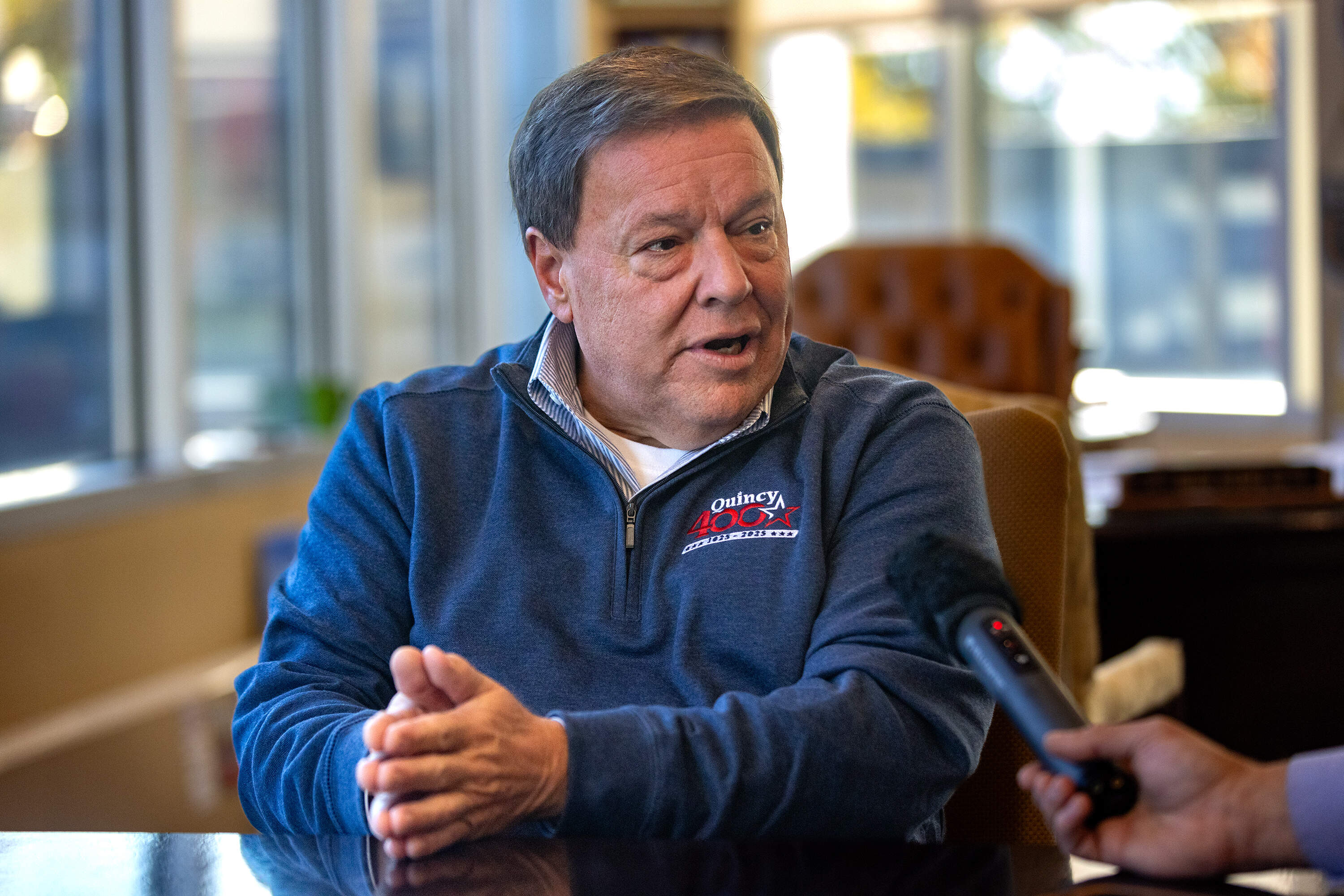
Quincy Mayor Thomas Koch’s campaign has paid a $55,000 penalty to resolve allegations that in 2022 and 2023, it received thousands of dollars in illegal corporate contributions, anonymous donations, prohibited checks and donations where the true source of the money was not clear.
According to an Oct. 28 letter from Massachusetts campaign finance regulators to Koch the mayor’s campaign committee paid $15,000 to the state and another $40,000 to charities of his choice to resolve the matter.
A spokesperson for Koch’s campaign said the mayor’s team “worked quickly” to resolve “issues concerning compliance with the campaign finance law” after state regulators brought them to their attention.
The state Office of Campaign & Political Finance’s director, William Campbell, in the letter said Koch’s campaign committee agreed to implement “internal accounting procedures” to more closely review donations before depositing them and to undertake “educational efforts” in the city to boost understanding of campaign finance laws.
Campbell also noted that the committee “should be aware, however, that further instances of noncompliance with the campaign finance law may result in referral to the Attorney General.”
Jon Carvalho, a spokesperson for Koch’s campaign, said the letter from Campbell “does not assert any intent to violate the law by the committee.”
“We are grateful to OCPF for identifying issues and working collaboratively with the committee for a resolution to these issues,” the spokesperson said in a statement.
Campaign finance records show Koch’s campaign made a $15,000 payment labeled “purge fee” to the state on Oct. 28.
He also paid $20,000 to the nonprofit Quincy Asian Resources on Oct. 16 and another $20,000 on Oct. 17 to the Dragon Boat Museum, a separate nonprofit in the city, according to state data.
“We are pleased that this innovative resolution allowed us to support Quincy’s Asian-American community through charitable contributions,” Koch’s campaign spokesperson said in a statement.
In the letter to Koch, state regulators said “multiple individuals” donated to the Quincy mayor’s campaign and were reimbursed for those donations by another person. State law bars people from “disguising the true origin” of campaign contributions.
Regulators acknowledged that “circumstances may make it difficult for a committee to ascertain at the time a contribution is received that the true source is not accurate.”
But once a campaign determines the true source of the donation, it “cannot retain and benefit” from the funds, Campbell said in the letter to Koch.
“There could be circumstances when the receipt of contributions may give rise to suspicion of true source violations, at which time the committee must exercise their best efforts to determine whether the contributions are legal at the time of receipt,” Campbell wrote.
Regulators also said Koch’s campaign received at least $7,750 in donations from corporations — a violation of state law that bars businesses from directly or indirectly donating to a candidate.
Koch received another $3,091 in contributions via PayPal, which regulators described as “anonymous” donations in violation of state law.
“Although the committee has attempted to obtain that information, it has been unable to do so. As a result, said contributions are considered anonymous and may not be retained by the committee,” Campbell said in the letter to Koch.
State law prohibits individuals from donating more than $100 via treasurer’s check, bank checks, or other similar methods. Regulators said Koch received $6,550 in contributions through those means.