Support WBUR
Polar vortex could bring cold temperatures after Thanksgiving and into December
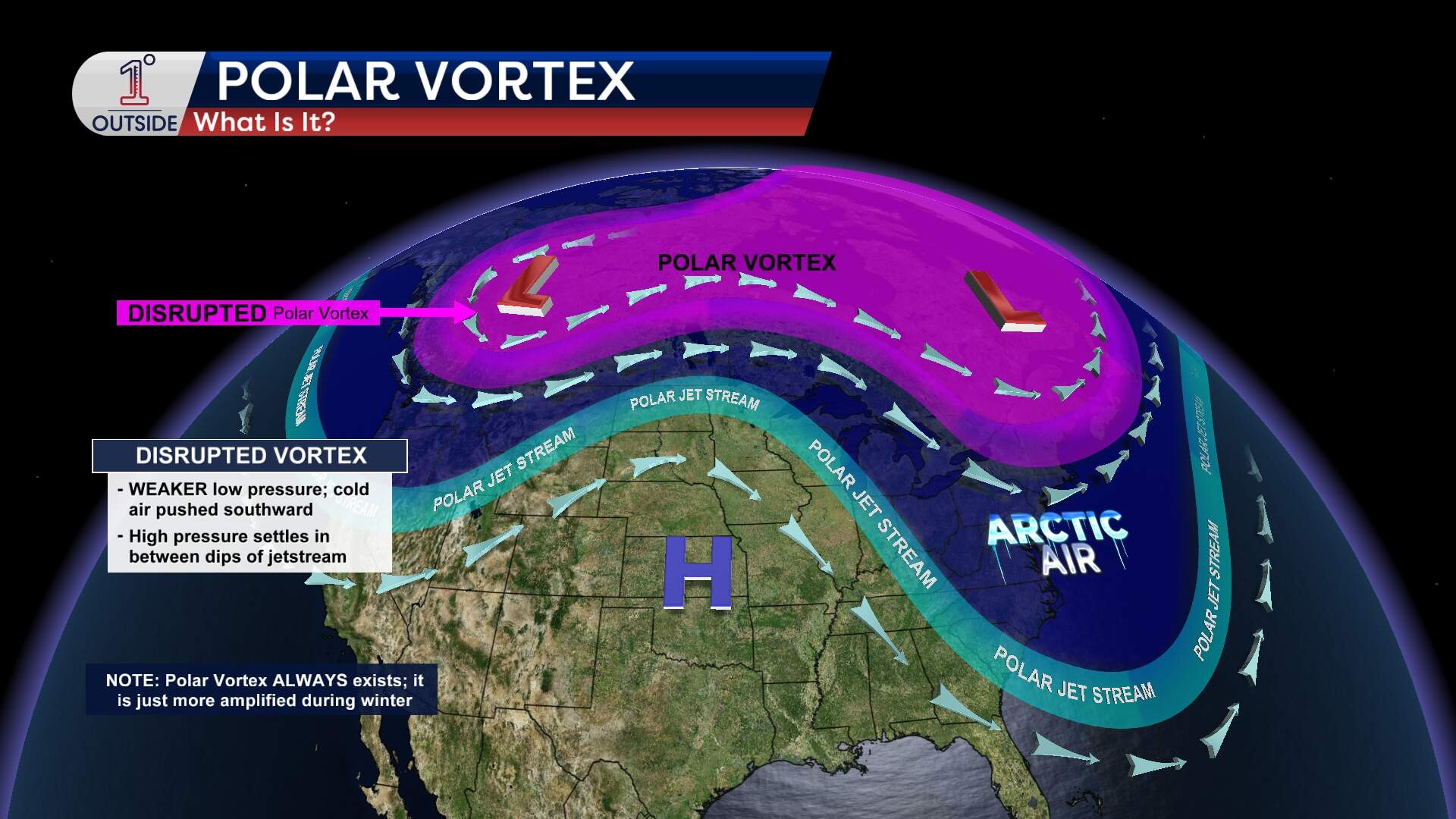
The polar vortex is weakening, which means New England is in for a colder than usual December, with episodic cold snaps.
Every year around this time, that phrase — “polar vortex” — starts to buzz around. But what is it? And what does it mean when it weakens?
Let’s break it down, and look at the forecast for next month.
What is the polar vortex?
The polar vortex is a large, swirling sheet of cold, low‑pressure air that circles the Earth’s poles in the upper levels of the atmosphere (the stratosphere and upper troposphere).
When the vortex is strong and intact, it keeps that very cold air bottled up near the Arctic. The jet stream and large‑scale winds remain fairly stable, which means the mid‑latitudes (including New England) tend to see more typical winter weather, not extreme surges of Arctic cold.
Why does a weaker polar vortex mean more cold?
Here’s where it gets a little counterintuitive: When the polar vortex weakens or is disrupted (for example, by sudden stratospheric warming events), it loses its strong containment of cold Arctic air. The jet stream can buckle, dip farther south, and allow cold air to spill out of the Arctic toward mid‑latitude regions.
In other words, a strong vortex means the cold stays north; a weak vortex means the cold can surge south.
When the vortex weakens, the result is often disjointed blasts of cold rather than one long, steady freeze. We'll see pockets of below‑average temperatures, sudden dips and more variability.
When are we going to see this cold?
There are signals the polar vortex will weaken as we head into the final days of November, thrusting cold air into the U.S. with intermittent Arctic bursts for the start of December.
The biggest impacts are likely to be felt in the Pacific Northwest, Northern Plains and Central Plains, where high temperatures could run 20–30°F below average.
For New England, the outlook is more modest. We’re not bracing for deep Arctic outbreaks, but we should expect cooler‑than‑average temperatures. The close of the first week of December will likely be a few degrees below normal and expect episodic cold snaps, with variability.
It's time to get the winter gear out if you haven't already.