Support WBUR
Rent control supporters say ballot question pits struggling residents against corporate landlords
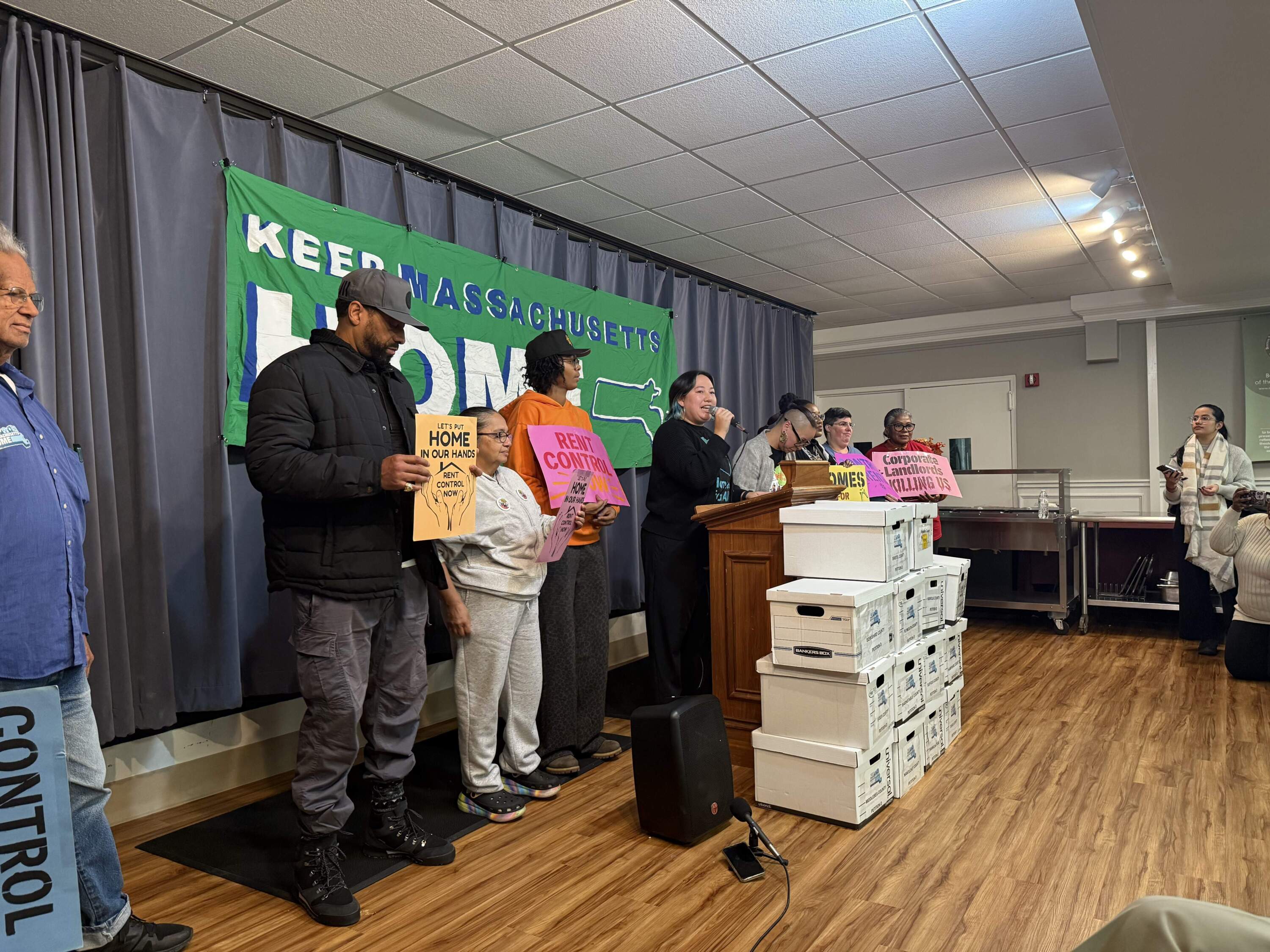
Antonio Ennis, a 59-year-old Dorchester resident and small property owner, takes a different view than many landlords in the latest battle to overturn Massachusetts' longtime ban on rent control.
Ennis said he has two tenants in the building where he also lives; one has lived there for 13 years, another for eight years. And he wants state residents and lawmakers to back a ballot question in 2026 that would limit yearly rent increases to inflation or 5%, whichever is lower.
“A landlord such as myself doesn't want to be looking for a tenant every other month, every three months, every six months,” he said Tuesday at a rally on Beacon Hill in support of a proposed ballot question for next year. “You have a mortgage to pay, and the mortgage company doesn't want to hear you don't have any tenants right now, you can't pay the mortgage.”
The proposed law would not affect him personally, because it doesn’t apply to owner-occupied buildings with four or fewer units. But he argues rent control will promote long-term rentals.
A similar measure failed to make the ballot ahead of the 2024 elections, and the current proposal has drawn fierce pushback from real estate and developer groups.
In a statement last month, three major real estate groups came out against rent control. The Commercial Real Estate Development Association, Greater Boston Real Estate Board, and the Massachusetts Association of REALTORS said the ballot question will create one of the most restrictive rent control programs in the country.
“It will unquestionably make our housing crisis worse and significantly reduce the supply of quality homes on the rental market,” the groups said.
Supporters of the ballot question campaign, dubbed “Keep Massachusetts Home,” say their effort pits working-class residents struggling to afford housing against corporate landlords, who consistently raise rents.
Organizers of the ballot question said they collected more than 124,000 signatures by the deadline last month, and turned in more than 90,000 certified signatures to Secretary of State William Galvin’s office Tuesday.
Advocates pitched their campaign as one that seeks to circumvent Beacon Hill, where the Democrat-controlled House and Senate have routinely declined to advance legislation addressing rent control.
Noemi Ramos, executive director of the New England Community Project, said housing advocates have been waiting far too long for the Legislature “to step up to the plate and pass our legislation.”
Our communities can't wait anymore, and this was about taking our power, taking our voices, and integrating civic action with housing justice on the streets,” Ramos said.
The proposal does not include an option for cities and towns to opt in or out of the policy, a key difference from the version advocates tried and failed to place before voters in 2024.
Boston Mayor Michell Wu told WBUR on Tuesday she still feels the bill should allow for different communities to make their own decisions on rent control.
“What the Cape needs could be different from what Boston needs or what Western Mass. needs,” Wu said.
The ballot question would put “pretty restrictive and pretty intense protections in place.” But, “that may be the only release valve.”
Boston Mayor Michelle Wu
She described the current ballot question language as putting “pretty restrictive and pretty intense protections in place.” But, she said, “that may be the only release valve,” and could be popular among residents for that reason.
The ballot measure would not apply to units that are subject to regulation by a public authority; units rented to people for less than 14 days; units operated for educational, religious, or nonprofit purposes; and units that received their residential certificate of occupancy within the last decade, according to a summary prepared by the attorney general’s office.
The rent charged on a unit as of Jan. 31, 2026, would serve as the base amount for the annual increase, the summary said. A failure to follow the new measure would be considered a violation of the state’s consumer protection law.
Carolyn Chou, executive director for the advocacy group Homes for All Massachusetts, said residents across the state are getting “squeezed” by corporate landlords who buy buildings and double the rent.
“We will not let that continue,” Chou said. “We are ready for change, for real change, for real affordability and to end displacement of our communities.”
With additional reporting by WBUR’s Tiziana Dearing and Eve Zuckoff.