Support WBUR
Citing improvements, judge ends oversight of MBTA accessibility
After almost two decades of court-ordered scrutiny and mandated reforms, the MBTA is preparing to close the book on one of the most sweeping accessibility agreements in U.S. transit — and to hand the watchdog role to riders themselves.
In a statement Wednesday, the T said that "after 19 years of steady improvements … the MBTA has fulfilled a substantial amount of its obligations under the 2006 Joanne Daniels-Finegold, et al. v. Massachusetts Bay Transportation Authority Settlement Agreement. As a result, court-appointed independent monitor Judge Patrick King will conclude his oversight role."
The shift marks a turning point for a system where under 60% of stations systemwide were accessible in 2005 and bus lifts worked only 19% of the time. Today, 83% of stations are accessible, elevator uptime hovers around 99%, and major Green Line and commuter rail upgrades are slated to push station accessibility to roughly 95% within five years.
On the Green Line, construction beginning in 2026 will make the entire C branch accessible, followed by upgrades on the B branch and Symphony Station, leading to 97% of Green Line stops and stations meeting accessibility standards within five years, according to Assistant General Manager for Systemwide Accessibility Laura Brelsford.
"That's something that when I first started, we were not sure if it would ever be a reality," Brelsford said.
King was appointed in 2006 to enforce more than 200 accessibility requirements and gave his final report on that job on Wednesday. He is now ready to pass the baton to a citizen-led Riders' Transportation Access Group (RTAG).
"Back in 2003, persons with disabilities found it very difficult, if not impossible, to use the system," King said. "Indeed, 25 years ago, you would find very few people with disabilities using the system because they were required to use The Ride … because the system was so unreliable."
The 2006 settlement, which the MBTA signed without admitting wrongdoing, committed the agency to a "shared vision … to make the MBTA a model transit system accessible to all," and required improvements across bus operations, rail platforms, station elevators, operator training and communication with passengers.
Statistics from the early years underscore the depth of the problem. In 2005, drivers denied access to riders with disabilities 11% of the time, refused kneelers (which lower a bus's entrance by releasing air from its suspension) at the same rate, and failed to secure mobility devices in 91% of cases.
"I recall watching an MBTA video… seeing a customer in a wheeled mobility device go flying to the other side of the bus because the driver never secured the wheeled mobility device," King said. "Fortunately, we never see that happening today." Today, failure to secure all four attachments on a wheelchair is down to about 7%.
MBTA General Manager Phil Eng hailed the "historic day" and said "we will never forget this date."
He emphasized the role of the plaintiffs who pushed the agency to overhaul its practices: "The passion that the plaintiffs had… is about paying it forward. It is about making our system available for future users and future needs."
"It doesn't matter if I could run twice as many trains, buses, etc, if it's not accessible, it's not available to all the folks that need to use it," Eng said.
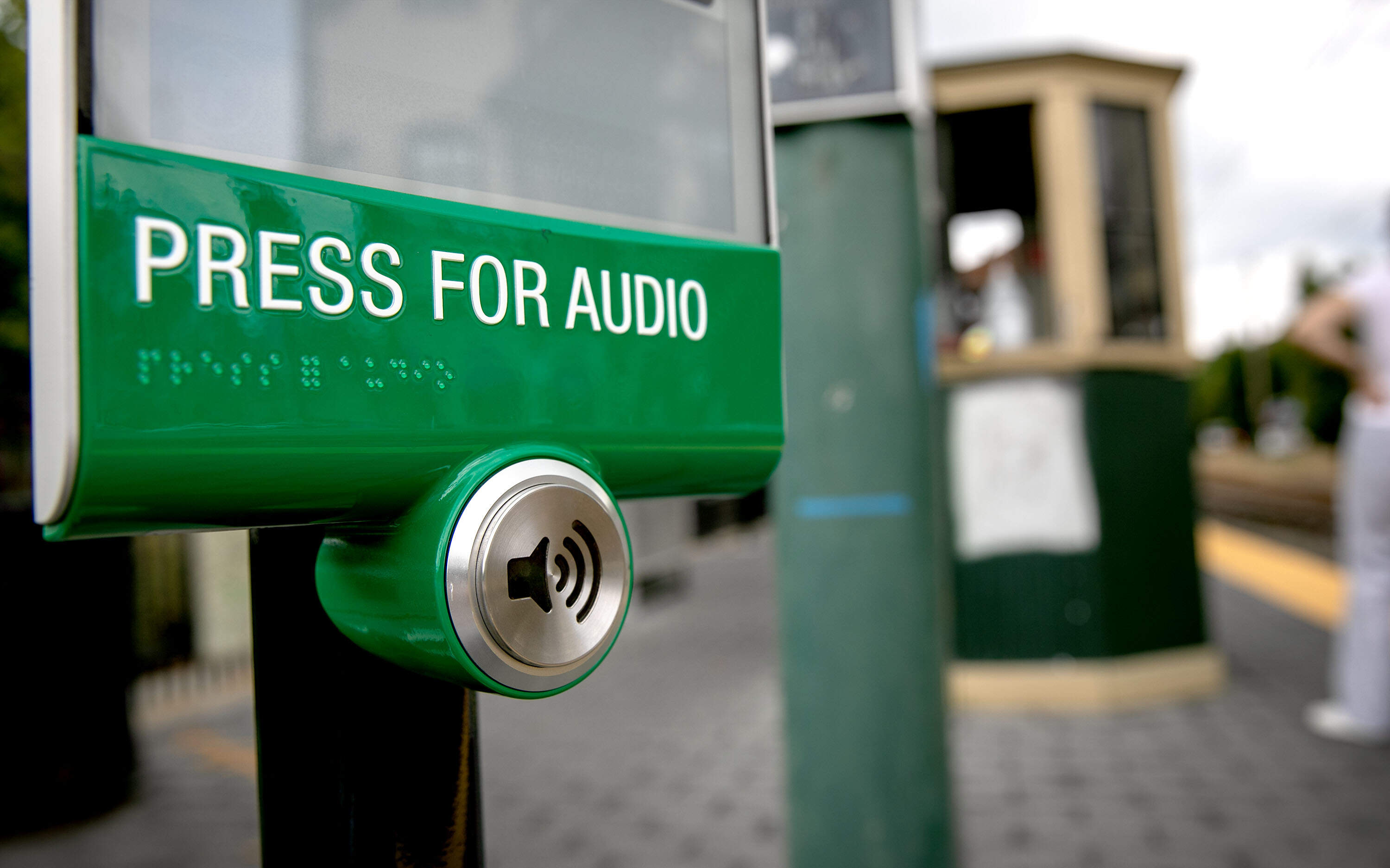
Lead plaintiff Joanne Daniels-Finegold said the agreement "recognizes the need to meet people with diverse disabilities." The settlement brought about audible stop announcements for those who can't see, visual stop announcements in stations for those with hearing impairments, braille and tactile warning strips for instruction and safety for the groups who need them.
"This is our legacy," she said. "Through RTAG we want to ensure our continued success in the future."
RTAG organizer Katarina "Kat" Torres Radisic said the group has developed a new agreement with the MBTA that is "focused on preserving the many gains made over the last two decades, preventing backsliding," with continued written commitments on elevator uptime, staffing and employee training.
"As a result of this new agreement, the oversight will be transferred to RTAG, and I'm confident that they will do a fantastic job and continue with the work that I have done over the past 18 years," King said. The new agreement, he said, "provides RTAG with the resources it will need … and provide ample options to enforce any agreements that are not kept."
For the lawyers behind the case, the transition is emotional.
Reading a letter to the plaintiffs, lead counsel Taramattie Doucette of Greater Boston Legal Services said, "From the very beginning, you saw the barriers in transportation created barriers in life, and since 2002 you have remained steadfast in your goal of making the T a system where every rider, regardless of ability, can travel with dignity, independence and safety." She added, "I'm so glad we took on this case decades ago. Our legal work with the community has transformed public transportation for every single rider... I dedicated my life to this case."
Plaintiff Myrnairis "Mic" Cepeda thanked other plaintiffs for bringing their different experiences to the suit.
She recalled fellow advocates with visual impairments who could identify the type of bus just by listening to them going by, and said their knowledge "reminded me how deeply people rely on this system and how much expertise riders contribute."
With King stepping down and RTAG stepping in, the plaintiffs say the transition mirrors the goal they fought for nearly 20 years ago: a system where those who rely on accessibility are the ones empowered to protect it.