Support WBUR
Healey's proposed ICE restrictions in Mass. could provoke legal challenges, experts say
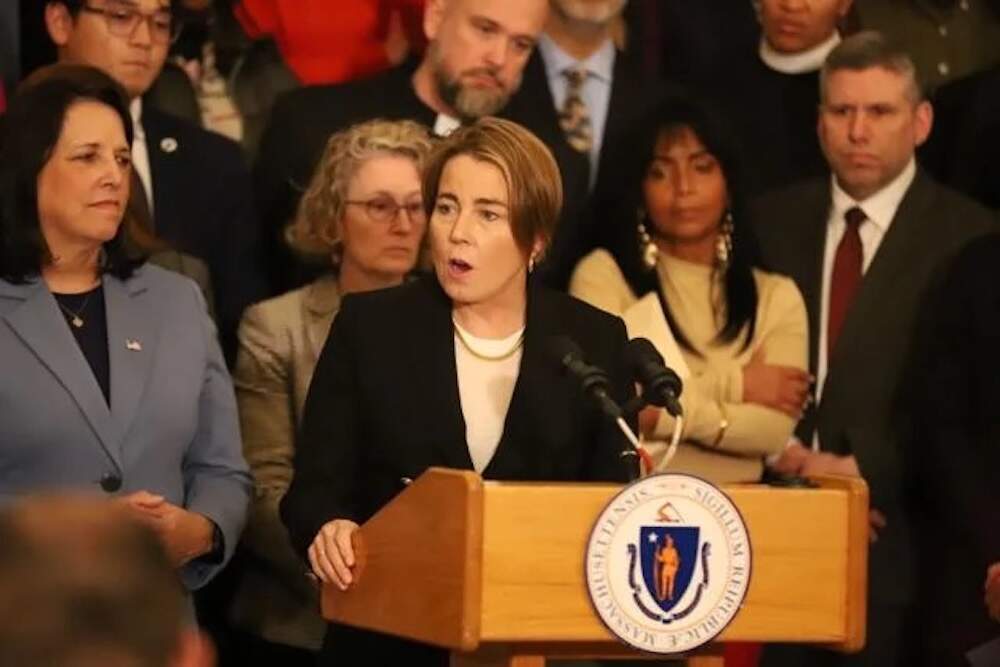
Gov. Maura Healey’s executive order restricting federal immigration agents from entering or using state buildings is likely legally sound, legal experts say, but legislation she filed that restricts those officers from entering day care facilities or schools could face constitutional challenges.
Healey last week announced the two-pronged action after federal immigration officers fatally shot two U.S. citizens in Minnesota in January. She faced pressure from progressive Democrats to push back against the Trump administration’s immigration crackdown.
Boston College law professor Daniel Kanstroom said Healey’s “moderate” executive order — which goes into effect immediately — is “well within” the scope of her responsibility and legal powers as governor.
But, he said, “there are some things in the proposed legislation that I expect will bring resistance from the federal government and possibly legal challenges,” he said in an interview.
The governor’s proposed bill, which requires approval from the state Legislature, is wide-ranging.
It takes aim at everything from banning warrantless civil arrests by ICE inside courthouses to barring the agency’s officers from making civil arrests while someone is attending a service at a house of worship.
The bill also prohibits federal immigration agents from entering schools, day cares, child care centers, hospitals and health clinics without a judicial warrant.
Legal experts said it will be difficult to enforce broad provisions covering non-state-owned spaces — even though federal policy in the past restricted ICE officers from conducting enforcement actions at so-called “sensitive locations.”
“Whether a state can generically restrict ICE activities in all these spaces,” Kanstroom said, “ I think could be challenged by the federal government, and it would be a sort of complicated lawsuit.”
Healey said during a press conference announcing the moves that she expects the federal government “to respect our sensitive spaces.”
“What we have seen week after week, month after month, are federal agents instigating, antagonizing, and, yes, causing violence in communities. People have been killed. Others have been shot,” Healey said at the State House last week.
The executive order Healey signed covers state properties directly or partly under her control, like the John W. McCormack State Office Building adjacent to Beacon Hill.
It bars federal officers from conducting civil immigration arrests in nonpublic areas of state facilities, prevents them from using state resources like parking lots as staging areas and prohibits state agencies from striking new enforcement agreements with ICE.
In one instance last year, WBUR reported ICE agents were seen at the Massachusetts Army National Guard armory in Framingham. The agents arrived on the property “without prior notice and without permission,” the Healey administration previously said.
Sarah Sherman-Stokes, Boston University law professor and associate director of the school’s Immigrants’ Rights and Human Trafficking Clinic, said Healey’s executive order is “moderately helpful” and on “solid footing.”
“In terms of the interplay between the federal government and state authorities, it's well established by Supreme Court law and decisions that the federal government cannot force state governments to enforce federal laws,” Sherman-Stokes said in an interview.
But Sherman-Stokes said Healey’s actions are too delayed and not enough.
“It's unfortunately coming at a time that feels politically convenient. This could have and should have been done months ago, if not years ago,” Sherman-Stokes said. “ICE violence is not new. It seemed to take the murder of two U.S. citizens to compel Healey to act. And I think that’s too little, too late.”
Healey’s proposed legislation makes it unlawful for another state to deploy its National Guard in Massachusetts without the permission of the Bay State’s governor, unless the military force has been federalized by the president of the United States.
Kanstroom, the Boston College professor, said Healey’s proposal could be challenged in court if the federal government argues federal law supersedes state law.
The state “can't control the whole situation simply by passing a state statute that makes it unlawful for another state to enter Massachusetts or be deployed in Massachusetts if that's what the federal government wants to do,” Kanstroom said.
Trump has deployed National Guard troops to six cities since June, including Los Angeles, Washington, D.C., Memphis, Chicago, New Orleans, and Portland, Oregon. The administration has also kept roughly 200 Guard personnel in Texas on standby after they left a deployment in Chicago.
The deployments, excluding in New Orleans, cost taxpayers nearly $500 million through the end of December, according to the nonpartisan Congressional Budget Office.
Some of the troop deployments provoked legal challenges and pushback from local leaders.
California Gov. Gavin Newsom alleged that Trump’s decision to federalize National Guard troops — purportedly to guard federal buildings and protect immigration agents in Los Angeles — was illegal.
A federal judge ruled in December that the Trump administration must end its deployment of California National Guard in Los Angeles and return the troops to the control of the state.
Kanstroom said there are “severe” limits on when National Guard troops can be federalized, and Healey’s measure serves to “draw a line in the sand.”
“Federal law is superior to state law in many ways, but states also have constitutional rights,” Kanstroom said.
Other Democratic governors also have taken steps to counter ICE.
New York Gov. Kathy Hochul introduced legislation last week that would ban agreements between local law enforcement and ICE that give local authorities the ability to enforce federal immigration laws.
The bill also bars federal agents from using local detention centers for civil immigration enforcement, mass raids or the transportation of detainees.
Healey’s executive order forbids state executive agencies from entering into the deals, known as 287(g) agreements, unless there is an imminent threat to public safety. But Healey left intact an existing agreement between the state Department of Correction and ICE.
“I actually support that agreement,” Healey said. “When you're incarcerated under … the custody of the Department of Correction, that means you've done something pretty bad.”
Sherman-Stokes said the state “shouldn’t define people by whether or not they've had interaction with the criminal legal system.”
“The criminal legal system punishes people. The deportation system is civil. It doesn't need to doubly punish someone,” Sherman-Stokes said.
This article was originally published on February 05, 2026.