Support WBUR
'Lifted' explores plagiarism, family inheritance and healing
A woman stands on a precipice, between crisis and discovery. She hasn’t left her office at Harvard University for weeks as she struggles to find the words to defend herself. Around the room are strewn chairs, a typewriter on a desk. This is her inner sanctuary, where her psyche has been split into three identities, representing aspects of herself that have risen to navigate the trauma she is experiencing. Toyoima Ufot has been accused of plagiarism because she has woven the work of her deceased father, Disciple Ufot, into her own thesis. The institution holding her accountable for these actions is shadowy, while Toyoima asserts a belief that comes from parts of Nigerian culture: one cannot steal something that already belongs to oneself.
This is the setting of the play “Lifted.” It isn’t an easy one, according to its writer, Mfoniso Udofia. This is the seventh installment in her nine-play Ufot Family Cycle, following three generations of a Nigerian American family. The Huntington Theatre Company spearheaded a festival producing the entire cycle over the course of two years, in partnership with other theaters, nonprofits and community partners.
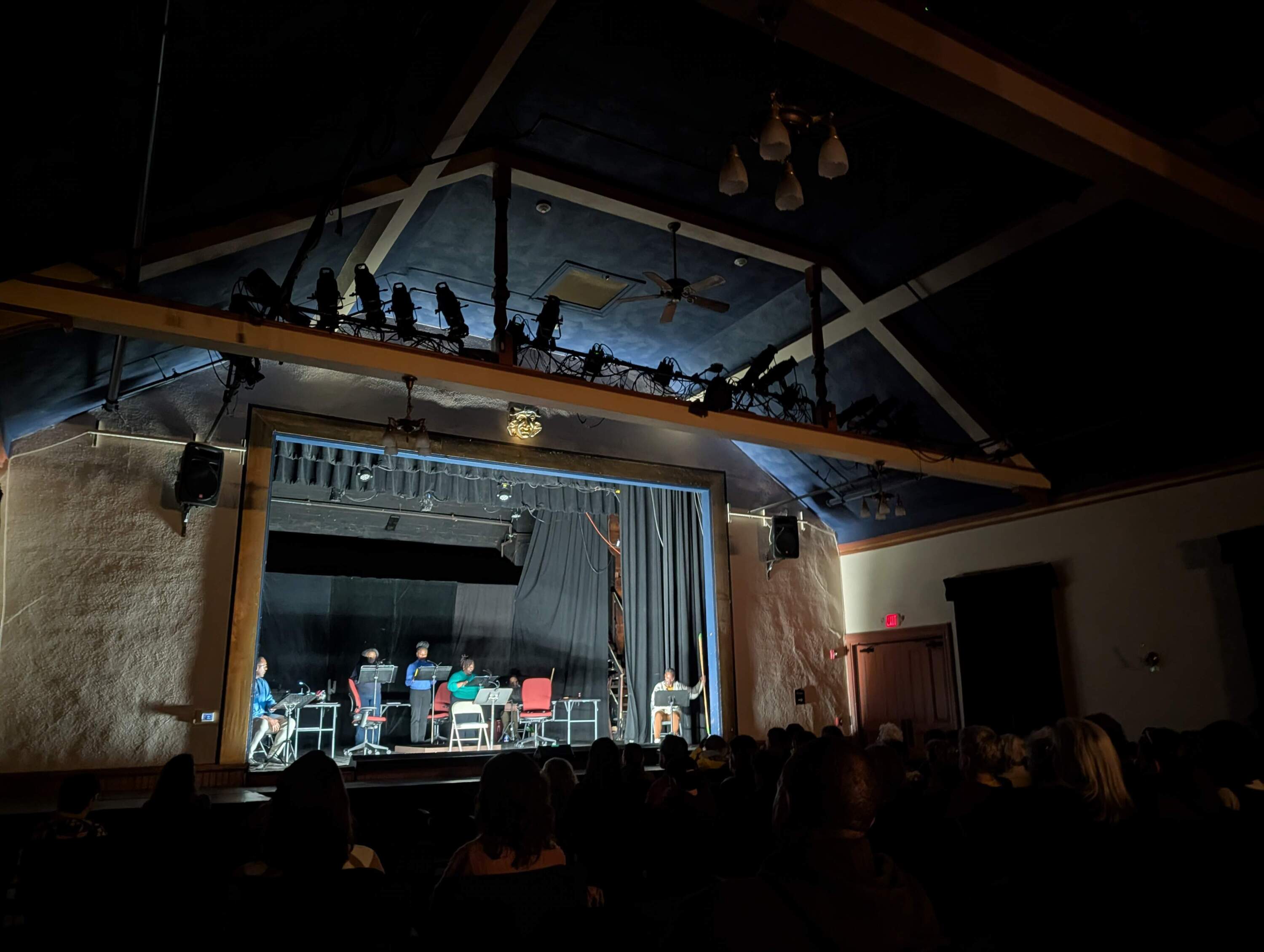
“Lifted,” directed by Josiah Davis and produced by Wellesley Repertory Theatre, opened at the Footlight Club in Jamaica Plain on March 10, and will continue to be presented at the Huntington Theatre’s Maso Studio March 24-28 and Wellesley College (Udofia’s alma mater) on March 29. Unlike other plays in the cycle, “Lifted” is being presented as an in-process performance, meaning that it is an open rehearsal or workshop. Constantly evolving and changing, audiences are experiencing the show at its most vulnerable and most exploratory developmental stage.
“This is the hardest one for me,” said Udofia. “This is the play that I think is actively trying to take a pound of my flesh and also the play that, once I crack it, might become one of the most difficult and beautiful.”
Udofia attributes some of the challenges of “Lifted” to the story’s protagonist, Toyoima, who’s always been difficult to understand, the forgotten middle child. Over the course of the show, she argues with the Chair of Professional Conduct that the work she has produced comes to her as family inheritance. She fractures into three personas played by different actors — Front-Facing, Innocence and Wrath — as we dramatically see the mechanisms of her psychological state. She is a brilliant mind, cerebral and strong-willed, but she is also someone who gets lost in the fabric of her family’s life. And yet she is a truth teller. Her fraught conflict reveals so much about the worlds we live in, and also ourselves.
“In this play, you’re watching this woman who is trying to hold onto all of the thought that she has amassed and have her academic career still hold. And then you’re watching the war of a trial, the war between different epistemologies,” said Udofia. “When you see ‘Lifted,’ it’s going to feel like a war, because it broke Toyoima into three. And so, you’re going to hear every version of what could happen.”
In the earlier plays in the cycle, characters tackle powerful existential questions. “Sojourners,” staged at the Huntington in the fall of 2024, tells the origin story of the family, following matriarch Abasiama, and what it means to carry a Nigerian dream to America. In the second play, “The Grove,” audiences meet Abasiama’s daughter, Adiaha, who grapples with honoring her parents’ wishes or acting on her own dreams. In “Lifted,” the question that the narrative revolves around is the issue of thought ownership. While Toyoima has not clearly cited her father’s influence on her academic work, she believes that she holds a different perspective on where ideas come from. In the culture of her ancestry, she has more liberty. Her trial leads one to ask, does anyone really own a thought? Can they belong to everyone, or are they the products of individuals?
Because “Lifted” is being presented as an in-process performance, a fresh batch of 60 new pages could be delivered to the hands of actors the night before their next show. During the Footlight Club reading, they carried their scripts, and stage directions were read aloud. Udofia started pulling together a functioning first act in 2018, and the full work is still not complete.
When Davis was approached about directing the work, he jumped at the chance to experiment with the new and unknown. At the time, he had only seen about 20 pages, and it has since completely changed, he explained. As the project was starting to take form, he asked himself, “What does this play need to be? What is the structure of it? There’s acapella music inside of it. Which songs need to be sung in order to understand [the story], and how much space does music need to take up in general?”
The three Toyoimas sing together in the show, sometimes representing one voice and sometimes in three-part harmony. That dimension reveals the ways that they all coexist, while the actors studied where one Toyoima ends and another begins. Front-Facing, the version of Toyoima that she presents to the world, is played by actor Natalie Jacobs. She is the figure who holds her different selves together, functioning as the brain and motor of the trio. Jacobs said she turned to Udofia’s writing to find insights into the role and her relationship to her character’s other parts.
“The language helps inform your internal,” said Jacobs. “When the other Toyoimas are speaking, I imagine that this is all happening in my mind. The quick change of thought, [and the way that] we have overlapping lines, as well, shows the turmoil and the combativeness within Toyoima’s mind, illustrating her constant state of chaos.”
Leading into the performances at the Huntington this week, Udofia’s narrative is still growing. Where Toyoima ends up by the third act will be strikingly different from where she started. Audiences will see her battle without quite knowing whether Toyoima is right or wrong, but the beauty in her journey is recognizing that there’s more to human life than these binaries. For Jacobs, that realization, coupled with the kaleidoscopic structure of the play, is part of what makes “Lifted” unique.
“Sometimes, it’s a question of how we remember, misremember or color our experiences, which aren’t always so clear,” said Jacobs. “There are colors in the world, and it’s not always so black and white. I think that’s a takeaway for audiences.”