New to soccer? Here's your World Cup glossary
You've decided to give the World Cup a watch, just to see what the rest of the planet is so mad for. Congratulations, you've made a good choice.
Even if you played soccer as a kid, there's a lot that's said during the course of a game that may have you scratching your head.
Blame the British.
England is the birthplace of modern soccer, and since they use a different (they would say proper) version of the language many Americans speak, British terms for the game have made its way across the pond.
Here's a glossary to help you keep everything straight as you drink in the most popular pro sports tournament in the world. Let's start with a quick one:
Football: What we call soccer. No hands allowed, usually (we'll get there). OK, moving on.
The field

Pitch: This is the playing field. It's a very British term but it's been adopted among many soccer fans in the U.S. as well.
Goals: Your goal in this game is to kick the ball into your opponent's goal, which results in a goal.
Center circle: The game starts here with a kickoff.
Touchline (end lines + sidelines): The edge of the pitch. If the ball completely crosses the line, it's out of bounds — with one important exception.
- If your team knocks the ball completely over the sideline, a player on the opposing team will heave it back into play. It's one of the rare times you're allowed to use your hands if you aren't a keeper.
- If the ball completely crosses the end line, one of two things happens. Either the team on offense gets a corner kick or the team defending gets a goal kick. More on those later.
- If the ball completely crosses the goal line, the line in front of the net, that's a goal. That's what we're here for. There's even tech to help tell whether the ball fully crosses the goal line on close calls.
Halfway line: Basically meaningless with one giant exception: the offsides rule. Offsides is probably the most complicated concept for American sports fans, so we'll do a whole section on that.
Penalty area: If you look at the goals on either side of the pitch, there are a couple of rectangles painted in front of them. The bigger of the two is called the penalty area. This is the area where the goalkeeper can use their hands. Also, if you commit a foul in the penalty area in front of your goal, the other team gets a free shot to score from the penalty spot (more on that in literally two seconds).
Goal area: This is the smaller of the two rectangles. If a defending team is awarded a goal kick to restart play, they have to kick it from within this area.
Penalty spot: This is a little dot 12 yards dead center in front of the goal. If your team is awarded a penalty kick, the ref puts the ball here for one of your players to try and boot it into the net. Penalty kicks succeed way more than they fail, so expect to see a lot of flexing and celebrating if a goalkeeper stops a penalty kick. (In fairness, expect to see a lot of celebrating from the other side if they don't. Because that's a goal. Counts the same as scoring in open play.)
Corner flags: These little banners fly where the end line and side line meet. They aren't there to be festive, though; the refs use the flags to determine where the ball went out of bounds, sort of like the pylons in NFL football. And like the pylon, the flag is in play.
Who's playing

Goalkeeper: Sometimes simply called the keeper. You don't hear goalie as much as you do in ice hockey. They're the only people on the field allowed to use their hands, and they can only do so inside the penalty area. Keepers wear a different color uniform (kit) than their teammates, which sounds confusing but it makes life easier for the referees.
Defender: These guys set up camp ahead of the keeper, just like in ice hockey. They're more often referred to as "backs" since they play to the back of the pitch. Depending on where exactly they line up, you'll hear them called "center back," "right back," "full back," etc.
Midfielder: I mean, do we have to explain where on the pitch a "midfielder" plays? Given their location, midfielders do a lot of the set-up when advancing the ball. Sometimes there's a defensive or "holding" midfielder, who tries to snuff out the other team's advances before things get too serious for the backs. Other, more offensively minded mids are some of the sharpest passers on the team and are responsible for creating opportunities for forwards (or themselves) to score. Think point guard, if you're a basketball fan.
Forward: These are the guys leading the attack, trying to score goals and claim glory for their nation.
Winger: Wingers can be either midfielders or forwards — honestly, the lines in modern soccer get super blurry on this end of the pitch. They play to the left and right of the next guy we'll talk about.
Striker: You're going to hear this term a lot because it's the big sexy position in soccer. A striker is a type of forward whose primary job is to try and score goals. To be fair, everyone, even the keepers, want to score goals. But strikers aren't asked to do as much tackling or defending as other players. They leave that grunt work for the others and take all the shine when the ball ripples the back of the net.
Reserves: These are your bench players.
Substitutions: In international play, a team can substitute up to five players per match. If you use all your subs and then one of your players gets hurt, tough cookies; you'll have to continue with fewer players on the pitch. If a match goes into extra time (yes, there's overtime in later parts of the World Cup), you get a sixth substitution.
Manager/Gaffer: What we'd call the head coach in the U.S., though soccer managers often take on player recruitment and other non-field tasks.
Club vs international: The World Cup is the pinnacle of international soccer. They're basically all-star teams based on nationality. "Club football" is what you're more familiar with in the U.S.: A group of teams that play each other in a league, like the NFL, NHL, MLB and NBA. But unlike the big four sports in the U.S. soccer clubs often play in more than one league. In Europe, for example, the top teams in each domestic league are invited to play in the Champions League, an annual, season-long tournament with a similar format as the World Cup, the following season.
Match: A game.
Friendly: A match that isn't part of any competition. The two teams just play each other for the love of the game to sell tickets. (OK, and also to get some reps together, since international teams don't play as frequently as club teams). You'll often see teams from Europe barnstorm through the U.S. and play friendlies before their seasons begin at home. And lots of World Cup teams came to the U.S. to play friendlies before the tournament.
FIFA: The Fédération Internationale de Football Association is the body in charge of international soccer. Association football is the name of the game; that's why we call it soccer (a corruption of association) and the majority of the world calls it football (also because you play with your feet, duh).

————
The tournament
Selection: Let's say your nation's team is one of the 48 that won the right matches and qualified for the World Cup. Congratulations! But now, who will they play? FIFA makes that determination months ahead of time, by sorting closely ranked squads into four "pots." So the elite squads — your Frances, Spains, Argentinas — were in Pot 1, and the "just happy to be here" teams — hello there Jordan, Haiti, Cabo Verde — were in Pot 4.
One team from each of the four pots is selected for each group in the World Cup.
This year's World Cup has 48 teams, way more than the 32 in previous tourneys. Proponents like that more of the world is represented. Critics hate that a lot of middling teams now get a crack at the big show. FIFA is presumably just happy that the tournament is poised to shatter revenue records, since more matches equals more money.
Groups: There are 12 groups at the start of the World Cup, and if you paid attention to the paragraphs above, you know that each group has four teams with varying levels of talent, with a world soccer superpower headliner, some pretty good teams and maybe a hanger-on that could upset someone else's plans for glory.
The teams in each group then play each other once. Wins earn you three points, ties earn you one point and losses earn you scorn from the fans at home (also, zero points). Yes, this is a tournament but in the group stage, ties are allowed.
Group of death: One of the more metal expressions in sports, a group of death is one where FIFA's efforts at fairness didn't go as planned, and two or three really good teams have to fight to advance to the knockout rounds. They usually feature ferocious early matches in the tournament, and a red-faced team forced to go home a lot earlier than they planned. Alas, expanding the tournament to 48 teams has watered down this fun, non-official designation.
Advancing: The two teams with the most points in each group automatically advance to the knockout round of play. If teams are tied on points, the team with the best goal differential (goals you made minus goals you allowed) advances. Because FIFA expanded the tournament to 48 clubs, the eight best third-place finishers from the groups will also advance.
Knockout rounds: Once group play is done, the remaining 32 teams will play in the knockout rounds, which are the win-or-go-home matches. No more ties; knockout matches can feature an additional 30 minutes of "extra time," which Americans would call overtime. This closely resembles the March Madness brackets.
The play

Kickoff: The start of the game.
Keeping time: There are two 45-minute halves to a soccer match, with a 15-minute break in between. This makes soccer a perfect sport for someone with a tight schedule. You're in and you're out in two hours, unlike baseball, which treats lethargy as a virtue.
Stoppage time: The referee doesn't stop the clock when the ball goes out of bounds or when players get injured, which feels baffling if you grew up watching American pro sports. Instead, when play is stopped (for a video review of a goal or penalty), the ref keeps track of how long play was held up. At the end of the half, they'll announce an additional number of minutes of "stoppage time" to make up for those pauses in play. Is it accurate? Not really, no. But you can watch a full match in just about two hours, so it's hard to complain about it.
Extra time: Overtime, baby! Once we get into the knockout rounds at the World Cup, teams tied after 90 minutes play two additional 15-minute halves.
Penalty shootout: We've played regular time and overtime, and the teams are still tied. What now?
It's time for penalty kicks without the penalty. Five players from each team take a turn shooting from the penalty spot. Whoever scores the most out of five wins. Still tied after all 10 kicks? Another set of players try to score until the tie is broken.
Purists hate this, because it reduces a team sport into a one-on-one contest between kicker and keeper. They prefer the olden days of replayed matches to settle ties. But the rest of the world loves it because it is some of the tensest drama in sports.
Formations (3-4-3, 4-4-2 etc.): You're going to see this a lot in the broadcast graphics before a match. Team formations determine the rough shape of a team's players on the pitch. These numbers should add up to 10 (they don't include the keepers in these formations to make it extra confusing). The first number is how many defenders you have, the middle numbers are your midfielders, and the last number is your forwards (including strikers).
Are those positions set in stone? No, since modern soccer strategy often sees defenders bombing up the sidelines to help on offense, as well as offensive players tracking back to receive passes. But it does give you a sense of who's who.
Positional numbers: This is another Xs and Os thing that you'll hear a lot, though it's a slightly archaic concept. It's also confusing because it's different from the numbers players wear on their shirts. Here's a chart showing the positional numbers for players:
Most of this you can ignore, but you're going to hear about some numbers a lot:
- If an announcer calls a player a "nine," that's a striker. That's someone you should pay attention to, because they're out there to score goals and be legends.
- You may also hear talk about the "eight" and "ten." These are offensive-minded midfielders who are tasked with creating opportunities to score.
Strategy

Park the bus/Low block: You see this a lot when one team is outmatched by another, or finds themselves ahead late in the match. All their players try to occupy as much space as possible in front of the goal and weather a storm of shots from the other team. Gripping to watch for fans of the underdog, but boring for the rest of us.
Counter/counterattack: Counterattacking teams are trying a bit of jiu-jitsu. They allow the opponent to build on offense. But once they intercept the ball, they spring their trap, sending players streaking the other way for breakaway scoring attempts. This is less boring, sprinkled with moments of exhilaration.
Pressing: Pressing is getting in your opponent's face to try and win the ball back. It's pesky and frustrating to play against, but can make for some entertaining watching.
Total Football: This is a system of soccer where positions become meaningless, and the focus is just the movement of the ball. Hard to master, but hard to defend against if you can. Coach Beard explains it well in season three of "Ted Lasso" (gentle warning about language with that link).
Tiki-Taka: Pass. Pass. Pass. Pass. Pass. Pass. Pass. Pass. Pass. Pass. Pass. Pass. Shoot score! OK, there's more to it than that, but this iteration of Total Football is predicated on keeping the ball for as much of the game as possible.
What's the score

Nil: Zero. Nothing. You haven't scored.
Nil nil: A scoreless tie.
Goals (NOT points): Points are called goals, just like points are called runs in baseball. And just like baseball, the hardcore fans get really sniffy if you say this wrong.
Clean sheet: A shutout. Keepers are often lauded for keeping a clean sheet, aka doing their job.
Draw: A tie.
Law and order

Referee: You know what a referee is, so we won't belabor the point. But fun fact, unlike American sports where refs are almost always in black and white, officials at a soccer match wear all sorts of colors. That makes sense, given some of the most famous teams in the world wear black and white striped uniforms.
Side judge/assistant referee: Similar to linesmen in the NHL, these officials run up and down the sidelines and spot offenses like offsides, whether the ball went out of play, fouls near the touchline, etc. They use jaunty little flags to signal offsides, corner kicks and other rulings, bringing a touch of semaphore to the proceedings.
Fourth official: This is the guy with the little electric board that manages players coming in and out of the game. But largely, this is the ref that gets screamed at by managers along the sideline.
VAR: Stands for video-assisted replay, which handles reviews for offsides, goals, fouls and other in-match shenanigans. If the VAR officials want the on-field officials to check something, you'll see that ref halt play, pantomime a square like they're Mia Wallace from Pulp Fiction, and trot over to a video monitor.
Foul: Knocked a guy over a little too aggressively? Stepped on a toe with your cleats? Clipped someone's heel while running? That's a foul, and results in the other team getting a free kick, aka a free possession with the ball.
Yellow card: Maybe your foul was a little reckless, or you've been committing minor fouls a lot during the course of the game. Or you fouled someone to stop a play in which they had an advantage. Then you get a yellow card, or warning. Now you're on notice: Get another yellow, and you've earned a red card …
Red card (sending off): Congratulations, you've been a noodge all match, or maybe you did something that was wanton or even violent during play. Now you've earned a red card, and the penalty is severe. You're kicked out of the match and your team can't replace you. So they're a player down for the rest of the way. Not only that, you're going to be suspended for at least the next match as well. Red cards mark a massive change in fortunes during a match.
"Penalties"/Penalty kicks: Defensive fouls committed inside the penalty area have dire consequences. The opposing team gets to set the ball on a spot just 12 yards from the goal and take a free shot at the net with no one but the keeper in the way. Something as simple as grabbing a player's arm can lead to a very high-percentage scoring opportunity. So defenders are generally extra careful in their own penalty area.
Offsides: This is probably the most confusing bit of soccer to American casuals, who are used to offsides being based on a line somewhere on the field. But no, in soccer offsides is all about where you are in relation to the defense at the moment a teammate passes you the ball.
In general, if you are across the center line, and someone from behind you passes the ball, there must be at least two opponents between you and the goal at the exact moment that the ball leaves the player passing it. That's almost always the keeper and another player. If you slip past that defender before that pass is kicked, you're offside. (The exception is throw-ins; there's no offsides on throw-ins.)
Refs used to frequently get offsides calls wrong. But with the advent of VAR, they're reviewed down to a matter of millimeters. If your toe or even your forehead is past that defender, you're offside. Play sometimes grinds to a halt while some guy in a booth constantly plays and rewinds video in slow motion, trying to find the exact frame when a ball was kicked to determine if the pass was kosher. It can last what feels like an eternity and leaves everyone frustrated. In that way, it's the soccer sibling of the NFL's perennial "what's a catch, actually?" debate.
By the way, your arms don't count when it comes to offsides, since you can't use your arms to score. When it comes to offsides, the rules begin at your torso. That's lovingly referred to as "the armpit rule."
The action

Corner/Corner kick: If a player knocks a ball out of bounds over the end line near their own goal, the opposing team gets a corner kick. One guy then boots the ball towards the net, and nearly 20 other guys try to knock the ball either in or out of the net, depending on which shirt they're wearing.
Goal kick: Opposite of a corner kick: If the attacking team knocks the ball over the end line, then the defending team gets possession of the ball. This used to be where the goalkeeper would wail the ball halfway down the pitch. That still happens sometimes. But the current trend in soccer is to play a shorter pass to your teammate and try to build momentum from the back.
Cross: A cross or crossing pass is a ball kicked from close to the sideline toward an attacking player (like a striker) in front of the net. Lots of teams design their entire attack around developing crosses rather than noodling down the middle of the pitch.
Header: You famously cannot use your hands in soccer. So if you can't kick the ball, why not use your head? This happens way more than you'd think for a game called football.
Through ball: A pass that snapped through a line of opposing players. Be careful that you time this right, else be flagged for offsides.
Touch pass: A touch pass barely looks like a pass at all. The ball sails towards a guy and through the flick of an ankle it's gone without their having dribbled with the ball at all. It makes for some very pretty play.
Free kick: Remember when we talked about fouls? Most require a quick stop of play, and the aggrieved team gets the ball back. That restart happens with a free kick from the point of the foul. These kicks can be direct (you're allowed to try and score from the kick) or indirect (you have to pass it to a teammate before you try to score) depending on the infraction committed.
Tackle: No, you cannot clobber a guy on the other team. Tackling in soccer is the art of stealing the ball off the other player's feet. It often involves sliding toward the opponent at full speed. But be careful: If you don't make contact with the ball first, you'll get called for a foul or carded.
Diving: When the other team fouls you, you get free stuff, like a kick or even penalty shot. So some sneaky players try to deceive the referee by throwing themselves to the ground, writhing in pain, and jabbing an accusing finger toward an opponent. When people make fun of soccer players, this is usually the first thing they point to, because it happens a lot. Inartful divers may get their own yellow card if the ref sniffs out the deception. The foul in that case is called "simulation."
The drip

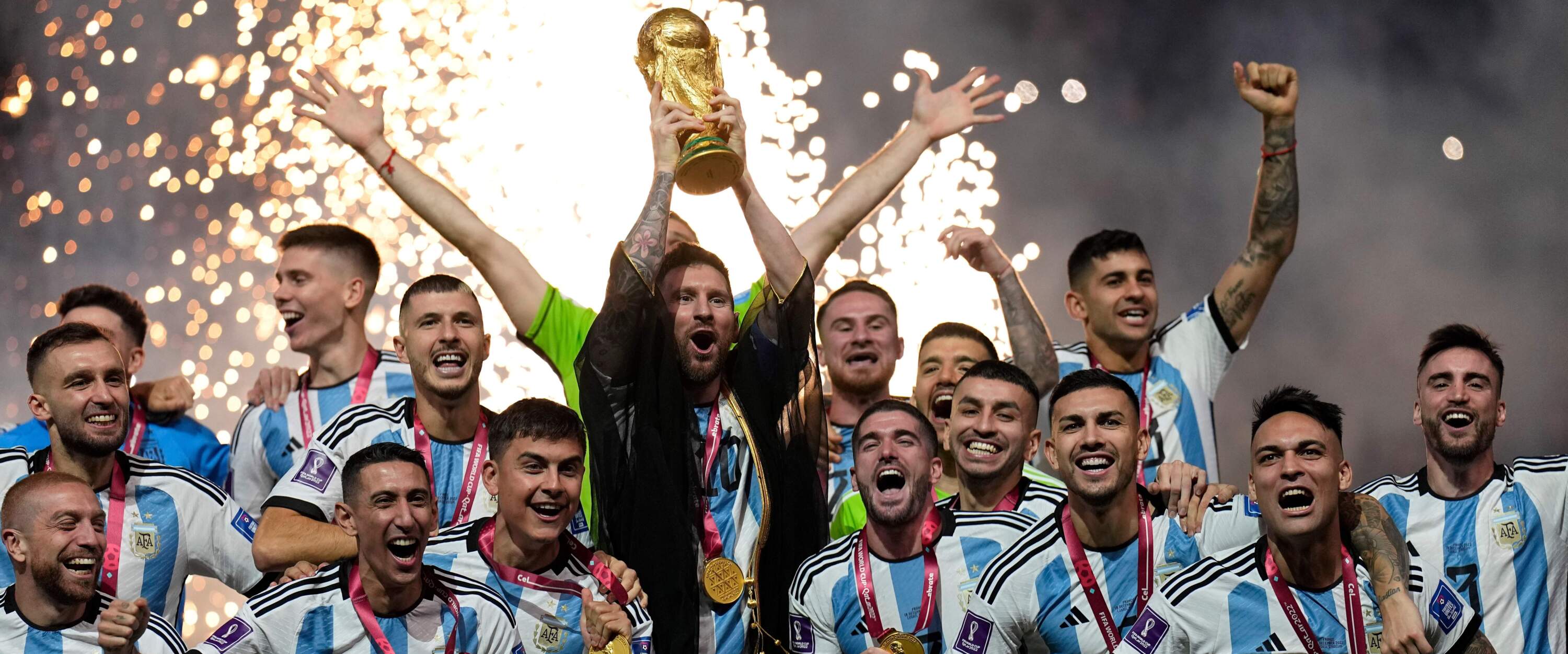
Kit: The uniform. What we often call a jersey. Teams' colors and even patterns are often a beloved tradition. The Italians always wear savoy blue. The Dutch are head to toe in orange. Argentina wear sky blue and white stripes. The U.S. men's national team hasn't had a hard and fast rule on its look. This year, they are going with a wavy red and white stripe home kit and a blue-on-blue star away kit.
Boots: Cleats. They don't look like boots but that's what the Brits call them so it's a thing you have to put up with.
Guards/shin guards: If you have kids, or you were once a kid, there's a good chance you're familiar with these little bits of plastic or thick padding to protect your lower legs from the boots of tackling opponents. At the professional level, though, players are opting for tinier and tinier guards that basically protect nothing. Some players have said it's a comfort thing, especially with the compression socks they wear.
A word on ripped up socks: The World Cup will feature the elite of the soccer world, and teams spend lavishly to train and prepare for the quadrennial tournament. So why do so many players walk around in socks your mom would have thrown out behind your back when you were a kid?
Modern socks are tight to compress the leg which helps with circulation. But players have complained that the socks are too tight, and in a bit of DIY transgression they've cut holes in their hosiery to vent a bit and release a little of that pressure. (We could write an entire article about sock style choices. In fact, some have.)
Badge/scudetto: This little crest on the front of a shirt is another long-held tradition for teams. The badge could be the national coat of arms, or a symbol of the nation, or, in the U.S. team's case, a logo from a 1980s video game.
Stars: Some clubs have little stars above their badge. In the World Cup, that represents previous tournament wins. Brazil leads the way in stars, with five. Uruguay, interestingly, has four stars even though they've only won two World Cups. They count two Olympic championships, which everyone else gives them side eyes for doing.
Team nicknames: It gets boring just saying the name of nations over and over. So each club has its own nickname. The U.S. is the "Stars and Stripes." England are "The Three Lions." Senegal is "Les Lions de la Téranga."
Lots of teams just lean on their colors. So Italy, who wear blue, are the "Azzurri." France, who also wear blue, are "Les Bleus." Spain, which wears red, gets a little feisty and goes with "La Furia Rojas."
Slang from the Brits

Hair-dryer treatment: Basically this is the coach screaming at their team. It's very British and not often used anymore, but it's fun.
Quality: It means what it means, but it's used as almost a noun.
Knock: A bump or bruise. A minor injury you play through.
Form: A team or player's form is how well they've been playing lately. To "be in good form," is a good thing, and promising for your games ahead.
Howler: a blooper or a gaffe from a player.
Cynical: Similar to NBA basketball players exaggerating contact to draw a foul, soccer players will sometimes fall to the ground and scream in pain at the slightest brush against an opponent. Even the trainers will get in on the act, squirting water on an ankle like it's some sort of salve. Then, the miracle occurs and the player pops back up healed and ready to rejoin the action. This is referred to as cynical play; it's the dark art of fooling the ref.
Gardening leave: Not really relevant to the World Cup but a fun concept: Someone on gardening leave (usually a manager) has been fired but is still under contract. As long as they don't take another job, the guys who just canned him have to pay out whatever sum was agreed in their contract.
Caps: Caps are a player's appearances for their national team. National teams would give players a fancy little hat as a memento of the game. Some teams still continue the tradition for special occasions. Seriously! Because who doesn't like a little treat?