Support WBUR
Man shot by Boston police officer had been hospitalized hours before he was killed, family says
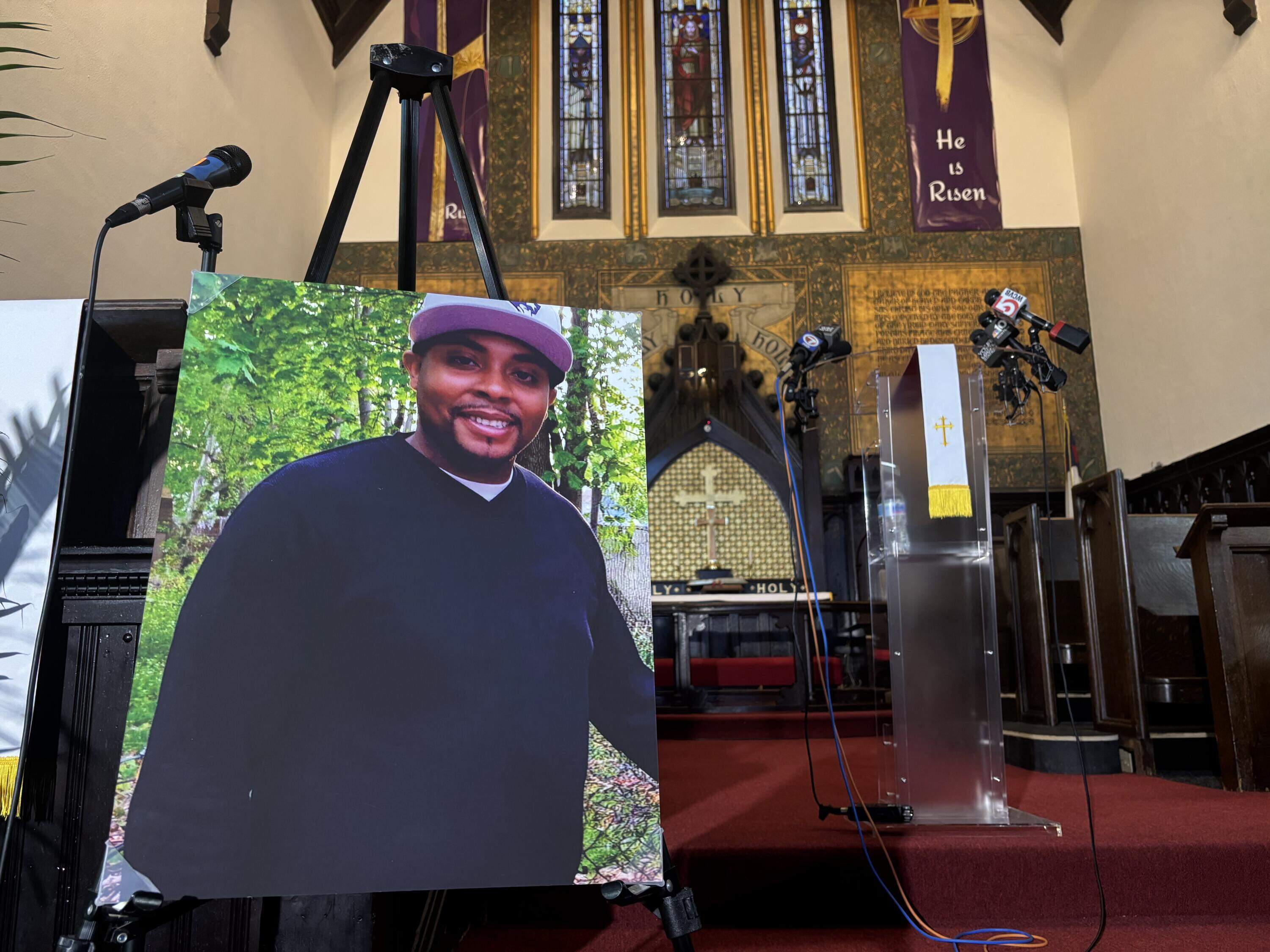
Stephenson King Jr.’s yearslong struggle with mental illness worsened in the days leading to his death at the hands of a Boston police officer, according to his family.
King Jr., 39, was shot and killed in a confrontation with police while trying to escape in a vehicle he allegedly stole on March 11. The officer who shot him, Nicholas O’Malley, said he feared King Jr. would run over the other responding officer, Todd Ho, with the car. O’Malley has been charged with manslaughter.
King Jr.’s three sisters, father and his father’s fiancé, spoke publicly for the first time at the GRANT A.M.E Church in Roxbury, alongside attorney Ben Crump. They were joined by two city councilors and several leaders in the Black community.
Stephenson King Sr. said he called 911 in the hours before his son was killed. King Jr. was still home, and had yelled to his father from the second floor for an ambulance. He had been badly beaten and suffered a head injury a few days prior, according to his sister, Ebony King Gibson.
King Sr. said he watched as EMTs took his son out of the home on a stretcher. It was the last time the two saw each other.
“I wasn't expecting him to be dead the same night,” King Sr. said. “I was expecting to go and see him the next day and bring him home so he can be with me, so I can keep an eye on him.”
King, Sr. who served in law enforcement for 27 years, briefly as a Boston Police Department recruit, retired as a state corrections officer.
King Jr. “wasn’t perfect,” he said, “but he was a great son.”
The family said they weren’t sure why King Jr. was released from Beth Israel Hospital and went to another medical facility on March 11. It wasn’t clear what happened there or when he left that second location.
By that evening, King Jr. was in Roxbury, where police say he punched a woman and stole her car. Boston police officers O’Malley and Ho found him nearby.
According to a police report, King Jr. tried to drive away from the cops. O’Malley said he believed King Jr. would run over Ho, so he fired his weapon, killing King Jr.
“ The fact that he is a Black citizen and he's having a mental health crisis does not equal the death sentence,” Crump said. “ He should have been given due process, also the same due process that they're asking [for] for Officer O'Malley.”
The family also told stories – at times through tears – about King Jr.’s kindness and generosity. They described the gifts he gave his nieces and nephews at Christmas, a call to wish his sister a happy birthday, a morning check-in that often began, “How you doing darlin’?”
King Jr.’s struggles began in 2009, his family said, when his mother died of cancer.
“Something different clicked into him,” King Gibson said. “He dealt with a lot of things, with drinking just to drown out a lot of those things. Then also came the voices.”
He racked up an extensive criminal history, with charges ranging from assault and battery to carrying a loaded firearm without a license. A video of that 2024 incident was posted on YouTube. In it, King Jr. is asleep in a stairwell; an officer takes the gun out of his lap.
King Gibson said he wasn’t planning on hurting anyone.
“He found out that his cousin, which would be his best friend, had committed suicide by taking a shotgun to his face. They were supposed to meet together the very next day,” she said. “That's the day that he had the handgun. 'Cause he called me and said he wanted to take his life.”
Several family members said his mental health issues grew more severe in the last few months. King Jr. began taping over his cell phone camera, outlets, even the logos on his shoes because he believed people were watching him, his father said.
Crump said he couldn’t answer questions about a specific mental health diagnosis, but the family often saw him talking to himself and believed he suffered from schizophrenia.
While he was incarcerated, they said, King Jr. was on medication. But after he got out, they said they struggled to get him help.
King Gibson said they tried “several times” through the court to get him involuntarily committed to a mental health treatment facility. They were denied because they lacked the necessary paperwork, King Gibson said. They also brought him to get assessed by a doctor at Dorchester Court, but he “didn’t fit the bill,” she said.
The day he was killed, she said she believed hospital staff would keep him admitted for treatment, buying the family more time for another intervention with emergency services.
“ Now he's gone,” King Sr. said. “And he shouldn't be dead because the fact is I tried to get some help from the same law enforcement I worked in.”
The family said they want to see the body camera footage of King Jr.’s final moments.
“ I would love to see the video because I want to see his face,” King Sr. said. “What really happened.”
The Suffolk County District Attorney’s office and Boston Police Department have both declined to release the footage, saying it could interfere with the investigation.
Crump – along with City Councilor’s Brian Worrell and Miniard Culpepper – said he didn’t buy that reasoning.
“We saw with the George Floyd video, Ahmaud Arbery video, Sonya Massey video, all these videos were released and yet they still had successful prosecutions,” he said.
The video will be the same, he said, whether it’s released tomorrow or a year from now.
“ What we've always been concerned about in the Black community has been when justice is delayed,” he said, “that becomes tantamount to justice being denied.”
This article was originally published on April 09, 2026.
This segment aired on April 9, 2026. The audio for this segment is not available.