Support WBUR
20 years after passing nation-leading health care law, Mass. braces for new challenges
In early 2006, roughly 530,000 Massachusetts residents did not have health insurance. Most of these adults and children did not have a regular doctor. Many waited until they were very sick before seeking medical care. A fund that covered emergency room and other costs for the uninsured had ballooned to $1 billion.
That year, state legislators passed a landmark law designed to fix those problems by providing near-universal health coverage for residents. Twenty years later, Massachusetts has among the lowest uninsured rates in the country. Its Health Care Reform Act inspired the sweeping federal overhaul known as the Affordable Care Act. And many are wondering whether that period of negotiations and compromise can offer lessons for solving urgent health care challenges at a time of intense political polarization.
The 2006 law was the product of an unlikely coalition of elected officials, business, hospital and religious leaders, and insurers, forged in response to political, financial and moral pressures.
The federal government had threatened to stop paying its share of the $1 billion bill for uninsured care from hospitals and health care centers.
The Blue Cross Blue Shield of Massachusetts Foundation had issued a series of reports modeling options for expanded health insurance coverage and invited top lawmakers to speak at summits attended by hundreds of health care leaders.
Consumer advocates and religious leaders added to the pressure with a ballot question that demanded action to cover the uninsured.
“From all across this commonwealth, we will rise up, take health care reform to the polls, but hold you accountable,” said Rev. Hurmon Hamilton, then-president of the Greater Boston Interfaith Organization, in an address to lawmakers in early 2006.
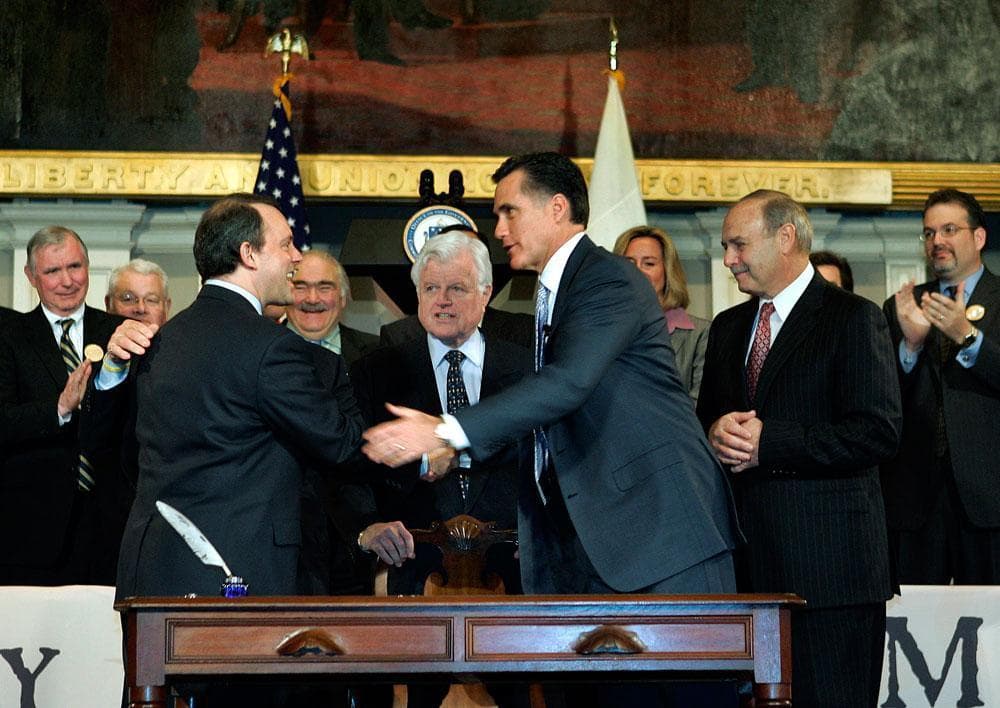
On April 12 of that year, after months of tense bargaining and stalemates, the governor at the time, Mitt Romney, a Republican, sat on a stage at Faneuil Hall, flanked by the late Democratic U.S. Sen. Ted Kennedy and the state’s top Democratic leaders, and signed a set of precedent-setting health care reforms into law.
The new law made health insurance mandatory for individuals, fined some employers who didn’t provide it and created subsidized health plans for low- to moderate-income residents.
“It was really a lifesaver,” Madelyn Rhenisch told WBUR in 2016.
She’d gone without health insurance for a decade before the law passed, and became the first Massachusetts resident to buy one of the new subsidized plans. At the time, Rhenisch received a routine physical and discovered the chronic fatigue syndrome she’d battled for years was actually Lyme disease. Her insurance covered the cost of treatment.
“I’m thrilled the law came along,” said Rhenisch on the 10th anniversary of the law's passage. “I can’t imagine life without it anymore.”
Studies show access to health insurance improved residents’ sense of health and wellbeing, reduced preventable hospital visits and led to 320 fewer deaths a year. Some have argued the law didn't go far enough toward creating a system of universal health care and has not contained health care spending.
“Giving health insurance to people makes them much better off,” said Larry Levitt, executive vice president for health policy at KFF, a health care research group. “But it doesn’t necessarily lower the overall cost of health care. When you give people health insurance, they use more health care, not less.”
The 2006 law had promised affordable health care but largely punted changes that might curb costs. Tracy DeJesus of Boston felt the impact in 2010 when her then 2-year-old was diagnosed with Type 1 diabetes. DeJesus stopped at a pharmacy to pick up her child’s new medications. They cost $250 even though DeJesus had health insurance through the dental office where she worked.
DeJesus looked at her budget, the demands of monitoring a toddler’s blood sugar, the expected medical costs and made a calculated, but difficult, decision: She quit her job, left her apartment and moved into a shelter in Chelsea.
"I realized that I couldn’t keep up the home plus the medical insurance and expenses," DeJesus told WBUR in 2012. "I just couldn’t afford both."
The mother and daughter switched from private insurance to MassHealth, the state’s Medicaid program, as lawmakers drafted a law designed to slow the growth of health care spending. It established a goal: Health care spending should not rise any faster than the economy overall. It didn’t, on average, through 2018.
But in more recent years, the state has failed to meet its targets. In 2023, the benchmark was 3.6% while health care spending increased 8.6%. In 2024, the most recent year with data available, the 5.7% rise was more moderate but still strained individual, company and government budgets.
Health care leaders have cited increases in people taking GLP-1 drugs for weight loss and diabetes, more costly procedures and increasing labor and other costs among the reasons for rising spending.
Massachusetts also faces new federal pressures. The Healey administration expects to lose $3.5 billion in federal health care funding every year once Medicaid cuts approved by the Republican-led Congress are fully in effect in 2028. Roughly 250,000 residents are expected to lose health coverage because of new Medicaid work requirements. One recent report by the Robert Wood Johnson Foundation shows a larger percentage of Medicaid recipients are at risk of losing coverage in Massachusetts than in any other state.
That grim prediction has demoralized many in Massachusetts' health care sector who do not want to see insurance coverage rates slide backward. Some are asking, as they mark this anniversary, whether the state’s elected, business, health care, consumer and religious leaders come together again to tackle pressing health care threats.
Several key figures, including Romney, will attend an event Monday marking the 20th anniversary of the Massachusetts health coverage law. Former Senate President Robert Travaglini and former House Speaker Sal DiMasi, who held office when the law was implemented, will also be in attendance, as well as former Gov. Deval Patrick and Gov. Maura Healey.
Editor's note: The event will be moderated by WBUR’s Martha Bebinger.