Support WBUR
Boston's Morning Newsletter
Here's how Gov. Healey wants to curb social media for minors in Mass.
Editor's Note: This is an excerpt from WBUR's daily morning newsletter, WBUR Today. If you like what you read and want it in your inbox, sign up here.
It's One Boston Day. Go do something kind (if not necessarily nice).
But first, the news:
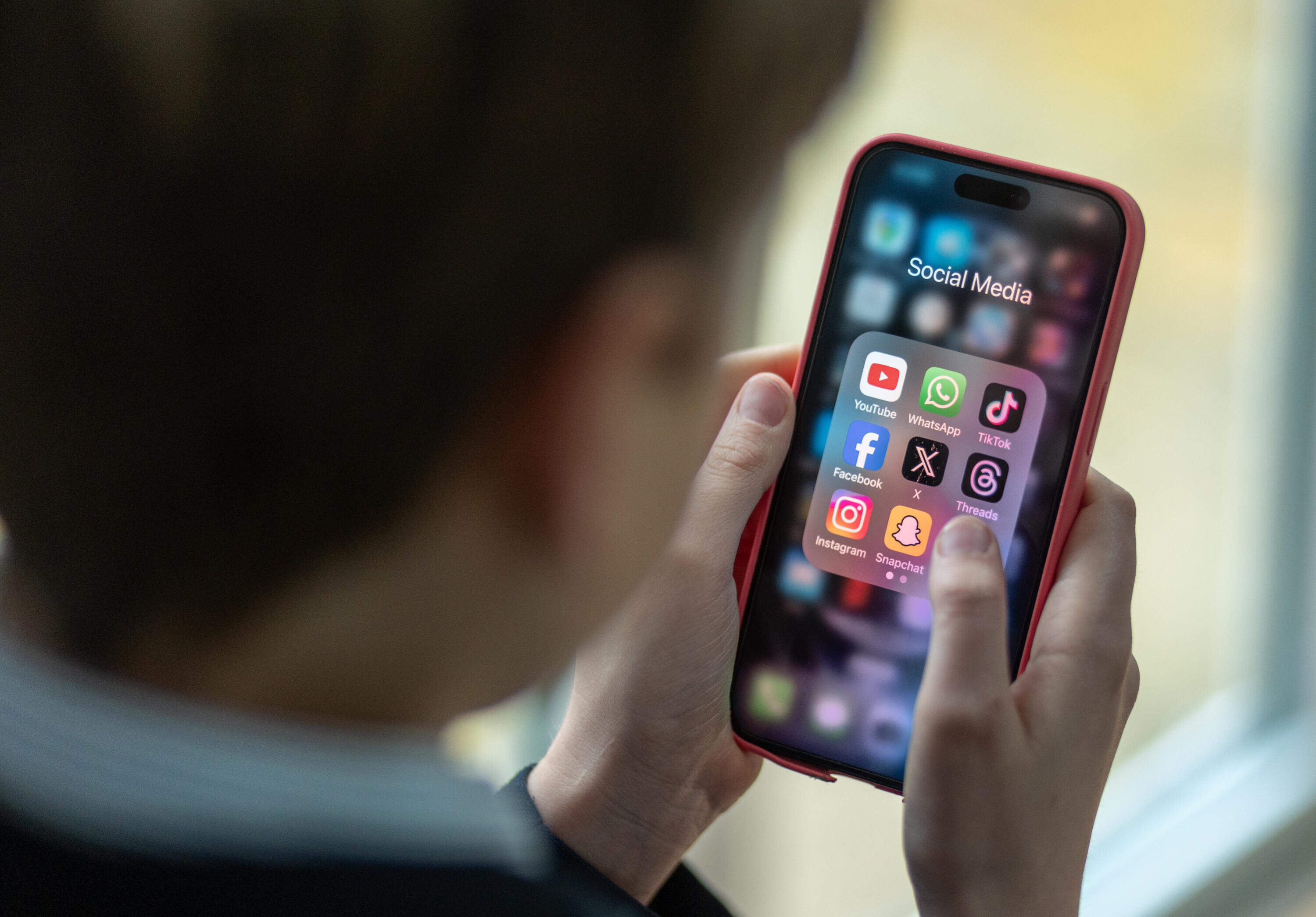
On Beacon Hill: Following a false start last week, Gov. Maura Healey is formally joining the chat about restricting social media for minors. However, her take differs from the House bill to ban social media for teens under a certain age. Healey's first-of-its-kind plan, which she unveiled yesterday, would require social media companies to have special default settings for Massachusetts users under the age of 18 that curb some of the apps' more addictive features. "Social media is driving a tremendous amount of anxiety and hurting kids in a number of different ways," Healey said during a press conference, adding that "these companies have designed products to be addictive and to exploit young people's insecurities."
- What are her proposed restrictions? As part of the default settings for minors, Healey's proposal includes time limits of two hours a day. Healey pointed to research showing that adolescents who spent more than three hours a day on social media faced double the risk of mental health symptoms like anxiety and depression. The default settings would also restrict access and notifications between the hours of 10 p.m. and 7 a.m., and during "hours when school is typically in session." And it would disable features like endless scrolling, video autoplay and algorithm-based feeds.
- How would they apply? For users under the age of 16, consent from a parent or guardian would be required to adjust the settings, while 16- and 17-year-olds would be able to modify or turn off the restrictions themselves.
- How would they be enforced? Healey's bill calls on social media companies to develop "age assurance" systems to verify the age of users — and would fine companies that don't comply. Healey said it would be up to the platforms to figure out how to implement the restrictions. "When you pass laws, you expect companies to abide by laws," she said. "So it's something that they'll have to do. I also don't think it's that hard as a technical matter."
- Zoom out: The proposed changes still need State House approval. Healey filed her plan as part of a wide-ranging supplemental spending bill that also includes her recent proposal to ease some Massachusetts hunting laws and would relax some of the tightened restrictions on the state's emergency shelter system. Healey said Tuesday's proposal is meant to be "complimentary" to the social media bill the House passed and the bell-to-bell school cellphone ban approved by the Senate. "I want to take the power away from social media platforms and big tech companies and put it back in the hands of our young people and our families," she said. "It's as simple as that."
Getting there: World Cup organizers unveiled plans yesterday to run buses to the games at Gillette Stadium — though it will cost up to $95 for a roundtrip ticket. The buses will run from 20 different locations, including downtown Boston, "every terminal" at Logan Airport and the Rhode Island Convention Center in Providence, according to Boston 2026, the local World Cup host committee. There'll also be buses from towns closer to Foxborough, like Norwood and Wrentham, for $25. In total, organizers say the buses have capacity to transport up to 10,000 fans a game. (Tickets went on sale yesterday via this website.)
- Cost comparison: The $95 bus tickets are a bit more than the $80 World Cup train tickets from South Station. Meanwhile, it will cost $175 to $220 to reserve one of the stadium's limited matchday parking spots.
- In related news: If you're reserving a parking spot at Gillette, don't plan on tailgating. Boston 26 says on its website that traditional tailgating (i.e. eating and drinking around parked cars) won't be allowed on match days.
End of an era: Hampshire College's six-decade experiment reimagining a liberal arts education is coming to an end. The small college in Amherst announced yesterday that it will permanently close at the end of the 2026 fall semester, following years of enrollment struggles and budget deficits. "The College no longer has the resources to sustain full operations and meet our regulatory responsibilities," Hampshire President Jennifer Chrisler said.
- What's next for students: School officials said that current Hampshire students who aren't graduating this year will be offered the opportunity to transfer to "partner institutions," including Amherst College, Mount Holyoke College, Smith College and UMass Amherst. Meanwhile, incoming students who paid deposits to enter the incoming 2026 class will get refunds.
On the ice: The Boston Bruins have locked in a first-round playoff opponent: the Buffalo Sabres. The B's win last night clinched the first wild card spot in the East. Game 1 is in Buffalo, but the specific schedule is still up in the air.
P.S.— The Celtics — who have the No. 2 seed in the NBA's Eastern Conference — will learn their first-round playoff opponent tonight: whoever wins the play-in game between the Philadelphia 76ers and Orlando Magic.