Support WBUR
House proposes slightly tighter budget than Healey, anticipating a 'very, very difficult' year
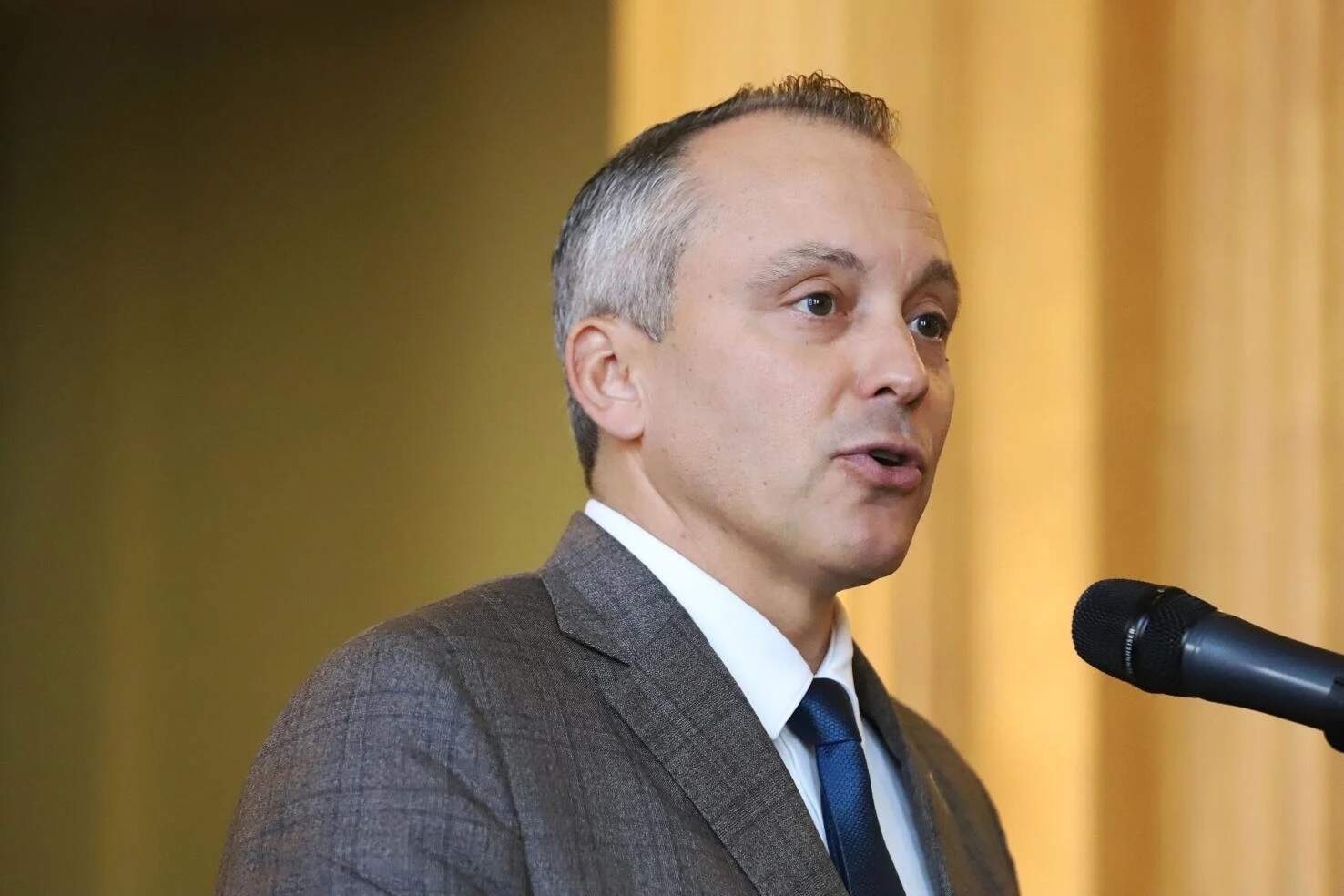
The House Ways and Means Committee released its $63.3 billion proposal Wednesday to increase spending by 3.6% in fiscal year 2027 — a plan that leaders said they crafted while bracing for the potential impacts of ballot questions that could slash revenue "leaving us with no choice but to make significant budget cuts."
Budgetwriters had to account for a number of colliding fiscal challenges, including a sluggish economy, eroding federal support, growing discontent around a rising cost-of-living, and two potential ballot questions that could put dollars back in taxpayers pockets while taking a chunk of revenue away from the state budget.
"The budget that we are presenting today aims to fund critical programs that help a wide range of initiatives, while at the same time making fiscally sound decisions in these uncertain and ever-changing times," House Ways and Means Chair Aaron Michlewitz said as he unveiled the budget to reporters at a press conference at the State House Library on Wednesday.
The committee recommends slightly less spending, about $33 million less, than Gov. Maura Healey did in her budget.
As always, the state's Medicaid program, MassHealth, is the largest chunk of the budget. House Ways and Means recommends funding it at $22.41 billion, a $282 million increase over last year.
One of the other biggest investments the budget makes is to local cities and towns, with nearly $10 billion going to local aid through Chapter 70 education funding, unrestricted aid, special education circuit breaker funding and the sixth and final year of implementation of the Student Opportunity Act bringing an extra infusion of dollars to school districts.
The budget fully funds obligations of the SOA, a 2019 law that was meant to make school funding more equitable. Schools received $7.3 billion last year, and would receive just over $7.6 billion under the committee budget, similar to the governor's proposal. That includes $550.5 million of SOA funds, which are supported by the 4% surtax on high-earners.
Of the $2.7 billion that budgetwriters plan to spend in surtax revenues, the committee is recommending a 63.89% / 36.11% split between education and transportation initiatives. This is a similar split to past years, and tends to even out as lawmakers later in the year take up a supplemental budget to allocate surplus surtax funds. Those supplements have weighed much more heavily towards transportation initiatives.
Michlewitz said Wednesday that for the past two years, after the surplus surtax supplemental budgets, transportation initiatives have actually received more funding in total, even though education programs get more surtax funding through the general budget each year. He said the same could happen this year, once negotiators wrap up talks on the latest supplemental budget.
With $1.725 billion in education spending of surtax funds, the committee is fully funding the SOA's requirements, as well as $364 million in child care grants to providers to continue a pandemic-era early education program, $198 million for universal school meals, $127 for free community college, an $85 million financial aid expansion, $62 million school transportation reimbursements, and other programs.
The House budget also plans to use $52.2 million towards minimum per-pupil aid, which representatives are recommending to raise to $160 per child. That would be an increase from $150 per child in fiscal year 2026, and more than double what Healey recommended at $75 for all districts.
On the transportation side, the committee appropriates $975 million, providing $470 million to the MBTA, $184.8 million to regional transit authorities, a $220.2 million transfer to the Mass Transportation Trust Fund, and $100 million for health and human services-related transportation.
The committee is recommending $40 million for the MBTA Academy to support workforce training and recruiting, and also supports water transportation and income-eligible reduced fares.
The budget also proposes reforms to out-of-district school transportation, after lawmakers required the inspector general last year to review the skyrocketing costs and provide recommendations to help districts save dollars. Districts say transportation is one of their most burdensome costs with out-of-control growth.
The committee is proposing that the Department of Elementary and Secondary Education maintain an electronic database for procurement and contract documents, establish best practices for districts, and study the special education school marketplace to identify areas for more transparency and improve competition for contracts. It would also require each school district to get a breakdown of detailed cost components from vendors, which could include costs on a per-trip basis, labor, fleet acquisition, fuel and vehicle maintenance, insurance, overhead, profit, and other costs.
Advocates have been at the State House for the last several months lobbying lawmakers on how federal immigration policies are affecting school budgets. Cities and towns around the state with large immigrant populations have seen steep enrollment declines over the last year, says the Massachusetts Education Justice Alliance, as families have been deported or voluntarily returned to their home countries amidst heightened anxiety. The U.S. Immigration and Customs Enforcement raids and deportations in these communities have now produced a ripple effect on school budgets, the group says — with declining enrollment, the districts receive less money from the state to run their schools.
The House Ways and Means budget includes a $10 million reserve for school districts that have experienced "unexpected enrollment reductions" in non-native English speaking students.
School committees, superintendents, educators and students have also been advocating for years for the state to change the Chapter 70 school funding formula altogether, which relies heavily on enrollment and has caused fiscal crises in districts with declining populations.
Michlewitz said Wednesday that with the final infusion of the SOA being implemented in this budget, it may finally be time to open the conversation about a Chapter 70 school funding revision.
"I think it's an appropriate time now to go back and see if we need to make further changes to the Chapter 70 formula. But the conversation always has, whenever you open up these conversations as we did with the Student Opportunity Act, whenever you change these formula mechanisms, you're going to have winners and you're going to have losers. And no formula change has ever had all winners. So I do think we have to be careful in our approach," he said.
He added, "I do want to underscore the fact that we're investing $10 billion into our local communities here. That's a huge amount of money in our budget."
The committee budget differs from Healey's in not fully funding snow and ice accounts. Michlewitz said the House does not typically fully fund this account, and backfills it if necessary through closeout budgets.
"This is the first winter that we've actually gotten over budget related to our snow and ice funding. And historically, not knowing what the final number has been, we would fix it in a closeout," Michlewitz, who has been Ways and Means chair since 2019, said.
The budget includes a number of small increases for affordable and accessible housing programs, including a $1.6 million increase for the $115 million Programs for Homeless Individuals; $28 million bump for the $281.3 million Massachusetts Rental Voucher Program, $2.5 million growth for the $210 million Rental Assistance for Families in Transition program, and a $25 million increase for the $82.3 million HomeBASE program.
It funds the family Emergency Assistance shelter system at $258.6 million, realizing $17.1 million in savings from the state's decreased shelter caseloads.
The committee also proposes a reform to the shelter system, requiring any child under the age of 3 in the system to be referred for an early intervention evaluation and assessment.
In a diversion from Healey's proposal, the committee recommends a new way to use sports wagering revenue.
Healey recommended in her proposal a 7.5% diversion of sports wagering profits to be deposited into an economic development fund. The committee is instead recommending it go into a Sports and Entertainment Events Fund.
This fund was created last November, and provides matching grants for major sports or entertainment events in the state. It's meant to drive economic development and increase jobs.
"Obviously, we're going to have a big summer here coming up. We want to make sure that we don't ever get caught flat footed, from a financial standpoint, from the state. Want to make sure that we have the resources to be able to support bringing these types of major events here to Massachusetts and to Boston ... we wanted to create a revenue source to do so," Michlewitz said.
Over the past several years of steady though sluggish revenue growth, the tone of the committee's budget release press conference has been fairly celebratory, as House Speaker Ron Mariano and Michlewitz laud the spending initiatives in the bill.
While Mariano still toasted a "strong budget," he gave several qualifiers this year, noting that it was "for a very, very difficult fiscal year, in a truly challenging economic environment."
"Of course, there are two revenue-related ballot questions that threaten to further complicate the fiscal picture. If these questions become law, the commonwealth's ability to fund services that are residents rely on, from the MBTA to MassHealth to public schools will be hampered significantly, leaving us no choice but to make significant budget cuts, and consider alternative sources of revenue," Mariano said.
If a ballot question reducing the income tax from 5% to 4% over three years passes in November, he said, the revenue losses begin "almost immediately" and could have an $800 million impact on the very fiscal year 2027 budget that House leaders rolled out Wednesday.
But when asked by a reporter about if they considered that potential revenue loss while drafting the budget, and if it materially affected whether they spent less on any accounts, Michlewitz did not directly answer.
He said there are not any policy controls responding to the ballot initiative, similar to what the House did in a recent supplemental budget, where lawmakers tied tax conformity changes to whether or not the ballot measure passed.
"We thought about that. Certainly there was some potential initiatives that we looked at on that, but decided not to do that, because it really is still a fluid process. It's a fluid process of what is actually going to be on the ballot. It's a fluid process of whether the ballot initiative passes," he said.
He continued, "I do think while we have to be careful and make sure that we are being fiscally responsible in this budgeting piece that we're putting together today, we don't necessarily have to be definitive, because I think that there's still a lot to be played on negotiations in question."