Support WBUR
How Boston's World Cup transit pricing compares to other host cities
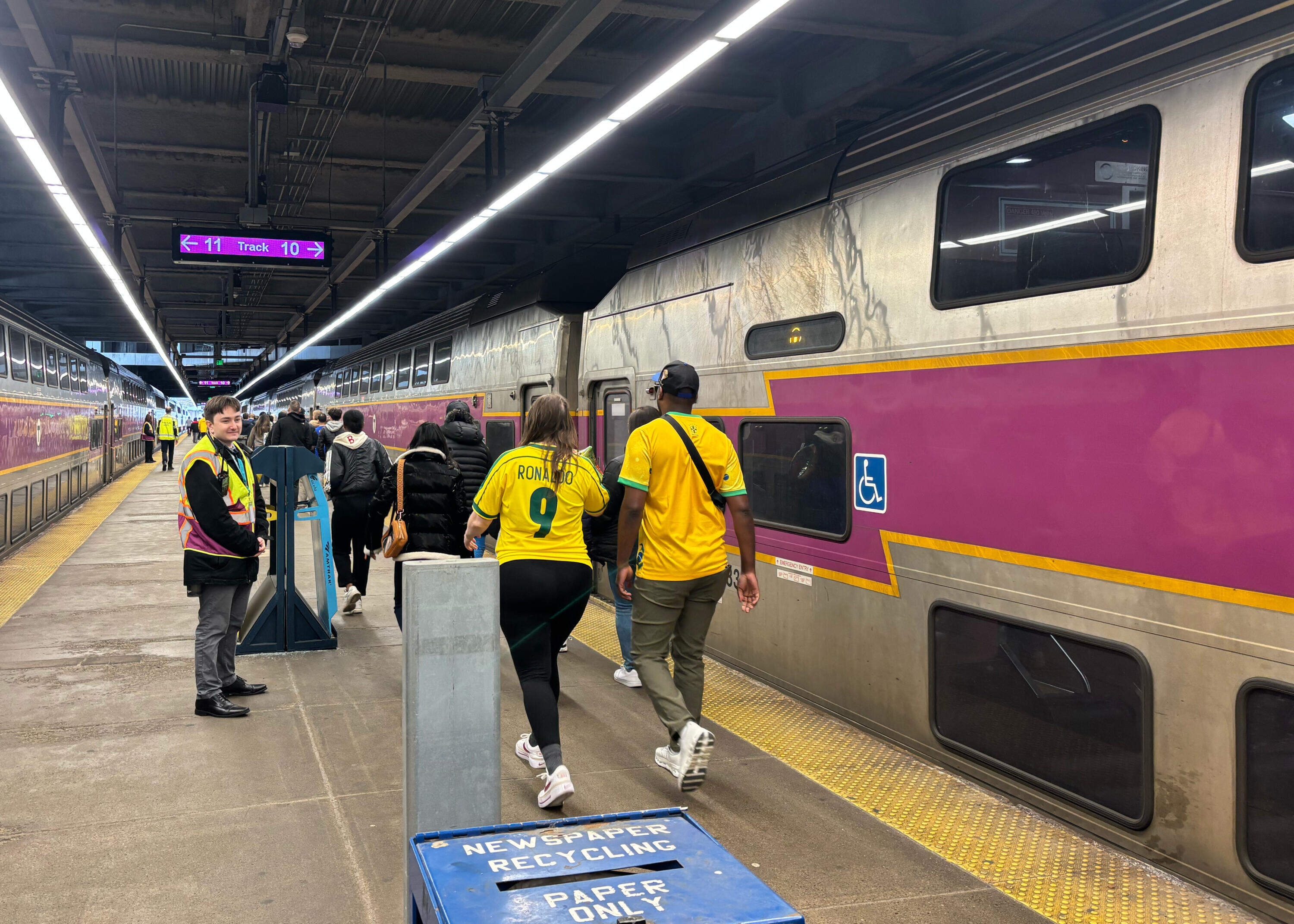
If you feel like the World Cup runneth over with the dollars of fans, you aren't alone.
The men's World Cup is back in North America for the first time since 1994, with 16 cities in the U.S., Canada and Mexico hosting 104 soccer matches this summer. For months leading up to the games, one of the biggest stories has been about ticket prices. Seats are selling for thousands of dollars. And even if you had the scratch to buy a ticket, FIFA last week quietly changed where you may be sitting.
But World Cup sticker shock doesn't end with the game tickets. Even getting to the matches can cost far more than usual, especially in Boston and New York.
Both host cities have to solve for a problem other Northeast venues, like Philadelphia and Toronto, don't: Their stadiums are miles from the city center. Fans in Philly and Toronto can take each city's respective transit services, and they'll pay the regular fare to do so.
But you can't just hop on the subway to get to Gillette Stadium in Foxborough or MetLife Stadium in East Rutherford, N.J. Both require trips on regional rail service.
While some fans assumed they'd fork over the same fare as a trip to an NFL game or concert, they were wrong. Exponentially wrong.
A roundtrip ticket to Foxborough will cost $80, four times as much as a game-day ride to see the New England Patriots.
But that's bargain bin pricing compared to NJ Transit's fare. The service will charge an eye-watering $150 for the ride. That's nearly 12 times the typical game-day ride of $12.90.
In Boston, officials leaned into the fact that, yeah, $80 is more than $20, but it's still cheaper and more convenient than trying to drive to and park at Foxborough.
"Taking the Commuter Rail will be one of the easiest and most affordable ways to get to and from the stadium," MBTA General Manager Phil Eng said in a statement.
And in New Jersey, Gov. Mikie Sherrill has defended the $150 fare, saying it will cost the state $48 million to ferry folks to and from the matches.
She also noted that FIFA, the international organization that runs the World Cup, hasn't chipped in a dime for transportation, and should pony up to help defray the costs.
That drew a quick response from FIFA, which said the original host city agreements called for free transportation to and from matches.
At least New York's planned $80 bus service to World Cup matches will be cheaper than the train. In Boston, you'll pay $95 for the bus. That's $15 more than the train fare, only to sit in traffic on I-95 and Route 1.
While transit may not be free, at least the fan festivals in most Northeast cities won't carry a cover charge. Boston, Philadelphia and Toronto have all committed to free fan festivals. That comes as a relief after both New York and Los Angeles organizers said they'd ask folks to cough up some dough to join in the fun.
World Cup matches will be broadcast on Fox and its suite of sports stations. Whether you decide to charge your friends and family to come over and watch a game is up to you.