Support WBUR
SJC weighs whether Quincy saint statues violate religious freedom laws
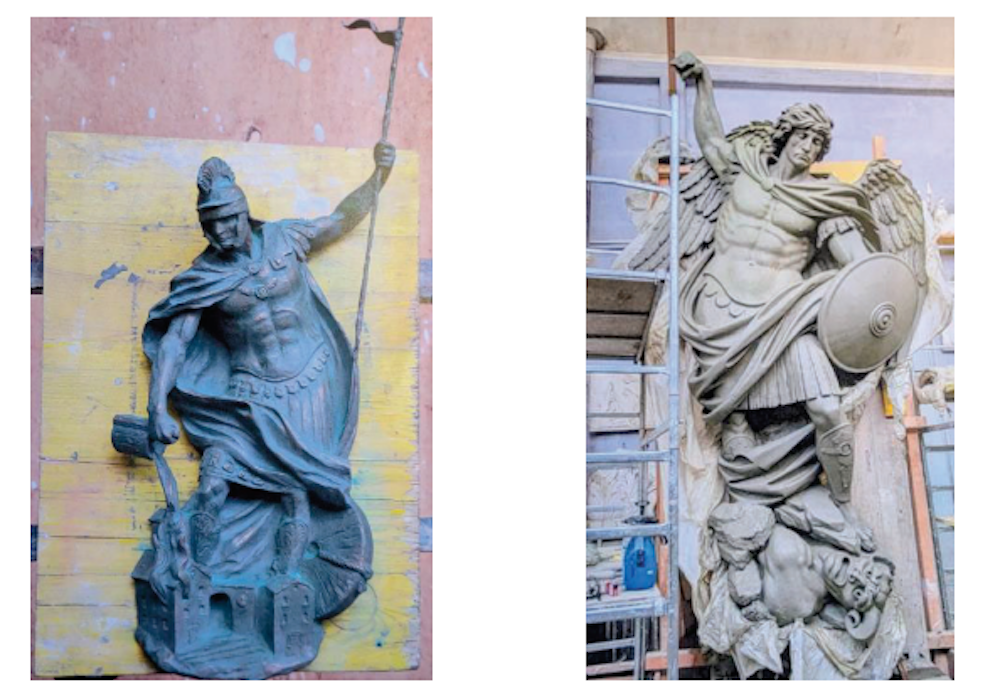
A battle in Quincy over whether the mayor can install statues of Catholic saints at a public building is now before the state's highest court.
The central question: Do the statues represent religious iconography that elevates one sect over another — or are these widely held symbols of inspiration for police officers and firefighters that transcend any particular religion?
Massachusetts' Supreme Judicial Court heard arguments Wednesday on the $850,000, 10-foot, bronze statutes, which were quietly commissioned for city's new police and fire headquarters by Quincy Mayor Thomas Koch, a self-professed devout Catholic.
After the Patriot Ledger first reported on the statues last year, more than a dozen Quincy residents, with backing from the ACLU, sued, saying the figures violated religious protection statutes. A Norfolk Superior Court judge agreed that the statues are not secular, and ordered they be kept in storage while the lawsuit plays out.
In Wednesday's hearing, an attorney representing the city, Joseph Davis, told the justices the statutes aren't just religious — they're symbols of courage for police officers and firefighters.
"They have a a significance that transcends religious lines, and they really do embody the core virtues that firefighters and police officers seek to display when they go to work every day," said Davis, an attorney with The Becket Fund for Religious Liberty, a law firm with a record of representing Christian causes which has taken up Quincy's case.
Davis cited briefs filed by Quincy's police and fire unions, as well as national organizations, including the International Association of Firefighters, the Fraternal Order of Police and the National Association of Police Organizations, which support the statues.
“The statues embody historically, and still today, this spirit of self-sacrifice and therefore profoundly honor the common spirit, the esprit de corps, on which the devotion to duty of the firefighters and police depend," the Quincy unions wrote in a brief filed with the SJC.
The ACLU's Jessie Rossman, representing the plaintiffs, said the statues amount to government speech, promoting Catholic icons.
These statues "are conveying a message that their particular religion is being elevated above other religious and non-religious beliefs," she said.
Justice Frank Gaziano asked about the reaction of the average person who spots the statues, such as "the person driving to Roxie's to get their bargain meat," referring to the meat market just around the corner from the new public safety headquarters building.
"They see this big angel smiting a demon," Gaziano said. "Someone has to explain that to them, 'That's St. Michael, it's the symbol of good versus evil in the police department.' So isn't that kind of a niche explanation, that when you see this immediately, it strikes as overwhelmingly religious?"
Davis noted there are other religiously affiliated statues in and around Massachusetts, including a statue of Moses in the Supreme Judicial Court building.
Justice Scott Kafker pointed out the "clandestine" nature of the art selection, which he said figured into the lower court judge's decision. The mayor ordered the statues without consulting the city council.
" Is there any precedent for a major piece of public art being done like this?" he asked Davis. "Usually there's tons of process, right? Art is controversial in general, right? People have strong views. That's got to be a factor to consider."
Davis said the way the art was selected does not affect the central religious freedom question at the center of the case.
Meanwhile, Justice Elizabeth Dewar questioned Rossman on whether St. Michael and St. Florian are "essentially the mascots in kind of a sports team way, of police and firefighters all across the country of every different religion." She compared the saints to Gritty, the Philadelphia Flyers' googly-eyed mascot.
"Are you saying that the well is poisoned because [these symbols] originally came from a religious tradition?" Dewar asked.
The justices also asked how a 1979 SJC ruling allowing for prayer in the State House would affect the statues' constitutionality. Kafker noted that St. Michael and St. Florian have "long-term meaning."
"There's not a hermetically sealed separation between church and state," Kafker said. "Some of it's allowed based on historic traditions and just sort of the way we live in this country and state. So I'm just trying to figure out why this crosses the line."
Rossman said the big factors are history and divisiveness: These statutes are new, not longstanding. And they are "certainly something that caused division" in the city, she said.
" St. Michael, the archangel, and St. Florian, as they are depicted on this building, directly reflect the Catholic iconography," Rossman said. "If there was a statue that directly reflected another religion, if there were two 10-foot-tall Jewish stars or two 10-foot-tall moon and crescent and stars that were outside the building, it would pose the same issue."