Support WBUR
At Harvard's Peabody Museum, a visual testimony of Iran's undocumented history
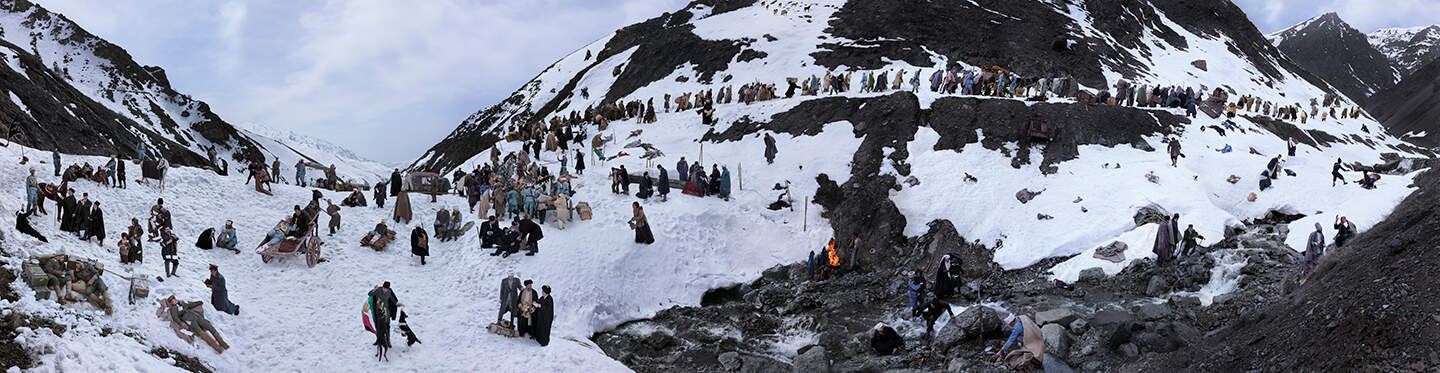
Snowy mountains surround hundreds of people near the Iranian-Ottoman border. Some people are carrying bags and walking around a large mountain, while others stand at its base, huddled together. A small fire burns nearby.
It looks like a still from a documentary or a photo captured by a roving journalist. But it’s neither of those things.
This image depicts the Great Migration, also called the Great Iranian Migration. It’s a real event that took place on the border between the Iranian and Ottoman empires during World War I. But everyone in this photo is an actor. It’s part of a new exhibit by photographer Azadeh Akhlaghi called “From Iran: A Visual Testimony,” opening May 15 at the Peabody Museum of Archaeology & Ethnology at Harvard University. Akhlaghi finished the work through the museum’s Robert Gardner Fellowship in Photography.
In the exhibit, Akhlaghi stages 11 pivotal incidents in the modern history of Iran, starting in 1908, following the dissolution of the country’s first national assembly and abolishment of its constitution, to 1979, when Islamic rule began. The result is 16 photographs that show a cycle of successful and failed attempts by the Iranian people to reclaim control of their country. Each photograph sheds light on events where there are little to no visual records in existence.
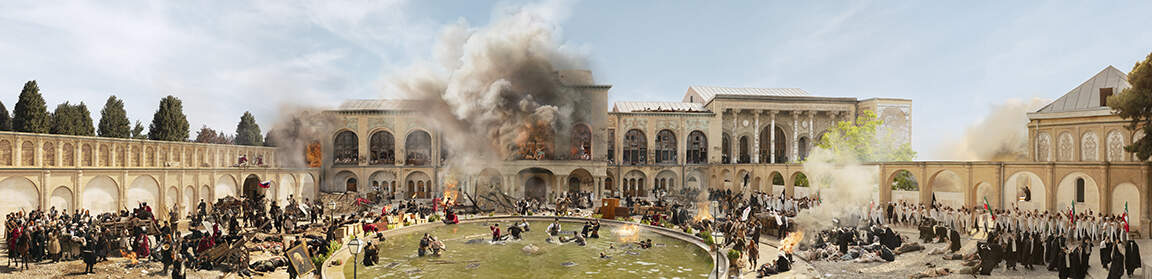
“What Azadeh does is she creates a reality from reality,” said Ilisa Barbash, curator of visual anthropology at the Peabody. “She creates an imagined world that looks real to many of us.”
When visitors walk into the exhibit, they’ll face enlarged copies of three of the photographs. Because of space constraints, Barbash said the museum couldn’t display all of the photographs in the same way. So nearby, there are interactive videos that show all of the images and background information on how Akhlaghi researched each and every photograph, using archival materials like newspaper clippings, diary entries and interviews with eyewitnesses. There’s also information on how she staged and shot the collection.
Akhlaghi says the photographs are deeply researched, but that’s also hard in a country like Iran, where “history is often fragmented, censored or officially rewritten, and public memory is never neutral,” she said. “It's shaped by institutions, by those in power and by what they choose to preserve or erase.
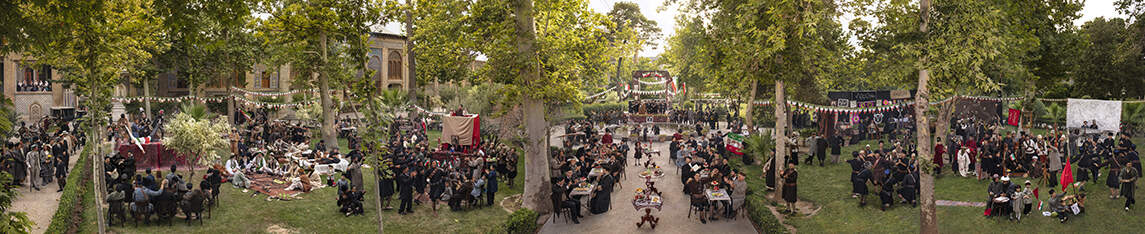
“I wanted to challenge that and ask what if we could re-visualize the moments that were never photographed? What if we could give visibility to the invisible?”
Each photograph is shot in Iran, and Akhlaghi is in every photo, wearing a red shawl to identify herself. Barbash said it creates an almost “Where’s Waldo?” game where visitors can try and look for her while learning about each photo. The rest of the people pictured are both professional and unprofessional actors.
This method of staged photography isn’t new for Akhlaghi. Her previous collection, “By An Eyewitness,” consisted of 17 images that reconstructed the suspicious deaths of prominent Iranian figures, from poets and writers to activists and athletes. All those deaths took place between 1906, during the Iranian or Persian Constitutional Revolution, to 1979, during the Islamic Revolution.
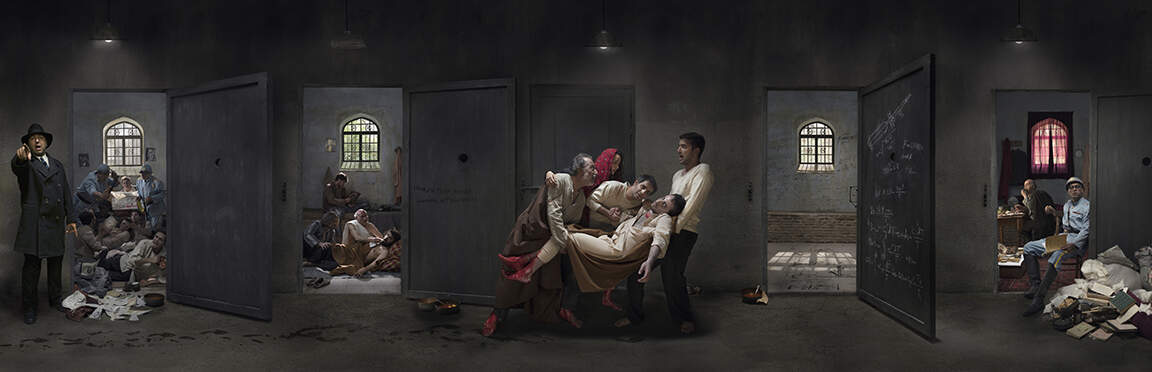
“In the collective memory of Iranians, they all had the image of their death, but they had never seen the image,” Akhlaghi said.
After the photos were shown in Iran, Akhlaghi realized that many people thought they were real images, rather than staged photography. By enlarging some of the photographs in this show — and including more about her process for creating them — she hopes to make clear these are not real, and are instead just representations of real events based on historical records.
Although the photos are staged, Akhlaghi sees her work more as “historical paintings,” rooted in fact rather than a type of “photo journalism.”
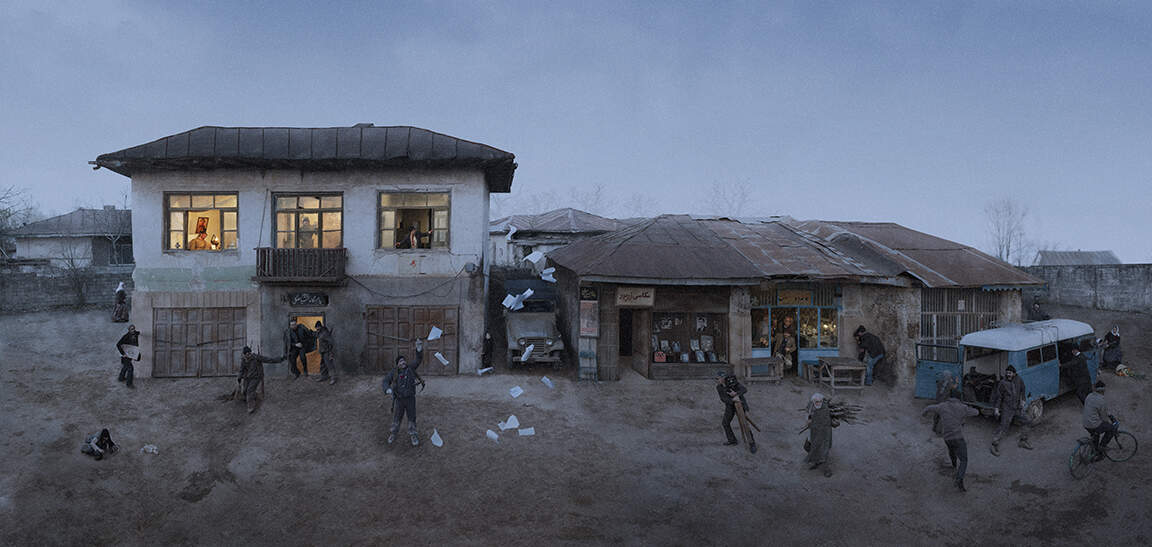
“I tried very hard to find the truth,” Akhlaghi said. “And in the end, I can say that it's impossible to find the truth, especially in a country like Iran. But I did my best.”
One photo in particular is especially meaningful to the artist. It documents the country’s first feminist or women’s rights movement that started around 1910. At that time, women experienced a dramatic expansion of their rights — the first periodical by women was published, and they formed community and activist groups. Akhlaghi’s photo, set in 1911, portrays 70 women who made crucial strides then. In the photograph, they’re sitting, standing and interacting in a room with giant stained glass windows. Some are wearing hijabs or hats. Some have children, while others are holding their country’s flag.
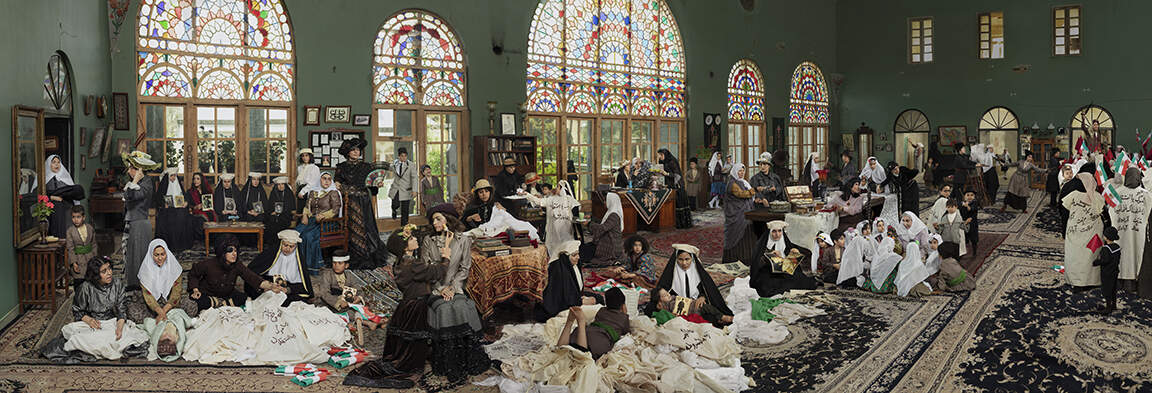
Akhlaghi said the majority of the women didn’t have surviving photographs of themselves in any archives. Some of them, though known, had their names missing from historical records.
“They were important women, they opened the first schools for girls …they were the first female journalists in Iran, first physicians,” Akhlaghi said. “They didn't have names …they were referred to only as the wife of mister so and so.”
She dedicated the image to her late mom Beti Nejati, who was a teacher, an artist and a feminist in Iran. Akhlaghi remembers when she was working on this project and the 2022 "Woman, Life, Freedom" movement happened, following the death of 22-year-old Mahsa Jina Amini when she was in custody of Iran’s morality police. She remembers walking in the streets of Tehran, with other women, without a hijab for the first time in her life.
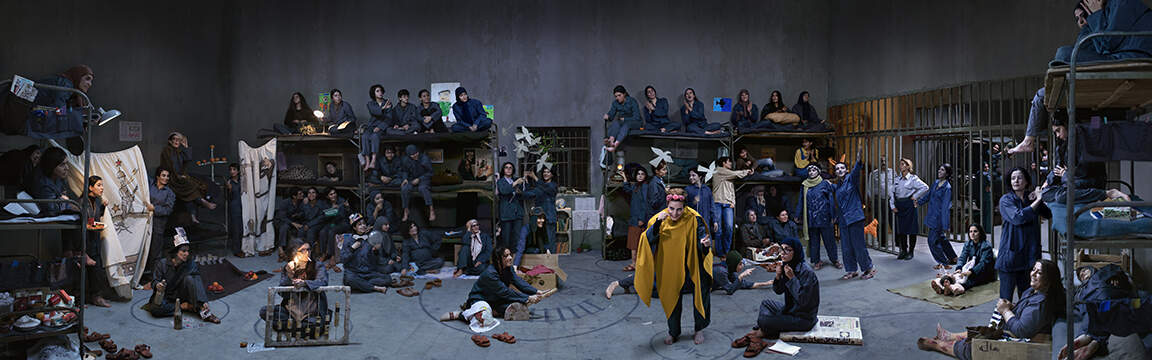
“It was my dream when I was a teenager that I could one day feel the winds of Tehran on my skin with no hijab,” Akhlaghi said.
Akhlaghi grew up in Iran. She left the country to study computer science in Australia. She returned in her late 20s to work as a filmmaker. That snowballed into photography, and then this related artform of staged photography. She’s spent over a decade on this project, and she says it is purely a coincidence that the release is happening as the U.S. remains at war with Iran.
“These are really, really sad days for Iranians, and I'm worried about my people, about my family, my friends over there,” Akhlaghi said. “I truly hope that peace will return very soon, and I have the opportunity to have my show in Iran as well.”
“From Iran: A Visual Testimony” is on display at the Peabody Museum of Archaeology & Ethnology through March 21, 2027.