Support WBUR
Review
The Huntington's 'Oedipus el Rey' is a singular and sharp retelling of a Greek tragedy

Every now and again, the reimagining of a classic tale reaches for and achieves singularity. That feels true of Luis Alfaro’s sharp and vigorous “Oedipus el Rey,” a retelling of Sophocles’ tragedy “Oedipus Rex,” presented by The Huntington Theatre through June 14.
Set in Los Angeles, the show starts out with four orange-clad inmates talking in front of the stone walls that confine them. They are a Greek chorus offering up a bit about who is who and the tale they’re about to tell.
The powerful show has a small, but ferociously talented cast consisting of Juan Arturo portraying Oedipus, Gabe Martínez as Laius and El Coro, Melisa Soledad Pereyra as Jocasta and Esfinge, Jaime José Hernández as Creon and El Coro, Victor Almanzar as Tiresias and El Coro, and Javier David as El Sobador, El Coro and Fight Captain.
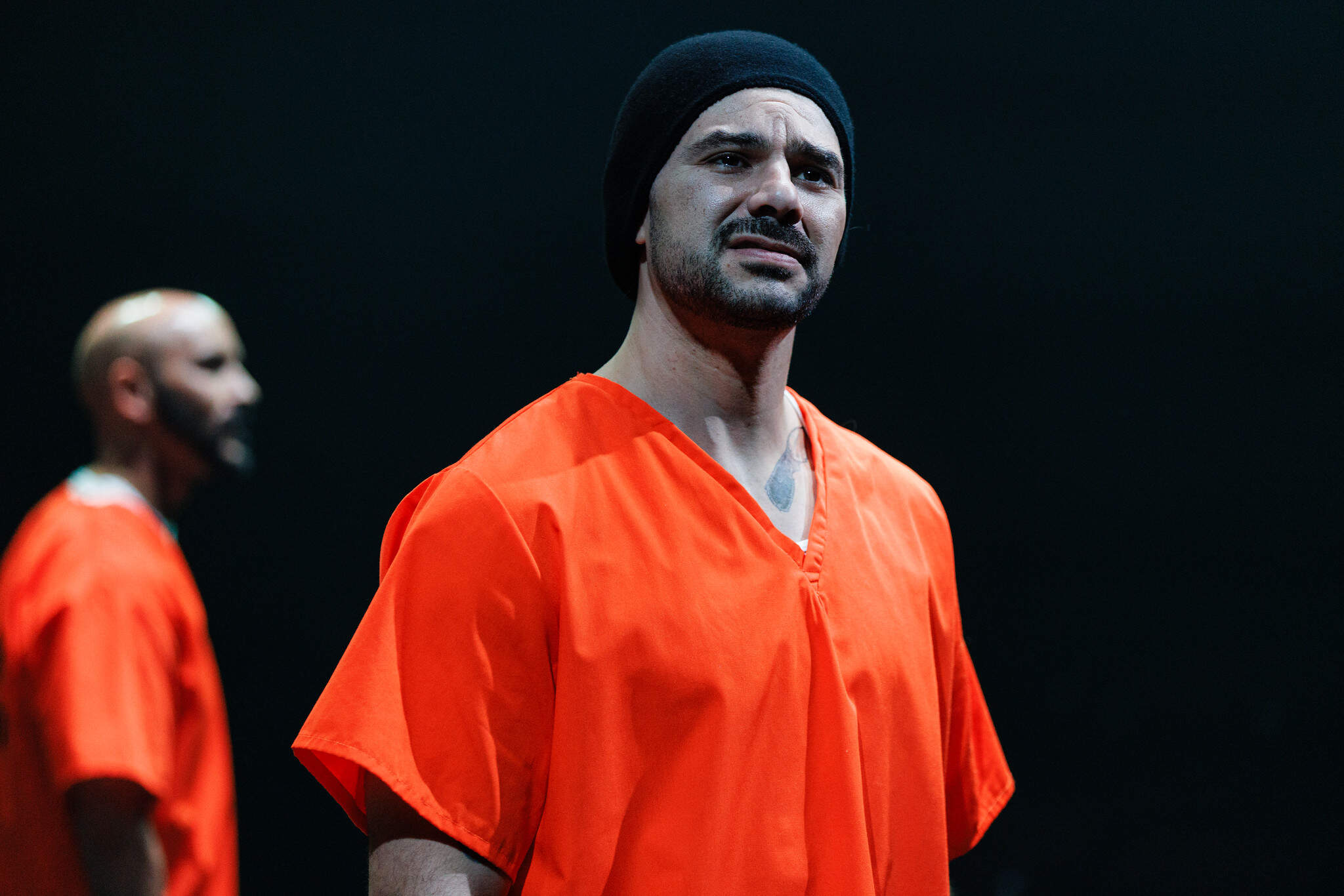
The bones of the Sophocles tale remain intact. There are mean kings, a prophecy that foretells the murder of the current leader by his son, and some incest between mother and child. In Alfaro’s tale, the characters are Chicano, and El Rey (meaning King) is the most powerful man in the barrio, or neighborhood. The formidable king in this tale, Lauis (a wonderful Martínez), is not a religious man, but when he learns that his newborn son might grow up to kill him, he hands him off to Tiresias (a fantastic Almanzar) to end the child’s life. He also cuts the bottom of baby Oedipus’ feet so that the child won’t chase him in the afterlife.
Despite his precautions, though, there’s no outwitting or outrunning kismet in Greek tragedies. But before the prophecy becomes reality, the action in this tale moves from the prison to State Route 99, Jocasta and Creon’s house and the Farmacia Million Dollar. There’s camaraderie and singing among the inmates, and a pursuit for power and riches outside the walls.
Soon, the script finds both Oedipus and Tiresias serving time in a California prison. And, to make the day go by, Oedipus accompanies Tiresias, whom he believes to be his father, to the library each day to read books from section 250 Ray-Rel (religious) books. Oedipus soaks up all the lessons Tiresias offers and reads with him, even though he isn’t religious.
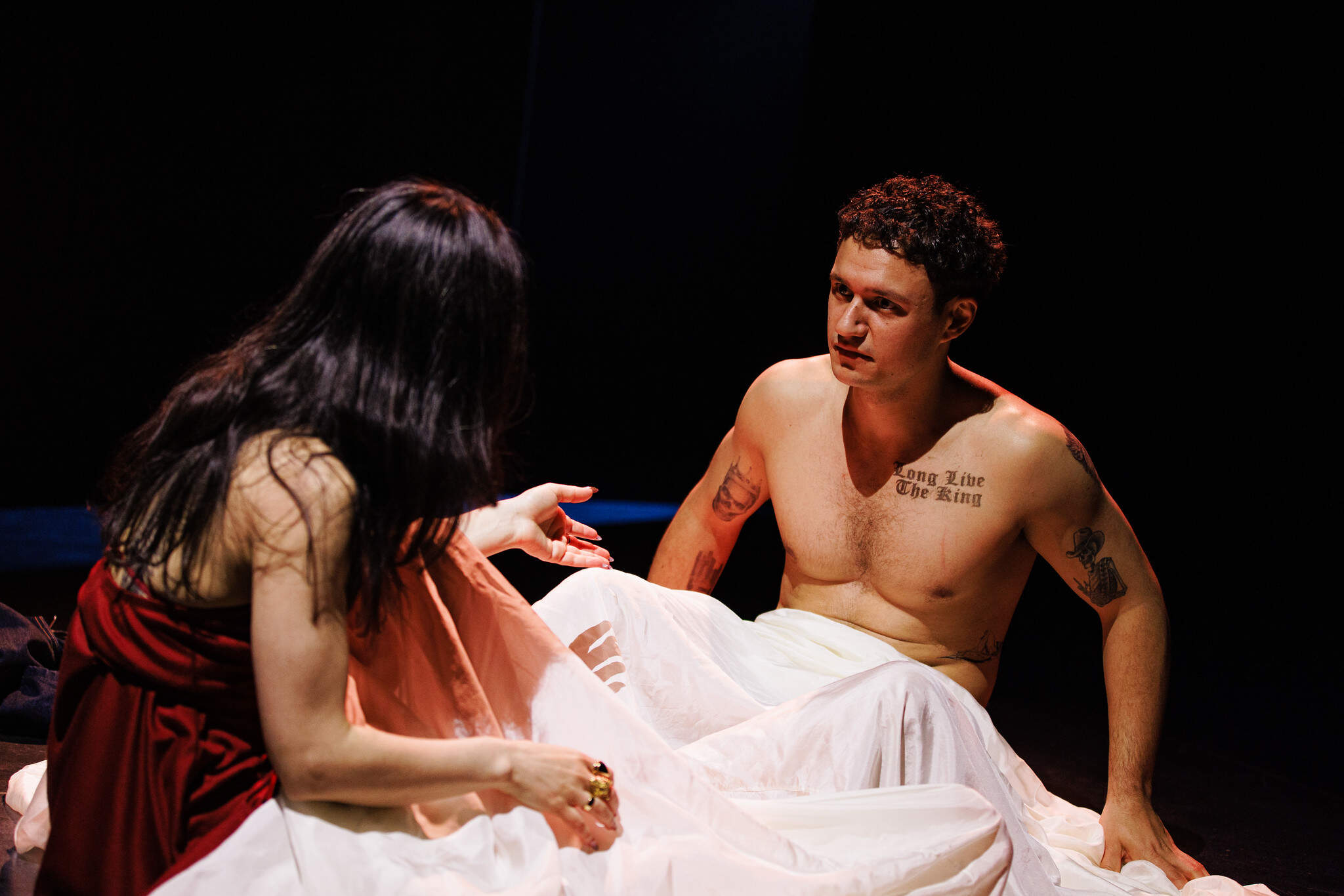
Watching a show where one already knows the ending could be tedious, but Alfaro’s excellent writing, Loretta Greco’s skillful direction, along with superb acting, make it anything but. Also, the dynamism that comes from cultural specificity, and the work of the creative team, further augments the experience.
The set, courtesy of scenic and projection designer Hana S. Kim, is spare but perfect, with just the walls of the prison and two large doors. As the story unfolds, colorful projections of flowers, dizzyingly fast-moving car lights and the Virgin Mary (like the one depicted on prayer candles) appear on walls. Sound designer Jake Rodriguez also composed original music for the show, and Reza Behjat provided the lighting design.
Some Spanish is spoken throughout, with some interpretation in between, but there’s a glossary in the program for audience members who haven’t kept up on what they learned in high school. The cultural richness lives not just in the dialogue, but in the curanderos (shamans) who heal, the tecolotes (owls) that acted as an oracle (fabulously outfitted by costume designer Alex Jaeger) or the boisterous wedding of Oedipus and Jocasta. During this scene, the cast quickly hung multicolored lights, handed out percussion instruments like maracas, güiros and castanets, while convincing showgoers to ¡bailar! onstage and in their seats.

Showcasing Latiné culture is part of Alfaro’s aim. He is a featured playwright with The Sol Project, an initiative that aspires to highlight Latiné playwrights and bring their stories to the stage. And in the show, he explores tradition, love, poverty, oppression, street code, family and more. There’s not an abundance of on-the-nose dialogue about the things that Alfaro wants audience members to ponder, but there are a few poignant one-liners. For instance, before Oedipus is released from prison, Tiresias says to Oedipus, “This is an industry, mijo, they gotta kick us out so we can get back in.”
Another time, Oedipus is convinced that he not only doesn’t need God, but that his choices are solely his own. And that he is most powerful. He bucks against fate, determined to have it all. But Jocasta reminds him that he didn’t get where he is on his own. And that there’s “someone upstairs pulling your strings.” She adds, “We’re already history and we just started living. Our story has already been told; we’re fated.”
Even still, it’s thrilling to watch the characters in Alfaro’s “Oedipus el Rey” hurtle toward their fate despite doing everything humanly possible to escape it.
The Huntington’s production of “Oedipus el Rey” shows through June 14 at The Robert Theatre in The Calderwood Pavilion.