Support WBUR
Paid for by Olin College
A toy story in STEM
This post was paid for and produced by our sponsor, Olin College, in collaboration with WBUR’s Business Partnerships team. WBUR’s editorial teams are independent of business teams and were not involved in the production of this post. For more information about Olin College, click here.
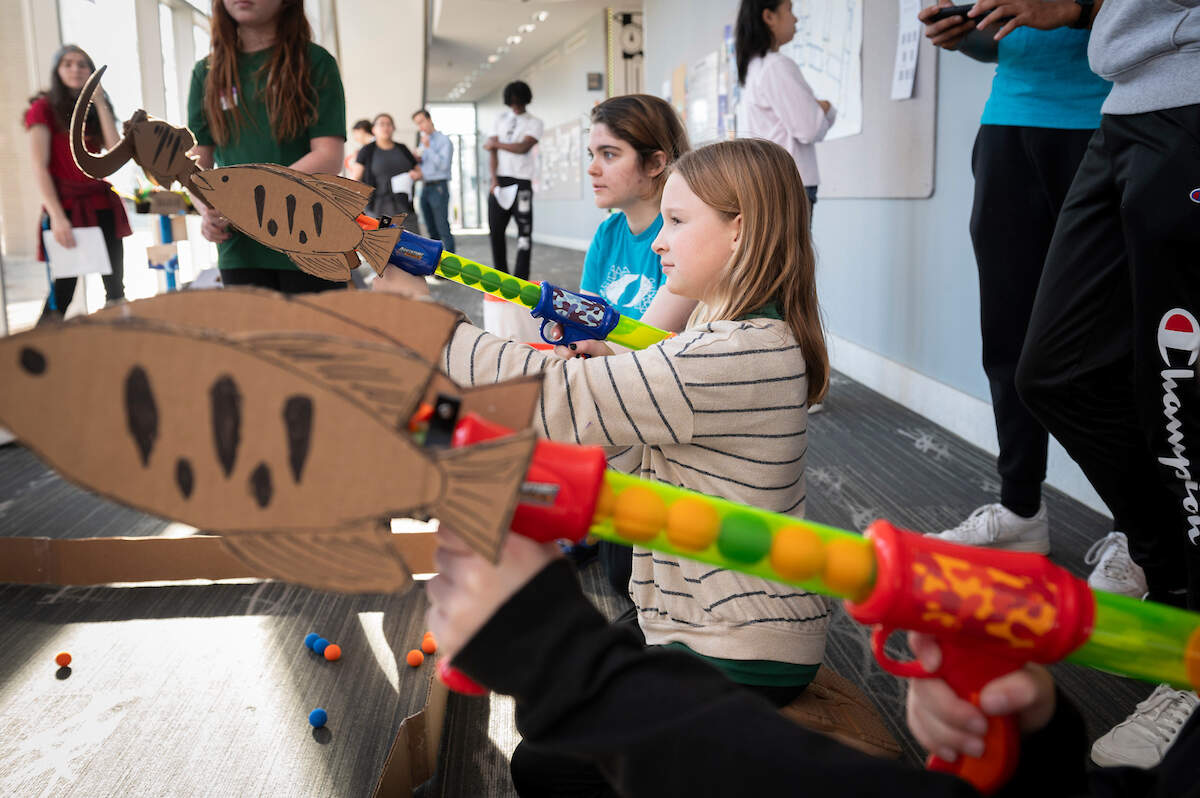
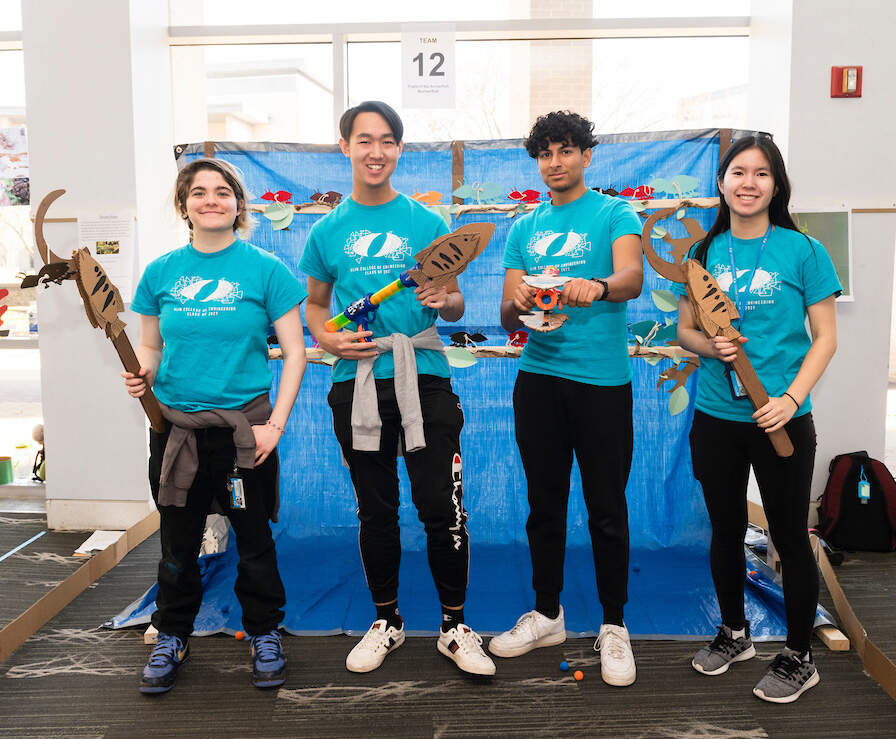
Students in the Design Nature class at Olin College, an engineering school just west of Boston, showcase their end of term projects to some special visitors — 10-year-olds from a local elementary school.
In the class, engineering students study nature by taking long walks in the woods surrounding campus and turning their bio-inspired ideas into functional toy prototypes of animals. The focus is on the general principles and methods that shape the practice of engineering design. The toy animals perform some sort of task: a mechanized camel that spits water at balloons, a boxing kangaroo, a crab trying to build a nest to protect her babies, among other creations.
The youngsters, 10 and 11-year-olds, are on hand to act as toy testers. They clutch clipboards as they crowd around each activity prepared to grade the toys in several different categories. Over at the pelican toy testing zone, students stand on a taped line and try to get as many projectiles into the pelican's mouth as possible.
What does this “toy story” have to do with engineering? At Olin, engineering classes incorporate foundational math and science principles, as well as design concepts and ethics—and no small dose of fun. All these components are needed to solve complex engineering problems.
Founded just twenty-five years ago, Olin College of Engineering has made a name for itself in the world of undergraduate engineering education. It is currently ranked No. 2 Undergraduate Engineering Program by US News & World Report. Olin was the first undergraduate engineering school in the United States to achieve gender parity with a student population of 50 percent women and 50 percent men. In just over two decades it is now known around the world for its innovative curriculum. In a recent study, “The global state of the art in engineering education,” Olin was named one of the world’s most highly regarded undergraduate engineering programs.
Olin has no departments and no tenure, a structure which supports the creation of innovation.
The curriculum at Olin College is centered around providing students with real-world experiences. Students complete dozens of projects over their four years, preparing them well for the workforce of today — and tomorrow. And the world needs more engineers. US labor statistics suggest the country will need six million more engineers to graduate, to fully meet the demand for their critical skill set.
Olin has succeeded in making engineering education more accessible for women. Now, in pursuit of its vision, Engineering for Everyone, Olin is also working to make an engineering education more accessible to underrepresented students of color.
The college is also building on its project-based, human-focused model of education, by more fully integrating ethics into engineering courses such as ‘Blending Ethics and Engineering in “AI and Society.
An emphasis on ethics isn’t surprising given that Olin’s most visible alumna is Facebook whistleblower Frances Haugen. In her new book “The Power of One,” Haugen writes about her experience at Olin as a place that “believed integrating the humanities into its engineering curriculum was essential because it wanted its alumni to understand not just whether a solution could be built, but whether it should be built.”
Learn more about Olin’s unique approach to engineering education at olin.edu.