Support WBUR
Paid for by The Boston Foundation
Mass. Migration: domestic departures exceed arrivals in the commonwealth
This post was paid for and produced by our sponsor, The Boston Foundation, in collaboration with WBUR’s Business Partnerships team. WBUR’s editorial teams are independent of business teams and were not involved in the production of this post. For more information about The Boston Foundation, click here.
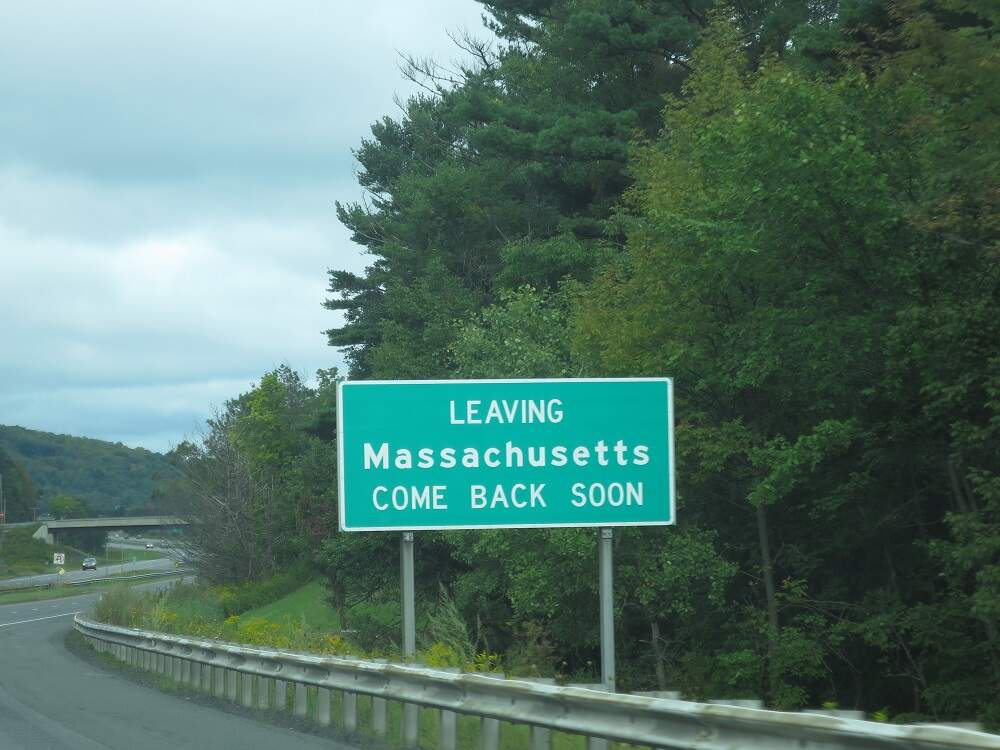
The Commonwealth of Massachusetts’s overall population growth over the past few decades has masked a concerning trend: the accelerating outmigration of longstanding residents to other parts of the country.
If not for growth from international migration, according to a recent Boston Indicators brief, Massachusetts would have been losing population for years. Recently, domestic outmigration outpaced international in-migration and the overall population of the state shrank in 2021 and 2022.
When population declines, everyone loses:
Political power: In 2012 redistricting, Massachusetts lost a U.S. House district.
Economic power: Fewer businesses and workers lead to tax revenue shortfalls that threaten Massachusetts’ safety net and other services.
Identity: Those who leave take with them ideas and cultural contributions that might have found a home here.
Birth, Death and Movement
Populations can grow through births outpacing deaths and migration. Births have been slowing in Massachusetts for years; as of 2022 the state averaged about 1.43 births per woman, one of the lowest state rates in a country also seeing declining birth rates. Meanwhile, deaths have increased, trending closer to a natural decrease. That makes migration especially important – both international (im)migration of people moving from abroad to settle in Massachusetts and domestic migration, people relocating within the U.S.
Who Stays, Who Goes?
Net migration measures people coming to the state minus those leaving. But it can be helpful to put those numbers in context.
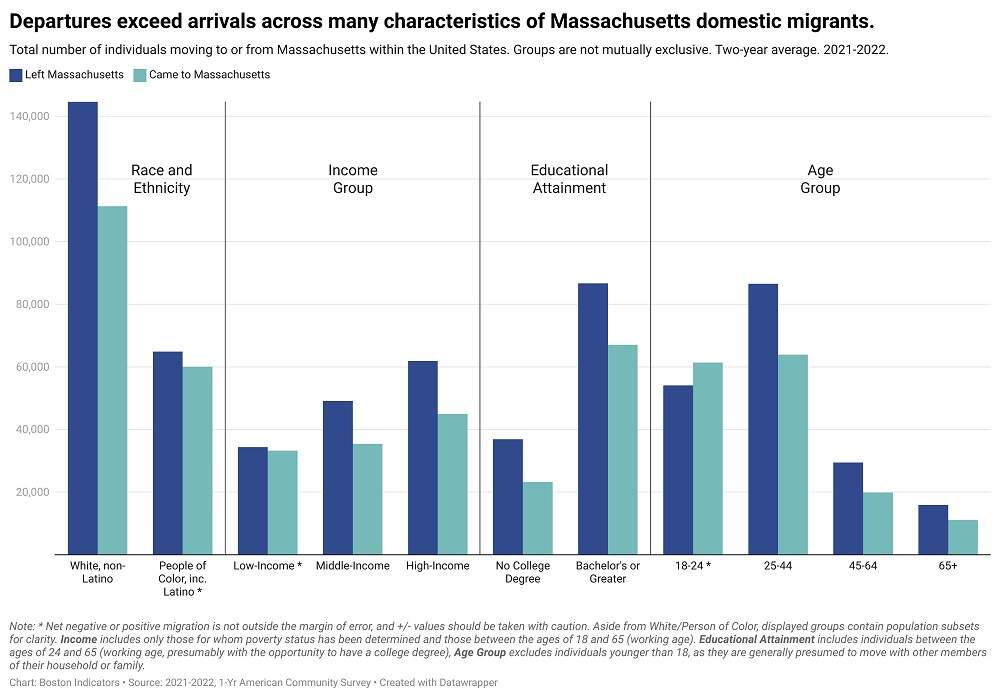
Across almost every grouping – race and ethnicity, income, educational attainment and age – more individuals made the decision to leave than come. Perhaps most worrisome, the state is losing young adults, with higher numbers of 25–44-year-olds leaving than any other age group. By 2022 the net loss of this group makes up about three-fifths of the total losses by age group.
Because the groups measured are large it is important to be careful about ascribing any single reason for group trends, as each data point represents an individual making unique decisions. Still, looking at data by income and age offers clues.
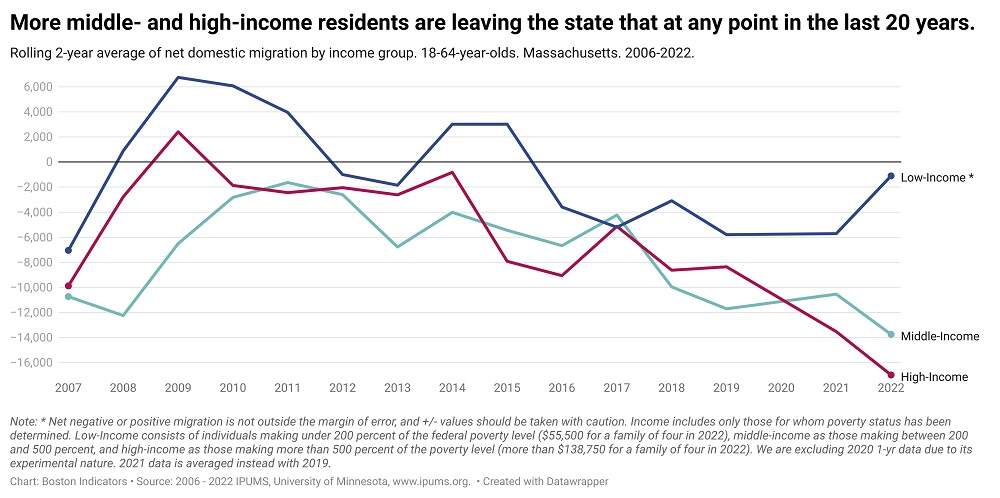
Across the board, a familiar push-factor may be at work: Housing costs have skyrocketed since 2018, with typical home prices increasing 20 percent in 2021 and 33 percent in 2022 [footnote below].
A recent housing cost analysis from the Center for Housing Data at the Massachusetts Housing Partnership finds that newly constructed housing statewide may be out of reach for many middle- and even high-income earners. Greater Boston’s extraordinarily low vacancy rates mean there is simply insufficient housing at any price point.
Then why aren’t lower-income residents leaving in comparable numbers? Unlike many other states, Massachusetts has a robust safety net and meaningful spending on low-income housing. For low-income individuals who would have to spend valuable time and resources to seek new housing out-of-state, moving may not make sense.
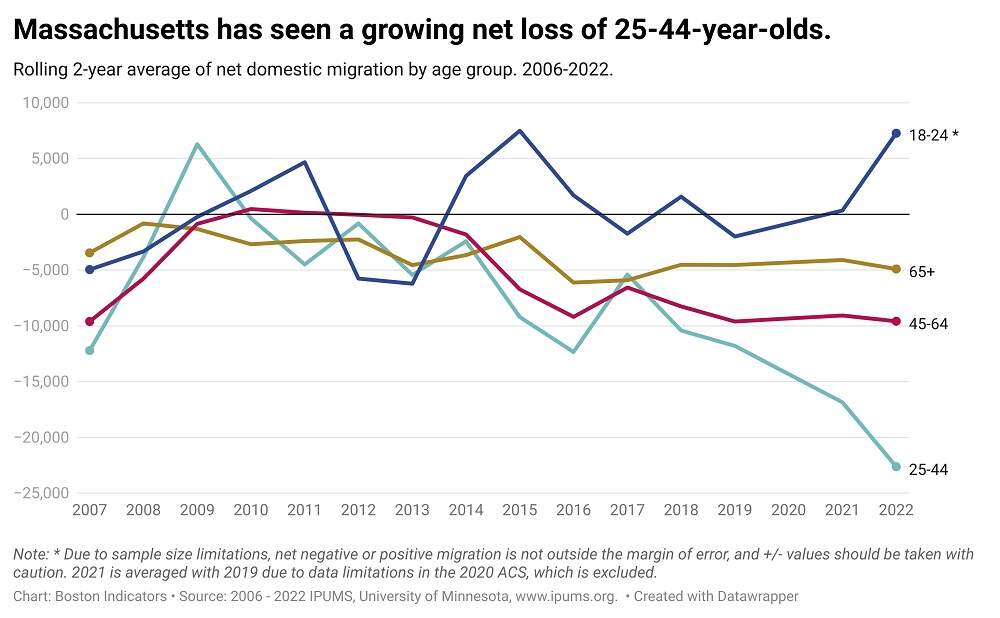
Age & life stage certainly drive trends too. The youngest group measured includes many students. Whether from the commonwealth going to college elsewhere or vice-versa, the undergraduate population is predictably in flux.
By contrast, 25–44-year-olds cover a wide spectrum of experiences. They may be recent graduates, young professionals or folks looking to start a family or buy a home. Housing costs are undoubtedly part of their decision-making. The availability of lower-cost housing elsewhere alongside expanded remote work opportunities may be drawing away Massachusetts residents in the prime of their career and family-building years.
Losses of older populations are low and stable. With a 70 percent homeownership rate in 2022, their housing situations may encourage them to stay put. Even so, Massachusetts is losing thousands from these groups.
The departure of talent, creativity and capital leaves those who stay with less political representation, diminished services and reduced vibrancy. If Massachusetts wants to improve its value proposition, it must tackle the issues that are driving people away.
About the Boston Foundation
Boston Indicators is the research arm of the Boston Foundation and produced the brief this article is based on. Research that illuminates issues and informs public policy is a core element of TBF’s civic work, along with catalyzing important conversations and facilitating coalitions that strengthen communities and drive positive change. TBF partners with community members, donors, government, businesses, and nonprofits to advance economic justice, build a more equitable future, and repair the harms of historical inequities. The Annual Campaign for Civic Leadership supports all this work.
[footnote] 1: Zillow Home Value Index, January to January prices. Seasonally adjusted.