Support WBUR
Cog's Weekly Newsletter
In celebration of the cold-water curious
Editor's Note: This essay appeared in Cognoscenti's newsletter of ideas and opinions, delivered weekly on Sundays. To become a subscriber, sign up here.
When Libby DeLana first saw videos of people in giant tubs full of water and ice, she couldn't imagine why on earth anyone would ever do such a thing. In fact, she couldn’t imagine anything more uncomfortable. Yet a quiet part of her also wondered: “Could I do it?”
I have a personal stake in Libby’s reflection about cold water dipping this week, because I, too, was curious about the cold.
Dipping (or plunging or polar-bearing, whatever you want to call it) seems to be everywhere these days. It was the premise of a New York Times photo essay, the subject of a New Yorker documentary and a NPR Life Kit episode.
But for Libby — and for me — dipping is more than a health fad, it's a way to be in the world. (And I write this fully understanding how dramatic it sounds. Bear with me.)
Years ago, Libby met “Iceman” Wim Hof, the Dane who is widely regarded as the godfather of the mainstream cold exposure movement. She didn’t start dipping at the time, but she was intrigued by the idea and tucked it away. Libby began her practice in the early days of the pandemic, just as she was also navigating some tectonic changes in her personal life: a marriage unraveling, career uncertainty and a newly empty nest. The things she most identified with were shifting.
I crave getting into the water for the dopamine rush, yes, but also for the profoundly vulnerable experience I’ve found it to be, between me and nature, and me and my friend.
I started a little bit later. I got interested in the idea after reading Katherine May’s book, “Wintering.” It was early March 2022, and I’d ceased being able to feel anything — good or bad. It was a disconcerting sensation, the result of two years of COVID and isolation and brutal news cycles. May wrote about cold water with such reverence that I decided to try it with two friends. We went to Walden Pond, stripped down to our bathing suits and waded into frigid waters. One friend decided immediately that it wasn’t for her. The other friend and I kept at it. Now we go at least once a week, sometimes twice.
Here’s what I can tell you: It doesn’t get any easier. Sliding into 37 degree water is uncomfortable; no matter how many times you do it, it hurts. Two years ago, I would’ve been awfully sheepish about having my picture taken in a bathing suit. Now, I allowed it to happen without thinking twice — for work, of all things.
I crave getting into the water for the dopamine rush, yes, but also for the profoundly vulnerable experience I’ve found it to be, between me and nature, and me and my friend. We are, quite literally, baring it all to the world, as we offer grace to ourselves and each other. With every exposure, I’ve learned to tolerate the discomfort a little bit better, and that has had implications on all sorts of things in other areas of my life.
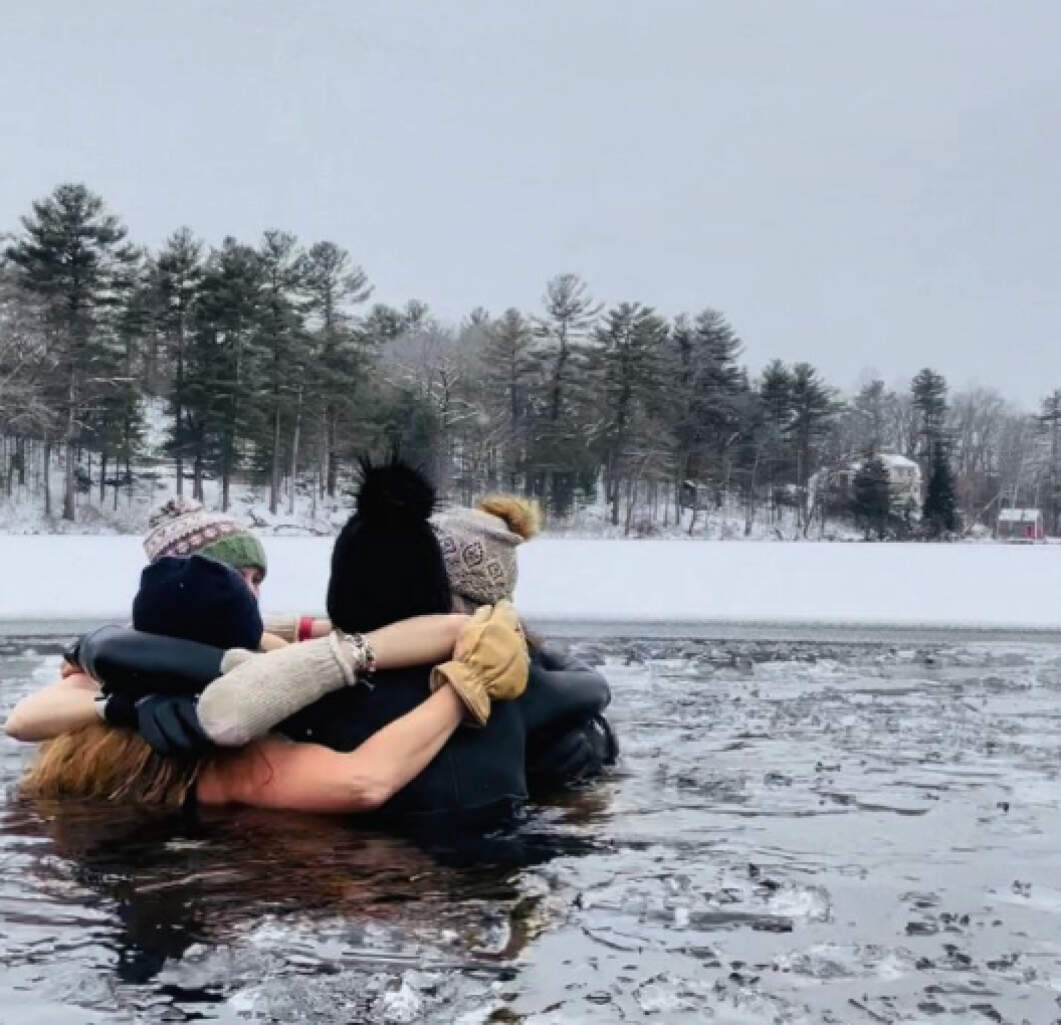
Libby gets in five to six times a week, and she almost always dips with a group of women — sometimes two, sometimes 50. She says she doesn’t know where she’d be without them. “We laugh. We yelp. We can hardly believe that we’re hacking through the ice,” she writes. For Libby, the physical act of getting in the water, alongside with the community of people she’s discovered, has helped remind her what she’s capable of.
If you’re cold-water curious, now’s the time. Come on in, before the water gets too warm.