Support WBUR
Cog’s Weekly Newsletter
Why I wear my grandfather's old key tag
When my maternal grandfather, Gilbert Frank Schneider, died in 1996, my mother returned to her hometown of Spokane, Washington, to go through his things.
There were few physical mementos among all his papers and photos, but she was able to find a keepsake for each of his four grandchildren. She found a framed watercolor of a mountain lion that he painted and gave it to my brother Tom. My grandfather was an avid hunter and fisherman, so she gave my brother Jim his beloved wicker fishing creel. And then she found two keys, each with their own brass tag attached. One read “IUSM 911,” the other “IUSM 898.”
It took her a little while, but my mom eventually figured out that the tags were the keys to my grandfather’s lockers when he attended Indiana University School of Medicine. And so, my incredibly creative mother took those key tags and turned them into jewelry for my sister and me. She had the backsides of the tags engraved with our initials and strung them on 20-inch-long chains. The pendant she made was very special to me, but I didn’t wear it that often — I’m not really a jewelry person.
All that changed a decade later.
I was in the early stages of my eighth pregnancy, after suffering five miscarriages. While I already had two children, it felt like there was someone missing from our dinner table. We desperately wanted a bigger family.
In addition to being worried about my high-risk pregnancy, I was concerned about one of my brothers, who was having open heart surgery that same week, as well as a dear friend whose husband had suddenly died of a previously undiagnosed heart problem. The night before my first ultrasound, I went to bed very anxious, with hearts and heartbeats on my mind.
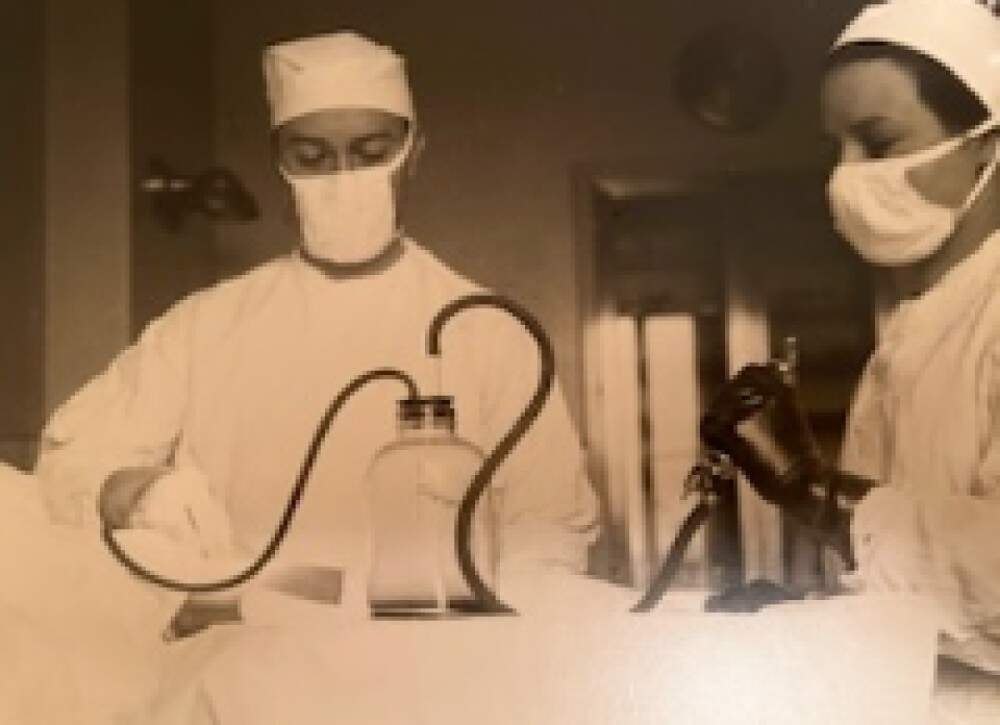
My grandfather and I had not been particularly close when he was alive. I was an Army brat, and we moved more than a dozen times during my childhood, so we were often physically very distant from him and my grandmother. My mother had not had an easy childhood, so there was an emotional distance, too. I can count my memories of my grandfather on one hand. But the night before that important doctor’s appointment, he came to me in a dream. Everything I had forgotten about him came back to me in vivid detail. His silver hair. His eyes, so blue they made you cold. His James Earl Jones-like bass-baritone voice. He was a cardio-thoracic surgeon, a heart expert.
“Katie,” he said. “Everything is going to be OK.”
I’m not a person who has ever given much thought to dreams. And if you had asked me if I “believed” in them before that night, I probably would have said no. But I woke up the next morning feeling so certain. I was positively reassured — convinced even — that I was going to have another child, that it would be a boy, and that we would name him Gilbert. I wore my “IUSM 911” necklace to the appointment the next morning and I’ve rarely taken it off since. I’m wearing it as I type this.
A priest at a church I used to attend liked to remind the congregation that our beloved material belongings would someday end up at a garage sale. And he was right. A lot of them will. But as Anne Gardner reminded us in an essay this week, some artifacts — like her dad’s 70-year-old telephone directory and my grandfather’s locker keys — are special. Some artifacts are a bridge that helps us connect to another time, another place, another person. We need to treat them with the same reverence their original owners did.
I didn’t know my grandfather all that well when he was alive. But this necklace I wear brought me closer to him after he died. It starts conversations about him, it reminds my mom and me where we come from, and it grounds my 18-year-old son — my Gilbert — in his own personal mythology. I’ll wear it forever.