Support WBUR
Commentary
The way forward runs through the places we call home
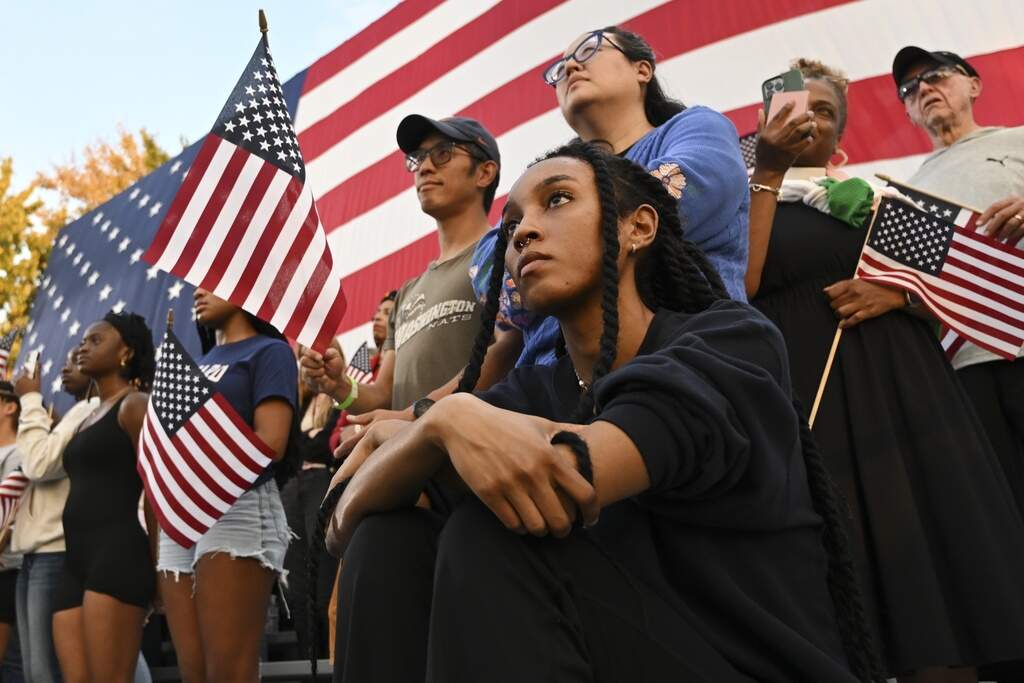
For the last year or more, our fixation has been the future of the presidency; in particular, the question of whether Americans might actually re-elect Donald Trump, an accused racist and fascist who associates with white supremacists (his former advisors’ words, not just mine), and who tried to stage a violent coup when he lost his 2020 bid for re-election. Now, we know how a majority of Americans feel, and we know what’s about to happen. With President-elect Trump having secured a mandate, our priority for the near future must be protecting each other, recognizing who’s most vulnerable among us, and finding strength through community.
This is the antithesis of what Trump and his wealthy enablers like Elon Musk stand for. Their vision for America is a top-down inversion of society wherein rights and freedoms are granted to an untouchable class of overlords, and stolen from women, racial minorities and immigrants. So for the next four years or more, our guiding vision must be built upon three essential things: direct action, mutual aid and, as Rep. Ayanna Pressley (D-Mass.) once put it, centering the experiences of people who are “closest to the pain” as we work for a better world.
It’s a very good thing that Massachusetts voters gave Diana DiZoglio, the state auditor, the power to shine much-needed light on our opaque, unresponsive and unproductive legislature, by voting “yes” on Ballot Question 1— which asked voters to decide whether the auditor should be able to investigate our legislative branch. If we are to have any hope of protecting the commonwealth from the most destructive and extractive policies unleashed by the Trump-Vance administration, we’ll need state leadership that’s accountable to the public, capable of meeting the dire moment in which we find ourselves. If state House and Senate leadership resist DiZoglio’s audits, then all of us who voted for the audits should be prepared to push back.
We can’t allow despair or grief to siphon away our energy, because we’re going to have to do a lot of local organizing and lobbying during these next four years. By January, each of us should have our state senator and representative’s office numbers in our phone contacts lists, because we will be calling and hounding them regularly. We will be urging them to use every lever of state power to save lives—because those are the stakes now. According to Trump's stated plans, immigrants, including asylum seekers, will be targeted for deportation. Women and LGBTQ+ people stand to lose access to essential health care services. And Trump will undoubtedly try to take away what little resources poor people and homeless people currently have.
Should our leaders prove themselves incapable of doing this job, we must primary and replace them. This is no small order in a state with some of the least competitive elections in America, but that’s part of the job we now share at the local level.
Local policies which bolster the rights and lives of the state's residents are not something that we can expect to just happen, or to retain. Consider House Speaker Mike Johnson’s (R-La.) recent slip about Republicans committing to destroy the Affordable Care Act, in the event of a Trump victory. We can get ready for this now, by engaging with our state leaders and demanding a plan for what happens if people who have pre-existing conditions are suddenly stripped of their health coverage. This demand can be voiced in public meetings and town halls, and in the streets if necessary, through emergency demonstrations in places where our lawmakers operate.
Just as Americans mobilized at airports in 2017 when the Trump-Pence administration barred Muslim travelers from entering the U.S., we must be prepared to bring back this mobilization at other venues, such as detention centers or police stations — in the event that Trump makes good on his cruel promise to carry out “the largest deportation in American history”— or at health care institutions in the event of a much-feared federal ban on abortions and other reproductive health services.
We can’t allow despair or grief to siphon away our energy, because we’re going to have to do a lot of local organizing and lobbying during these next four years.
Even our workplaces are slated to become battlegrounds, as Trump and his allies plan to launch an assault on labor laws that give us the power to organize for better pay and working conditions. The good news is that there’s something you can do which requires zero time spent persuading politicians; you can join a union or attempt to unionize your colleagues. The labor movement, which has shrunk massively since the Reagan era, has made promising gains in recent years. Unions will be a crucial bulwark against Trump and the plutocrat class, and it’s time that more of us joined one. (Even as a freelancer—for now—I’m exploring how I might do this.)
It might seem counterintuitive, to devote more focus to our local leaders and surroundings as the horizon burns. But localized political action yields the most visible changes in our day-to-day lives, for better or worse. Using our voices and our bodies to help shield Massachusetts residents from the worst of Trump, Vance and company will prevent deaths. It will also force us to reckon with some of the most chronic and neglected vulnerabilities of Massachusetts, like our affordable housing shortage, which undermines our conception of the state as this liberal bubble in an increasingly red tide. If people cannot afford to live here, we will lose them to that tide, as we’ve already witnessed in recent years with the population of the Greater Boston area shrinking. The families being priced out are more than likely jettisoned to red states where the consequences of Trump will be even worse.
But as I see it, the most essential reason for adopting a more localized engagement with politics, against the backdrop of American fascism, is that it requires us to spend more time with each other. It necessitates a kind of social cross-pollination which has been declining in recent years, to the detriment of our health and happiness. This can take many forms. It might be checking in on a neighbor with a health problem, contributing to community aid networks or abortion funds, or simply carving out more time each week to talk with family or friends —resisting the atomizing lure of social media, Netflix, and the other accessories of these lonesome, frightening times. By spending more time together, helping each other find our way through the darkness, we will raise our odds of holding onto a vision for a better world than the one Trump has to offer; a vision that you can persuade people to fight for, as the scorched earth reality of Trump’s policies kicks in.
This is the road forward, and it runs though the places we call home, through ourselves and through each other. If there had to be a seismic catalyst for this, I wish it hadn’t been the re-election of Donald Trump. But it’s the fire we must now walk through, arm in arm.
Follow Cognoscenti on Facebook and Instagram. And sign up for our weekly newsletter.