Support WBUR
Commentary
You never get this time back
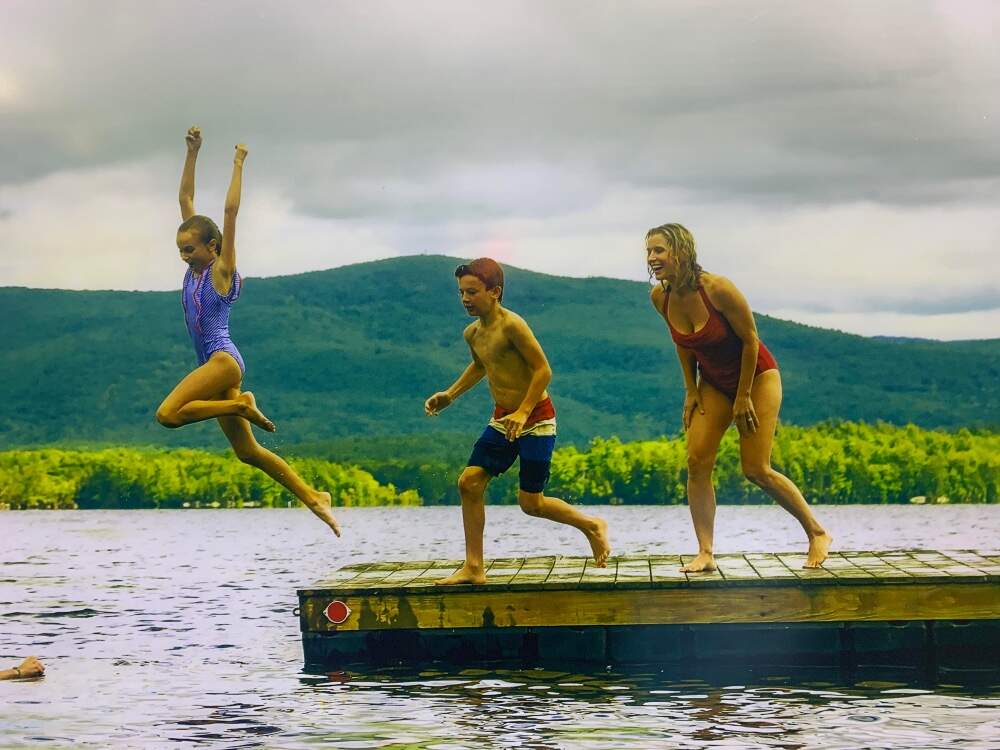
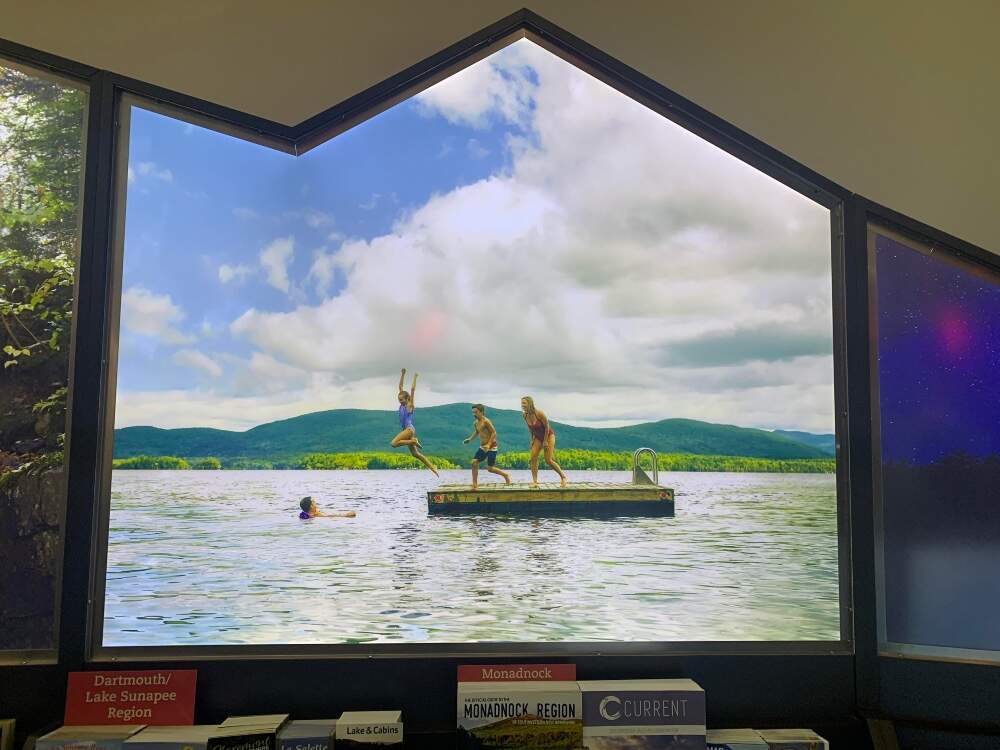
When my son was 8, he was in a New Hampshire Tourism campaign. We spent an October day at a shoot at Squam Lake, where he jumped into the water over and over, warming up in a hot tub between takes. The campaign ran everywhere, and a photo of him launching from a Squam Lake dock still graces the digital photo billboard at the welcome center in Hooksett, New Hampshire. It’s like he’s frozen in time, all the innocence, energy and joy of childhood on display for every traveler who stops.
Years later, my son has graduated from professional lake jumper to competitive freestyle skier, and our time together looks more like this: On a typical Sunday at 7 a.m. in central Vermont, we pull into the mountain parking lot. The snow crunches under the tires as we creep through a sea of coaches, competitors and parents making their way to the lodge. Today’s temps are expected to reach 30 by noon, when my 16-year-old son’s division will be competing. From the passenger seat, he snaps a new lens into goggles and presses play on his iPhone. A jarringly explicit rap song commences at full volume through my car speakers. I sip my coffee and take a deep breath. This is how we both prepare for the day.
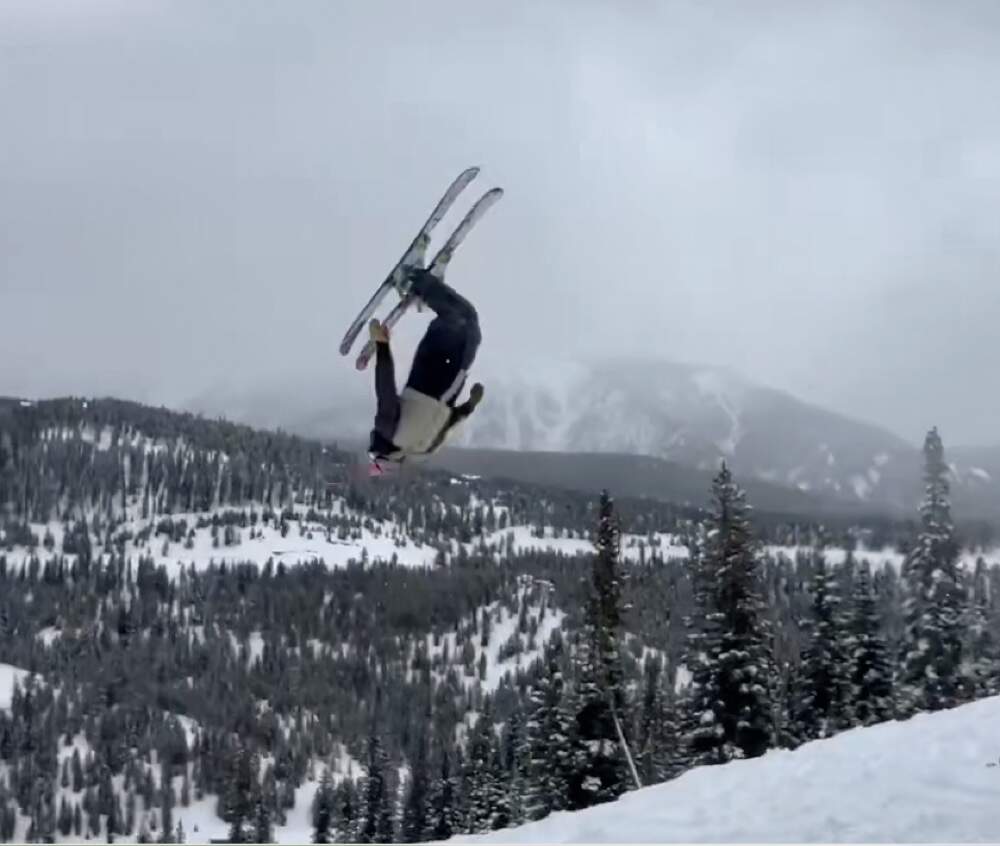
Freestyling skiing, or freeski, is judged on a combination of complementary factors—line, technique, control and style—over natural, ungroomed terrain. The best competitors have great skill, but the ones who consistently place have a fearless passion for skiing, showcased in one harmonious package of grace, athleticism and energy. As a parent, it is beautiful and terrifying to watch.
When my son first began competitive freestyle skiing, I imagined I’d be spending a lot of time skiing. Instead, I spend most of my time driving between mountains—largely in silence—or standing on a black diamond trail in single digit temps silently hoping everyone else’s kid isn’t as good. To feel reduced, seemingly overnight, to nothing more than a ride and an ATM is a particularly cold wake-up call, and in the first few weeks I resented my son’s immunity to my instructions: get out of bed early, eat a healthy breakfast, double check your equipment, put your phone down. During those long drives, I drifted between anger and deep melancholy for the days when he needed me for everything, when his innocence and wonder at the world were fully intact.
Somewhere along I-89, my son snoring in the backseat, I would tear up as I remembered his chirping toddler voice singing nursery rhymes and his tiny eyes lighting up at pancakes and picture books. Today I’m lucky to get a mumbled “good” or “OK” at any question, any meal, as opposed to an “I dunno” or the standard eye roll. Nothing prepares you for the silence of teenagers. I’d rolled my own eyes at older parents who’d said, “It goes by so fast. You never get that time back.”
Every day he becomes more his own person, no matter how hard I fight it and pretend not to.
One weekend I booked an AirBnB close to the mountain for one night. As the Jeep devoured the miles in the frozen darkness, the stark landscape was like another planet—nothing for miles except snow and gray road. My son looked up from his phone. “Where are we?”
“Almost there,” I said, wondering what on earth I would do if we ran out of gas or punctured a tire. I was still the captain of this ship. “Check the map.”
When we finally arrived, the house was better than expected: warm and well appointed. My son’s bedroom was in a loft. A gargantuan flat-screen TV hung over the fireplace. “This place is lit!” he exclaimed, and my heart leapt; I’d done something right. Moments later, however, I was texting the owner trying to work the TV, staring flummoxed at the remote with a bag of Reese’s Pieces in my hand. My son peered down from his loft.
“You look like a toddler, standing there in your pajamas in front of the TV with a bag of candy.”
I looked up and laughed. There it was—proof we could still share a moment.
We get smarter with every competition. Register early to get a better start number. Pack our own food. Study the mountain map the night before. Take a run before inspection to loosen muscles and nerves. Bring my laptop to catch up on work and bills in the long hours before that one minute and forty seconds.
Every time we approach a mountain, I am in awe of how it suddenly rises from the winding access road. You round a bend and the thing appears, like a white, hairy-backed beast cresting from the horizon. We take it in, knowing he will be flying down it in a few hours. His fearlessness still confounds me, his love for speed as foreign to me as another language. He never seems nervous, and I know he got this from his father, not me. Or maybe it is his alone. Every day he becomes more his own person, no matter how hard I fight it and pretend not to.
We find his coach and team in the lodge, and I drift into the background. And this is perhaps the hardest parenting lesson of all: it’s not about me. I’ve been trying to learn that since the day he was born.
My son affixes his number to his helmet and dumps his registration packet on my lap. “Can you put this in the car?” I don’t nag him to say please and thank you in front of his team and coach. I don’t ask, again, if he has his helmet, his back protector. I take his stuff, put it in my bag, and sit down to wait.
On the way home, though, we stop in Hooksett. There he is on the wall, his 8-year-old body running for the lake, his childlike joy—totally lit. Sometimes I pull into the rest station even if we don’t need to stop. I like knowing that no matter what happens on the mountain, on the way there or on the way home, whatever is said or isn’t, his 8-year-old self will be here waiting. At least for now. Back at the car, I toss him a freshly purchased bag of Cheez-Its, his favorite. Because you never get this time back.
Follow Cog on Facebook and Instagram. And sign up for our weekly newsletter.