Support WBUR
Commentary
Dartmouth's connection to the Trump brand of right-wing populism
Donald Trump famously boasted in 2016, before he’d even won the Republican nomination for president, that he could stand in the middle of Fifth Avenue and shoot someone and not lose voters. He has proven it metaphorically every day since. And particularly since Inauguration Day 2025, machine-gunning the norms of governance while retaining resilient (if cracking) support. Critics scratch their heads, or tear their hair, asking a question that will obsess historians: How did we get here?
Does the right-wing populist hold on American politics trace back to that famous descent down the Trump Tower escalator in 2015? Is it even older, its rage visible in the culture wars-obsessed campaign of Pat Buchanan in 1992?
In a recent interview with his New York Times colleague, conservative pundit David Brooks spies a more ancient nativity, in 1986, involving a forgotten event in tiny Hanover, N.H. He’s right. I know, as I witnessed that prophetic episode.
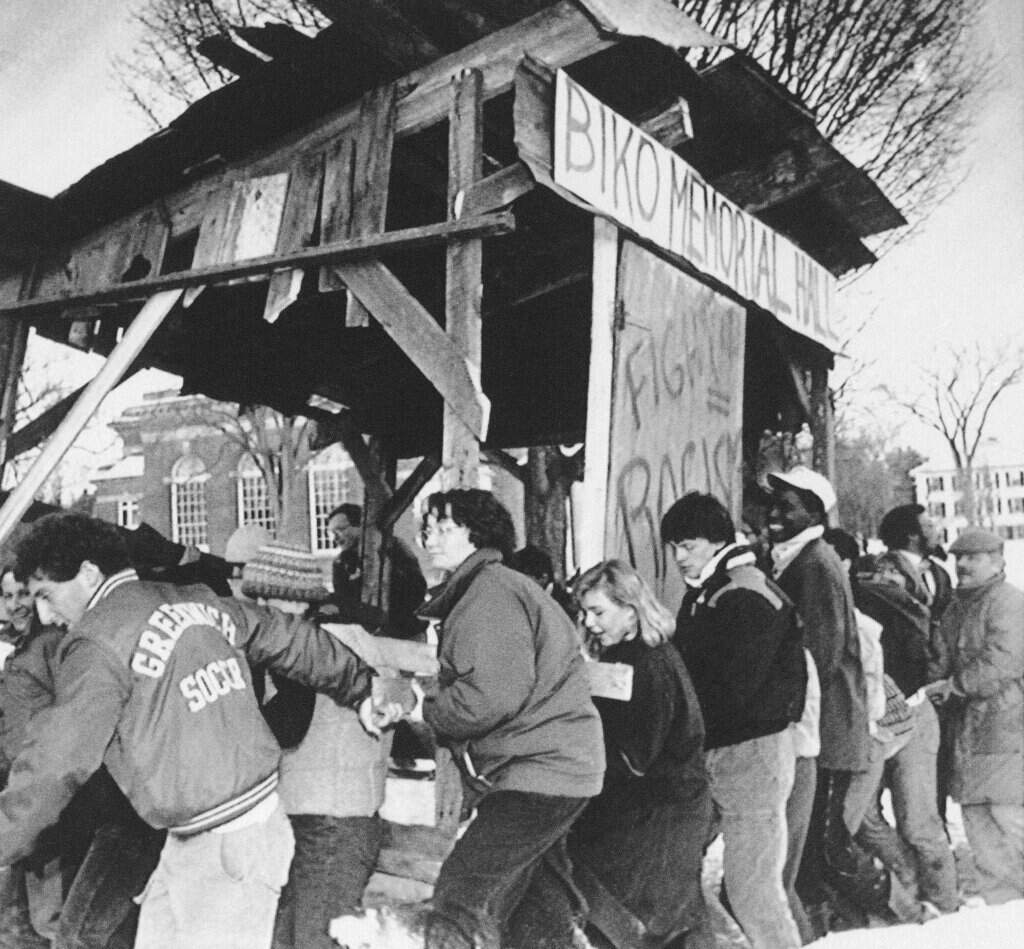
Student activists at Dartmouth, my alma mater, squatted for four months in shanties on the college quad to protest apartheid in South Africa. Student journalists from the conservative Dartmouth Review, appalled by what they called administrators’ coddling of lefty agitators, "beautified" the Green by sledgehammering the shanties under cover of dark. The destruction triggered a takeover of the main administration building by 175 outraged students, national media coverage and suspensions of the hammer-wielders, later commuted to probations.
As a 26-year-old reporter for the local newspaper, the Valley News, I was frantically covering the tidal wave of news, oblivious to the fact that we were observing the birth of “faux populism” (Brooks’ apt term) that would one day upend 21st-century politics. The actions of the Review student journalists so preoccupied my thoughts that, approaching apartheid protesters for an interview, I absent-mindedly identified myself as being from that publication. (I corrected the slip before enraged students stormed my apartment.)
Witnessing those events taught me lessons for keeping sane amid today’s firehose of insanity from Washington. Before sharing them, I should explain Brooks' bullseye in tracing MAGA to the Review.
The mindset. Brooks in 1986 was a youthful scribe for William F. Buckley’s National Review. Brooks says he was struck by the difference between his teacup-with-pinky-raised conservatism and the Review’s other-worldly conservatives. “We read Adam Smith and Edmund Burke,” Brooks recalls. “The [Dartmouth Reviewers] were like, ‘Let’s take on the left.’” Their 21st-century descendants call it “owning the libs.”
The tactics. At 3 a.m., a dirty dozen squad of mostly Review students drove a flatbed to the green and shattered three shanties. Two women students, sleeping in one as security, fled “in their long underwear, terrified,” the Washington Post reported.
The demolition hardly constituted violence akin to MAGA’s Jan. 6 insurrection. Even so, Brooks says, “I remember thinking that’s appalling. First, apartheid really is terrible. We [conservatives] should not be defending it. But also, coming in with sledgehammers, that’s more Gestapo than Edmund Burke.”
Famous foot soldiers of 21st-century populism. Laura Ingraham and Dinesh D’Souza, who helped found the Review, graduated before the shanties incident in 1986. But as undergraduates, they pioneered the professional provocation they would embrace as Trump supporters. Ingraham, the Fox News host and author, for example, had written one of the Dartmouth Review’s critiques of a Black music professor that the Review deemed incompetent. He sued for libel. He dropped the suit but, after multiple clashes with the paper, ultimately decamped from Dartmouth.

Ingraham would go on to informally advise Trump in his first term. D’Souza became a bestselling-author, filmmaker and Trump-pardoned felon. (He was convicted of making illegal campaign contributions in 2014; Trump pardoned him in 2018.)
The Ivy League's most traditional, conservative campus was an ideal incubator for the Review, especially because its student journalists were mentored by English professor Jeffrey Hart, a friend of Buckley's and a long-time National Review editor and writer. I was an undergrad at Dartmouth when the Review launched and knew some of its founders, including Ben Hart, Professor Hart's son.
Brooks’ observations remind me that confronting campus liberalism was but part of their goal. They also craved attention as an abuser craves his substance. “Owning the libs” is a resentment-releasing attention-getter, not Socratic political philosophy. Too many at Dartmouth proved ineducable about the wisdom of ignoring these kids except when, as with the shanties, their antics trespassed into actionable wrongdoing
With that in mind, I suggest two guardrails to stay sane amid Trump II’s insanity.
First: Thou shalt reserve outrage for crimes against humanity rather than mere stupidity. I’m wary of authoritarianism and weary of hysteria over every idiot utterance out of 1600 Pennsylvania Avenue. Tariffs, ill-advised federal layoffs, tampering with Social Security over microscopic fraud? Boneheaded. But America has survived blunders. It’s something else to pardon Jan. 6’s violent rioters, thereby encouraging future anti-democratic criminality. That endangers the country that my almost-20 son will inherit. And mass deportations (should they become more than logistically farcical) would shred the nation’s morals.
Granted, one person’s stupidity is another’s atrocity. Serious analysts fear a recession from Trumponomics. I was unemployed for much of the Great Recession under President George W. Bush, so I know a downturn’s financial and emotional havoc. But I never feared Bush, who didn’t aspire to autocracy.
I alluded to my second guardrail: Thou shalt not freak out over Trump’s impossible dreams, only the evil that he might realistically pull off. I couldn’t panic with my progressive friends over the risible rescission-by-fiat of birthright citizenship; it was only a matter of time before a judge (one appointed by that famous wokester Ronald Reagan) blocked it as “blatantly unconstitutional."
It’s one of many Trump edicts stalled in courts. If the president swings the sledgehammer of defiance against judicial rulings, then we, like those 1980s apartheid opponents, must man the ramparts. We’ve seen already this from angry constituents at recent town halls, heeding Ben Rhodes, a former Obama aide, who writes that with Trump’s toxic proposals to cut Medicaid and veterans’ services, opponents have the foundation for a protest movement.
Sign up for Cog's weekly newsletter, sent on Sundays. We share stories that remind you we're all part of something bigger.