Support WBUR
Commentary
‘Making your way in the world today’: Watching ‘Cheers’, saying farewell to Norm
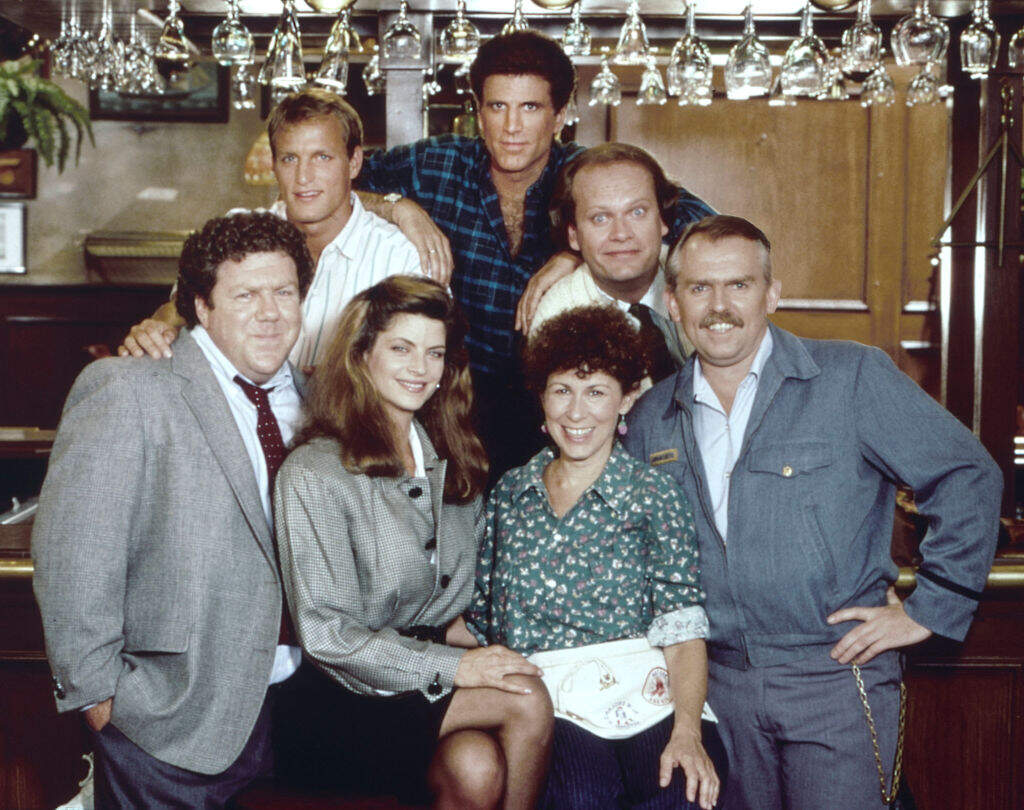
Night after night, for the past five months my husband and I have made the mutual, sometimes verbal, sometimes unspoken decision to turn back the clock 40 years.
Another episode of “Cheers? He’ll ask, placing two pieces of bread into our toaster oven.
Sure, I’ll reply, filling up the water pitcher.
Sometimes we listen to the opening song; mostly we don’t. It’s too familiar. Too addictively sweet, like eating honey straight from the jar.
My husband and I both work in education. He is an associate professor of journalism at Northeastern University. I teach literature at Emerson and MassArt. This semester, every Tuesday and Friday he taught a class in media ethics to 27 undergraduates. Following the news was his job, and when he came home, it was the last thing he wanted to talk about. While I would want to share my outrage about the latest student to be rounded up by ICE, or about another assault on healthcare or the arts or education — he needed to put it all away.
What he craved, and what I realized I also needed, was an escape. The kind that’s only possible when a minor problem can be resolved within a 30-minute block, just enough time for us to relax, eat our dinner and return to the endless work of grading and prepping for the next day’s lectures. After all, "making your way in the world today takes everything you got."
“Cheers” is the only show Jeff and I have been able to count on to get through these last five months. I think it’s because the world of that show, created by brothers Glen and Les Charles, and the great James Burroughs was so fully realized — NBC catching lighting in a bottle with its combination of good writing, impeccable casting and stellar acting, all performed before a live studio audience. By its fourth season, it was among the most popular shows on TV and would go on to win 28 Emmys.
It takes watching only a scene or two before you're fully immersed in that world, hands on the polished brass rail of the bar, the taste of the beer cool and wet on your lips. When I first moved to Boston from Brooklyn, I would sing the “Cheers” song in my head whenever I drove by 84 Beacon Street, where the tavern sign can still be found, and pretended that this show was actually delivering me some piece of Boston realness, not realizing that all the interior scenes were shot on a Paramount Studio lot in California.
It’s strange just how alive the world of “Cheers” continues to feel given that the 11th and final season aired in 1993.
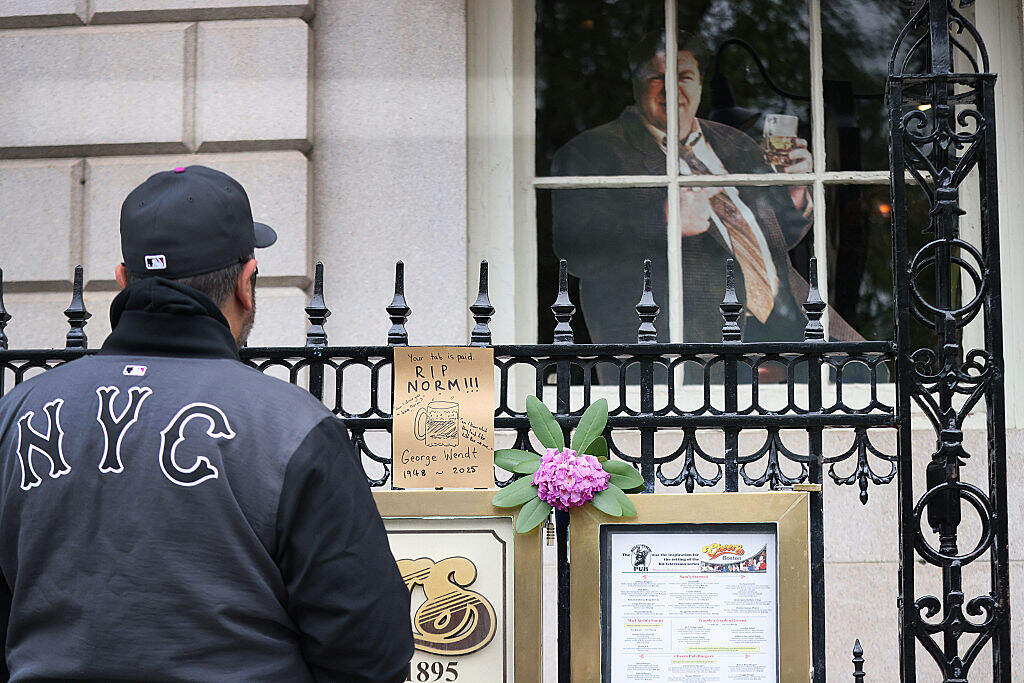
It’s strange just how alive the world of “Cheers” continues to feel given that the 11th and final season aired in 1993. And maybe that timeless vitality is why it was such a shock to learn that George Wendt, who played Norm Peterson, died on Tuesday, at age 76 — 32 years to the date that the final episode of “Cheers” aired on television. In my mind he’s the most regular of regulars. If “Cheers” is comfort food, he is the grilled cheese.
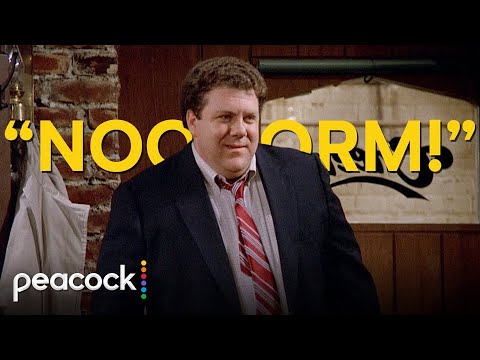
I wouldn’t say Norm is my favorite “Cheers” character. That would have to be Ernie Pantusso, aka Coach, a character I’ve only come to appreciate for his comic timing on this second marathon viewing. (Much as we love Woody Harelson, Jeff and I dreaded season four when Nicholas Colasanto, the actor who played Coach, left because of his worsening heart disease.) But Norm was clearly the favorite among “Cheers” patrons. Where Cliff was dorky and boring, a mansplainer before that word was invented, Norm radiated an unlikely charm. He drank but never got drunk. He was unhappy in his job and in his marriage but never lost his sense of humor. He was the only character whose entrance provoked the whole bar to call out his name in unison: Norm! Which would in turn prompt one of Norm’s many beer related jokes:
"What would you say to a nice beer, Normie?"
"Going Down?"
Or:
"What'll you have, Normie?"
"Well, I'm in a gambling mood, Sammy. I'll take a glass of whatever comes out of that tap."
"Looks like beer, Norm."
"Call me Mister Lucky."
Such jokes, good as they are, could never be broadcast on network TV in 2025. Alcoholism isn’t considered funny these days. Many other “Cheers” bits also scream 20th Century. It’s unfathomable to our Gen Z daughter, for example, that owner Sam carries on an affair with one of his waitresses, Diane, and then, after they break up, makes jokes about her appearance and their sex life in front of patrons and staff.
And yet “Cheers” continues to have this staying power. I’m not the only one who’s been revisiting the series during the dark days of Trump 2.0. Why? Maybe because “Cheers” delivers the platonic ideal of the “third place,” sociologist Ray Oldenberg’s term for a location that is neither home nor work, but somewhere equally important precisely because it exists outside these other, occasionally oppressive sites.
It can be a bar, a cafe, a sports team or club. You regularly go there, not because you have to, but because you want to. It’s a place where you return because the people you see are people you want to see. More importantly, they want to see you too. Such people can over time become a chosen family, which the “Cheers” gang so clearly becomes for each other. And while “Cheers” is in no way a truly diverse show — queer people and Black people must be patronizing other bars in Boston — socio-economically the characters are radically different. Norm and Cliff are the classic friendship across class lines, white collar and blue collar together, an accountant and a mere postman. (This class insecurity perhaps explains why Cliff is forever trying to prove his intellect.) And class tension is of course at the heart of the otherwise mismatched Sam and Diane’s electric chemistry.
Only within the confines of the “Cheers” universe do the vulgar hoi polloi and the erudite snobs all laugh together side by side at the bar, if not friends then at least friendly, respectfully coexisting in a way they rarely did in Reagan’s America and certainly don’t in Trump’s America. With third places increasingly in decline, political tribalism has so severely fractured our society we aren’t consuming the same version of truth, or even reading the same versions of the constitution.
But in “Cheers,” for as long as the show’s in syndication, Norm Peterson will forever be walking through that tavern door, forever longing for one more beer. And as long as he does, there will always be a place for our own flawed selves, a seat with our names on it.
Follow Cog on Facebook and Instagram. And sign up for our newsletter, sent on Sundays. We share stories that remind you we're all part of something bigger.