Support WBUR
Commentary
With Paul Simon, I'm always homeward bound
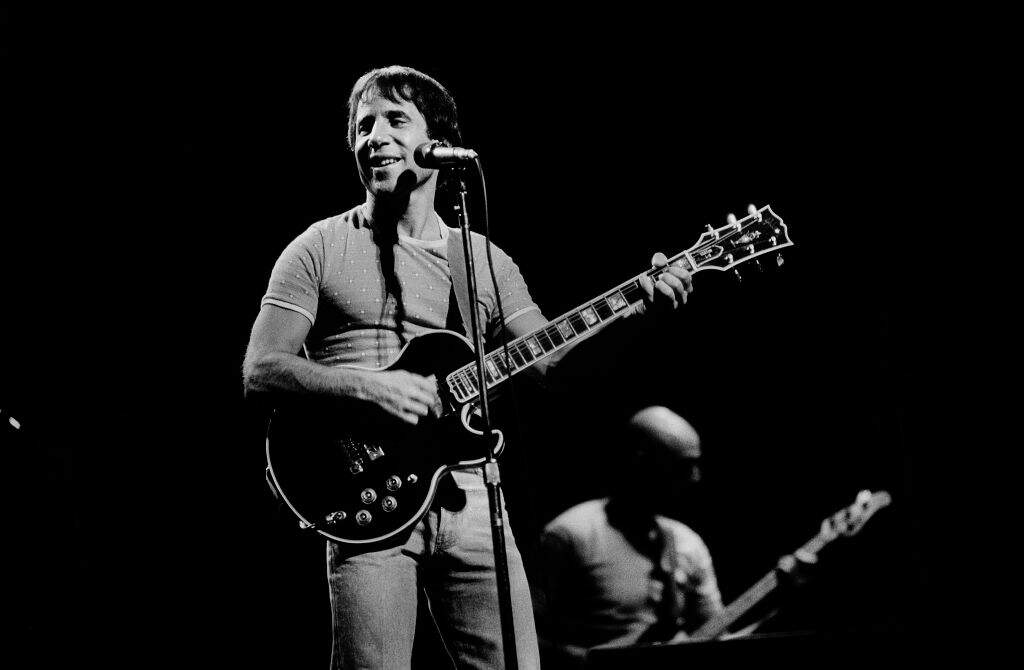
On a Friday night in June, I finally saw Paul Simon live. I’ve been a fan since I was young, and I arrived at the Wang Theater in Boston expecting to nod along, lulled by a gentle breeze of romantic nostalgia. Instead, the first chords of “Homeward Bound” hit like a gut punch. And I found myself crying uncontrollably.
As a child, Paul Simon was my first road trip companion. His melodies stitch together the blurred memories of family drives through the high mountains and dry heat of northern Mexico in the ‘90s. My brothers and I, crammed in the backseat, laughing, elbowing, crunching chips too loudly. Back then, the soundtrack was “Mrs. Robinson” — a scratched-up CD my dad played so often it stuttered, lingering on certain notes before slipping back into the “coo coo ca-choos.”
Where have you gone, Joe DiMaggio?
Our nation turns its lonely eyes to you
As a kid still learning English, I couldn’t grasp Paul’s disillusionment with conformity or his longing for a quiet kind of courage. That would come later. But I didn’t need to understand the lyrics to feel understood. The “woo woos” and “coo coos” met me right where I was — in feelings I didn’t yet know how to name in any language. I was an 8-year-old girl from Mexico, and he was a 59-year-old American singer-songwriter, but none of that mattered. In my mind, he got me.

During my teenage years, “Homeward Bound” sounded like a promise, playing in the background of endless afternoons spent scribbling poems in my bedroom. At home in Monterrey, the view outside my balcony was like a new watercolor painting every evening, with the sculpted ridges of the Sierra Madre and sunsets painting the sky purple, pink and orange.
Outside, expectations felt prescribed, gendered and narrow — like a script I was meant to love and recite without questions or notes. Inside my home, my parents encouraged me to write, imagine and travel. I was convinced I’d been born in the wrong place and the wrong decade, that leaving was the only way to be free. My mother still half-jokingly blames my father for my eventual departure. After all, he passed down his taste in music and planted the idea that there might be a place beyond the mountains big enough to hold my dreams. But it was she who bought me new notebooks every season and urged me to write and rewrite my way into becoming.
Today, I find myself living the story my teenage self began drafting in Monterrey. My instinct to question and reshape the rules led me to a career as a human rights advocate. I’ve left and returned to Mexico enough times to wonder whether there was ever really that much pressure to conform, or if I was just listening to too much protest music from the ’60s. Now, at 33 and recently married, freedom feels like harmony, and choosing to stay.
That’s why I expected “Homeward Bound” to feel like a full-circle moment. But after all these years, the live version of my coming-of-age anthem sounded more solemn, a little lonelier. It wasn’t just the song that had changed. I had, too.
This time I heard it as someone settling into a kind of becoming that feels more permanent than adolescence. I’m no longer a student or a traveler chasing adventure. I’m an immigrant, making a life in the restless, drifting America that Paul Simon wrote about. And even in its most privileged version, like mine, immigration is a lonely road. It’s the ache of being forever homeward bound — the lifelong grief of carrying the versions of me who never left.
We belong in the homes we miss, and the ones we’re building as we go.
Sometimes, I catch myself longing for the selves that never became, whose complexities I willfully ignore. The one who could fully appreciate the warmth of home: the smell of chiles poblanos, the rain on desert ground, the sound of her parents chatting downstairs. The one who doesn’t carry so much guilt or shame — for nearly losing her work authorization to bureaucratic delays or missing her brother’s wedding while waiting for a travel permit. Someone who moves through the world without translating her jokes, her history, her thoughts. Someone who simply belongs.
But my grief is proof that I am not rootless, even if my roots are far away. They’re buried in the rhythm of my ever-changing accent, in the subtle change in registers when I switch languages. Grief, too, is a form of belonging. It’s a messy corner of the heart filled with plot holes, but one I can still share.
That night at the concert, with streets and headlines humming with hate and protest, the words that cut the deepest didn’t come from an old classic, but from “My Professional Opinion,” one of Paul’s new songs. On stage, he sang:
So all rise to the occasion
Or all sink into despair
As America stumbles through its own becoming — uncertain, fractured, stuck — it might do well to learn from the very people it’s so eager to reject.
The immigrant experience is defined by the quiet courage of reconciling where we come from with whom we hope to become. We know what it means to exist between memory and motion — to feel unrecognizable to our past selves, fending off the constant signals that insist we’re out of place. For us, belonging isn’t just a feeling. It’s how we rise to the occasion. It’s an act of resistance.
We belong in the homes we miss, and the ones we’re building as we go. We belong in the losses that root us, and the stories we carry. We belong in the different versions of the songs we’ve loved, and the people we’ve sung them with.
By the end of the concert, I belonged in “The Boxer,” singing “la la la” with 3,600 strangers, while my husband held my hand.
Becoming can feel like one lonely road trip. Thank God, I’ve still got Paul Simon along for the ride.
Follow Cog on Facebook and Instagram. And sign up for our newsletter, sent on Sundays. We share stories that remind you we're all part of something bigger.