Support WBUR
Essay
How Addie, the blue heeler rescue, made me part of her pack
We’ve all seen that romantic-comedy meet cute: Tail wagging, the dog bounds toward the woman. She stoops down, and the dog steals a lick on her cheek. She gently pushes away the wet nose and stands up to find herself face to face with the handsome owner.
My life isn’t a rom-com, and it’s not how it happened for me. But I did fall in love with my future husband’s dog, before choosing to be with him.
Parker and I had our first date at a speakeasy-themed bar, on the second floor of a quaint old Iowa City building — one of those places the over 30-somethings flock to in a university town. By the time I ordered my third old fashioned, I had learned a little about Parker, and a lot about Addie, his blue heeler (otherwise known as an Australian cattle dog).
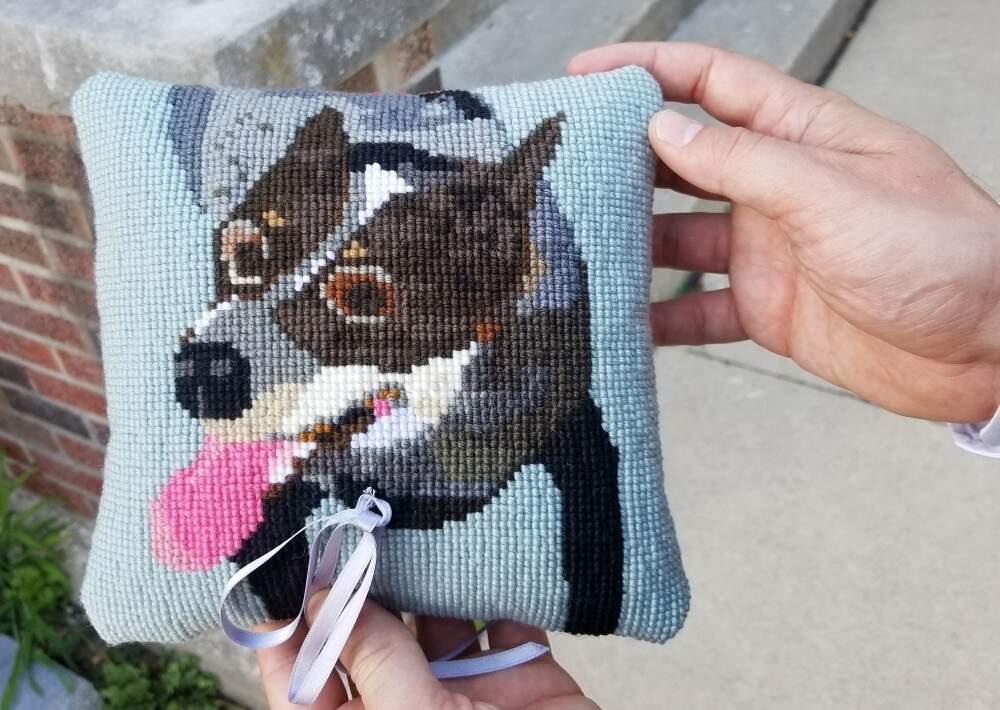
Addie was a rescue dog. A couple years earlier, she had landed in an animal clinic with a broken leg, possibly after being hit by a car. The woman who fostered her called her Adelaide—Addie—after the place from whence the pup’s ancestors hailed. Cara, a veterinary technician, determined her approximate age — around 1 year — and decided her birthday should be February 14. Then she called her friend Parker, whose living situation could be summed up as itinerant bachelorhood with the stability of a day job. This left the door open for a four-legged friend, she reasoned.
I met Addie three weeks after I met Parker, when he invited me to his house. Around the time Addie came into my life, I had started working on what would become my debut novel. It was not my first novel, if you count the ones in the proverbial drawer, and I had no idea if it would be any good, or sell to a publisher, or find an audience. If my previous attempts were any indication of future outcomes, it would not do any of those things. At the time, my relationship with my novel was similar to my relationship with Parker: uncertain.
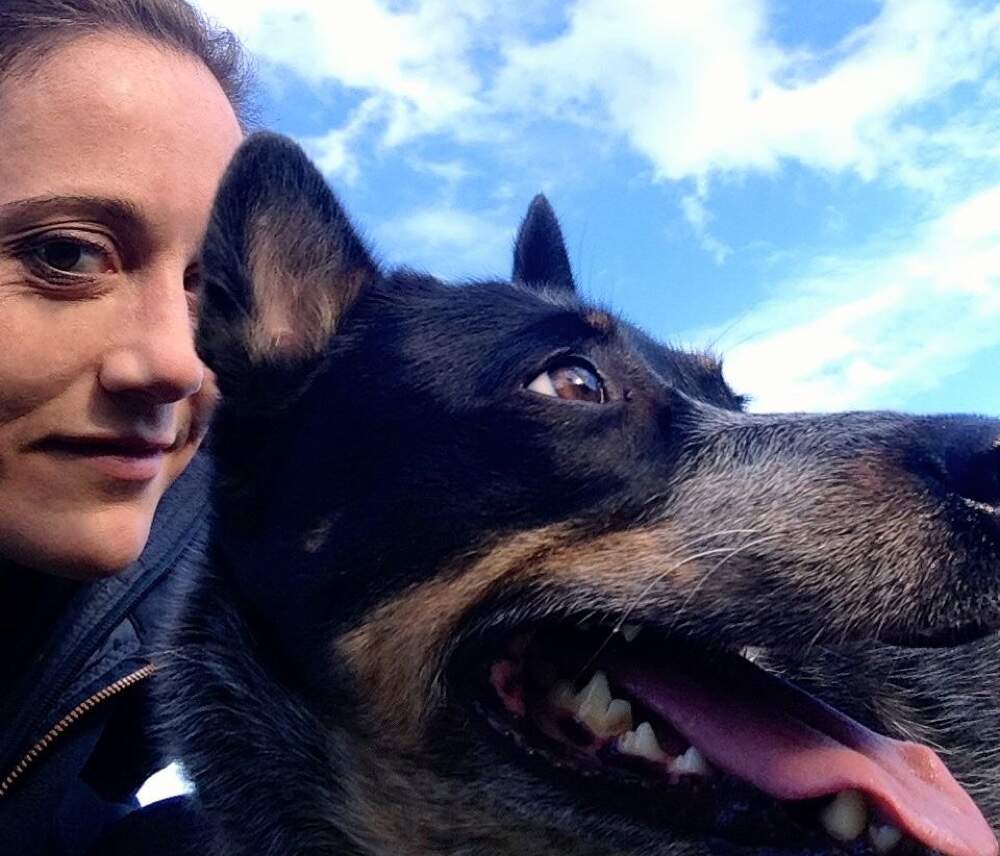
Parker’s house was only four blocks from my own, and I started picking Addie up on my daily run. She was young and spry with energy to burn. I was also spry back then. On a typical day I ran about six miles, bounding with Addie along a trail by the river and uphill through a neighborhood with the nicest houses in town. Often, we’d stop mid-run to take a selfie and send it to Parker. He hadn’t asked me to take Addie out on my own, and I didn’t know what he thought about what we did together in his absence. I just knew I liked running with Addie.
A few months after we met, Parker invited me to a back-patio gathering of his friends and coworkers—people who had known him (and Addie) longer than I had. I laughed awkwardly along with their inside jokes and shared grievances. Then I helped myself to another drink. Without their shared history — with Parker, with each other — I saw no future. I couldn’t manifest a published novel, and I couldn’t imagine a romantic relationship lasting forever. While nobody said or did anything to make me feel this way, I felt like a temp worker, imminently replaceable.
Addie, however, never left my side. When I went into the house to use the bathroom, she waited by the back door until I returned. The host, who had just adopted a puppy with her partner, looked at me and said, “That’s what I want — I want us to be a pack.” I looked at Parker, who was having a conversation across the patio, and then down at Addie. I felt my heart catch a little bit. Were we a pack?
Blue heelers are classified as working dogs because they are bred to herd livestock, and Addie’s head is abnormally hard, lest she gets kicked by a cow. Pressing my soft head to her hard head had the power to alter my mood. It took the sting out of rejection; it softened the edge of my anxiety. I thought about how Addie nips at ankles when people get up to leave the house. While she naps on the end of the couch, she yelps and her paws move, as if she’s in mid-chase. If she couldn’t live on a farm, the next best thing must have been those six-mile runs. Day in and day out, I sweated, and she panted. We climbed hills. We labored for breath. We found our way home. If that was being a pack, maybe I could sign on for it.
I felt my heart catch a little bit. Were we a pack?
Still, my most significant crisis of uncertainty hit me just days before I moved into Parker’s house. A new bed was being delivered during the workday, so I agreed to be there. The delivery guys maneuvered the king-sized mattress through the narrow corridors of Parker’s 100-year-old house, grumbling about the difficulty of it. Though they’d seen these old stairways before, there were several tense moments when they debated if it was even possible to get the enormous thing into the bedroom. The mattress had to be folded in half and taped, then released once inside. It was never coming back out. When they left, I sat down on the bare mattress and realized I wasn’t getting out either.
I’d never lived with a romantic partner before. I’d never not had a place to escape when I wanted to be alone, or a place to recover when a relationship didn’t work out. I was 34, and, not unlike those manuscripts that never saw the light of day, none of my past relationships had “worked out.” Regardless of any hopes I’d started with or effort I’d put in along the way, fate and agency had always run their course. I wondered, how can I be sure? About this. About my writing. About anything. I thought, What have I done?
Then Addie jumped up next to me, sniffed around, circled, and lay down at the foot of the bed with her head between her paws, as if it had been hers forever. As if I had been hers forever. I understood. Through all that uncertainty, I had always been a writer, just as we had always belonged there, together. Then she lifted her head and wagged her tail as if to say: Let’s go. There's work to do.
Years later, I would visit Parker’s office and find that he had printed and displayed one of those pictures I sent him early on, a selfie of Addie and I out on a run. They both knew then what I was only beginning to understand — that I was already part of the pack.
Follow Cog on Facebook and Instagram. And sign up for our newsletter, sent on Sundays. We share stories that remind you we're all part of something bigger.