Support WBUR
Essay
The gerrymander wars are only just beginning
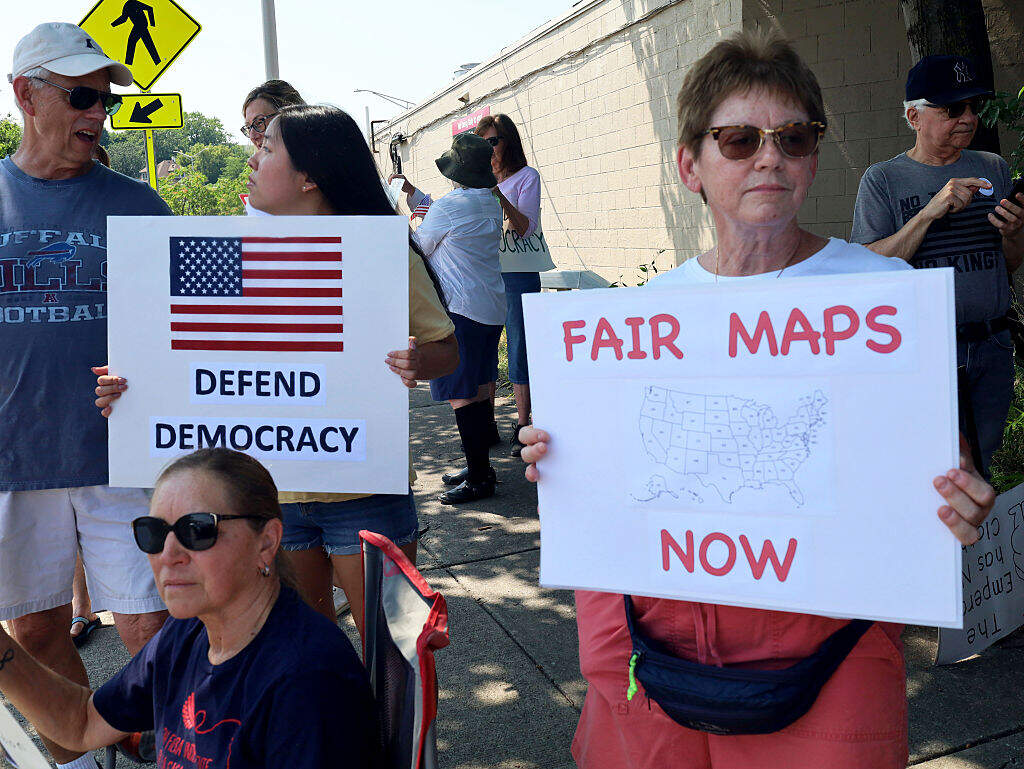
Some 250 years after the first shots were fired in the American Revolution, Massachusetts was among President Trump’s first targets when he launched this year’s gerrymandering wars. In July, Trump asked Texas Republicans to redraw that state’s congressional maps — five years ahead of schedule — to create five more reliably Republican districts, and potentially help the president’s party retain control of the U.S. House in the 2026 midterm elections.
But on August 5, Trump blamed the origin of the partisan war on states with heavy Democratic majorities. “They did it to us,” he claimed, “the blue states … Somebody gave a good example. In Massachusetts, I got, I think, 41% of the vote, a very blue state, and yet [Democrats] got 100% of Congress … (I)t shouldn’t be that way.”
In fact, the president received 36.5% of the 2024 vote in Massachusetts. His assertion that Massachusetts gerrymandered its way to a 100% Democratic congressional delegation only serves to stoke his base or reinforce the president’s preferred political narrative, but it is not supported by the facts. He may have won 36.5% of the votes cast, but he certainly didn’t win areas of the state that contain 36% of our population. According to an analysis by the New York Times, “he won areas containing only about 15% of the state’s population.”
We are now on the precipice of a pitched political battle. Texas will move forward with its plan. In response, California, led by Democrat Gov. Gavin Newsom, will hold a special election in November to decide whether or not that state can redraw its congressional districts (to be more favorable to Democrats). “They fired the first shot, Texas. We wouldn’t be here had Texas not done what they just did,” Newsom said. Prominent Democrats, including former President Barack Obama, have endorsed Newsom’s efforts as a responsible response to Trump’s move to undermine American democracy. Other states may follow suit.

Commentators have been quick to throw the U.S. Supreme Court under the bus for its 2019 opinion, which declared that nothing in the Constitution prohibits partisan gerrymandering. In that case, a five-justice conservative majority said that claims of partisan gerrymandering (that time, in North Carolina) were beyond the reach of federal courts. However, the Court’s complicity began long before that.
Going back to 1962, even as the Court recognized for the first time that the judiciary had a role to play in ensuring that the apportionment process did not violate the Fourteenth Amendment’s guarantee of equal protection, it acknowledged that drawing legislative districts is a political process. Two years later, when it established the principle of "one person, one vote" as the standard for drawing state legislative and congressional districts, it did not unequivocally establish that injecting partisan considerations into the apportionment process at either the state or federal level would be constitutionally problematic.
Those cases — and their hands-off approach to political gerrymandering — opened the door for what is happening right now.
Gerrymandering has become another symptom of what Northwestern University political scientist Eli Finkel and his colleagues call “political sectarianism.” This is a condition in which politics is not focused on winning contests of ideas, but instead on “dominating the abhorrent supporters of the opposing party.”
One of the key tenets of political sectarianism is that the other side cheats. In the face of that belief, the temptation to respond in kind becomes overwhelming, and political life seems to be a race to the bottom.
California State Senator Sabrina Cervantes captured this aspect of political sectarianism in a speech during the debate over what California should do.
This is a rigged game…We are here because the federal administration and Republicans in Congress know they are losing….(I)nstead of competing fairly, they are changing the rules of the game.
It’s true that Massachusetts Gov. Elbridge Gerry first played this game. During his tenure he signed into law legislation that drew districts favoring his political party. But today the game is played all over the country, in red and blue states.

The Gerrymandering Project at Princeton University, which ranks every state in terms of the fairness of its redistricting, lists 15 states as the worst offenders. Ten of them are reliably Republican in their voting in presidential elections, including Florida, Louisiana, South Carolina and Texas.
Even before the most recent spate of redistricting in Texas, Republicans already held 25 of the state’s 38 seats in Congress. Democratic stalwarts, including Oregon and Illinois, also made the list of states that earned an “F” for being among the most gerrymandered. Their congressional delegations are as lopsided as Texas’. In Oregon, for example, five of their six members of Congress are Democrats, while in Illinois, there are 14 Democrats and five Republicans.
On the other end of the scale, the Princeton project gives 21 states “A” grades for the fairness of their congressional districting. They include solid Republican states like Alabama, Missouri and Montana, and Democratic states New York, Rhode Island and Washington.
And, sorry Mr. President, the Princeton researchers found no evidence that Massachusetts’ congressional districts were drawn to tilt the political playing field. That fact likely won’t deter him from using the Bay State as a target to justify his efforts to stack the deck for the 2026 midterm elections.
Whether or not he succeeds in that effort, the gerrymandering wars are unlikely to end with next year’s election. In the end, they seem certain to further erode public confidence in the fairness of America’s electoral processes.
Correction: An earlier version of this piece misstated Gov. Elbridge Gerry's position on what eventually became known as "gerrymandering."
Follow Cog on Facebook and Instagram. And sign up for our newsletter, sent on Sundays. We share stories that remind you we're all part of something bigger.