Support WBUR
Essay
My toddler likes to talk about death. So do I
Every now and again, my 3-year-old daughter asks me how old I am.
“Forty-three,” I say, smiling, already anticipating her next question.
“Is that old?”
I know why she asks. My daughter has come to realize that old people eventually die, and she is trying to work out how much time we have left together. I assure her that though 43 isn’t young, it’s not that old either. Satisfied, if only for the moment, she returns to her play.
I never deliberately set out to raise a daughter attuned to death. But given my professional background, it was perhaps inevitable. As a cultural anthropologist studying the end of life, I spent years teaching college classes on death and dying. About 10 years ago, when I began researching a book on medical aid in dying, I was initiated into the hidden world of people — mostly women — who live in the presence of death professionally: hospice nurses, morticians, death doulas and others. Immersed in this community, and convinced we need to talk about death more freely, I have let conversations about mortality become a natural part of my parenting — and I have never regretted it.
My daughter is growing up in a household rife with death-related imagery: a framed, black-and-white drawing of a skeleton marinating in a bathtub, gifted to me by a girlfriend; one of my own book covers depicting a skull halfway submerged in water; a coffee table book showing in intimate detail the final six months of the life of Morrie Schwartz, the Brandeis professor whose journey with ALS became the subject of the bestseller “Tuesdays with Morrie.” Starting at age two, my daughter would declare, “I want Morrie!” and fish the book from the shelf to flip through its pages, mesmerized. We read children’s books about life’s impermanence as I (intermittently) work on my own. On a recent trip to the secondhand store, she gravitated toward a T-shirt with a grinning, glittery Day of the Dead calaca riding in a car while playing the guitar. It’s become a wardrobe staple.
My daughter’s fascination with death is neither cartoonish nor gratuitous. It stems from a place of deep curiosity — a pure desire to grasp life’s shadow in ways she finds accessible.
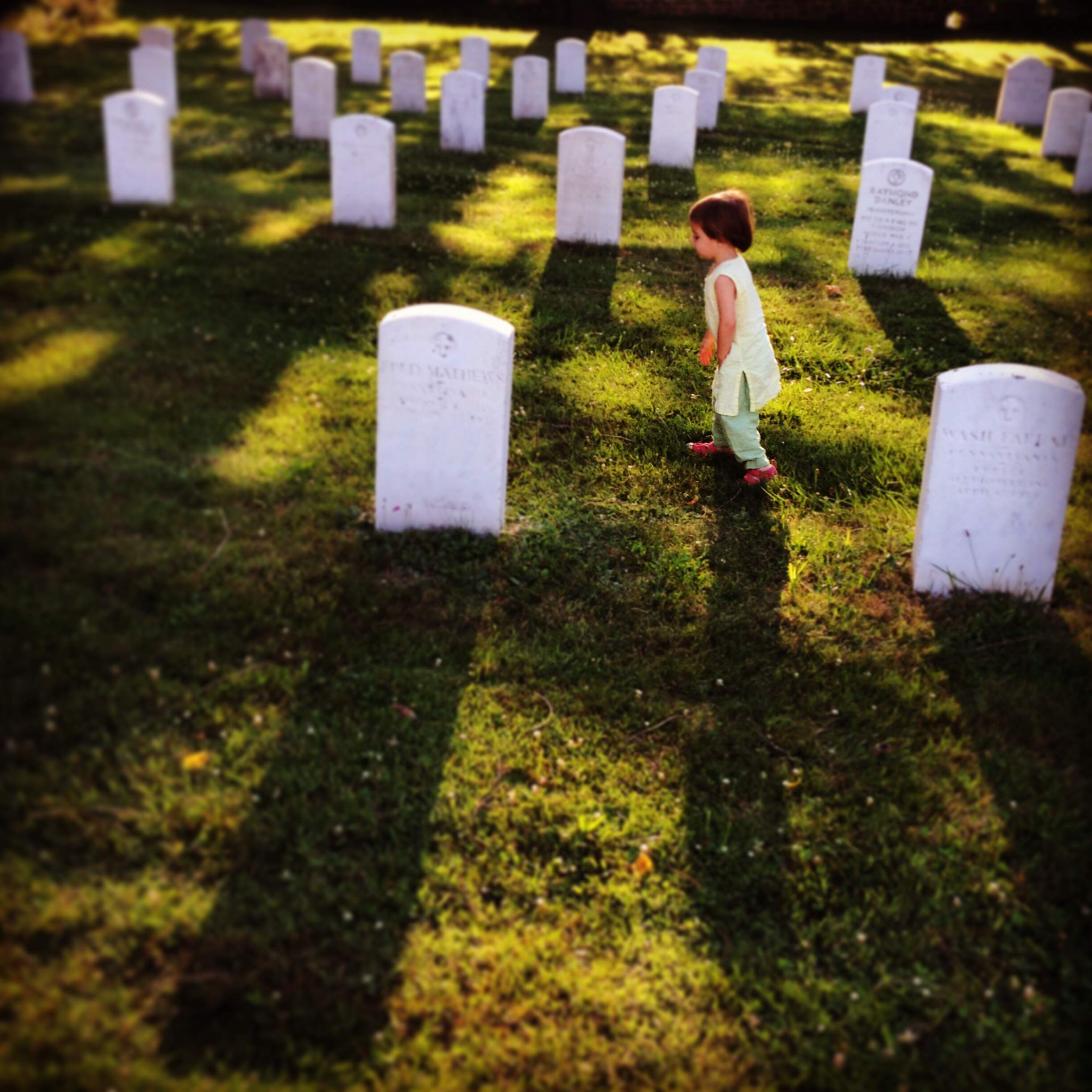
My daughter’s fascination with death is neither cartoonish nor gratuitous. It stems from a place of deep curiosity — a pure desire to grasp life’s shadow in ways she finds accessible. When we visit her great-grandparents’ graves, she enthusiastically insists I read the names and inscriptions on all the gravestones aloud, row by row. Then she plucks tiny daisies from the grass and gingerly places them on the smooth, cool markers. During these visits, she muses about all the things dead people can no longer do: they can’t talk, they can’t eat, they can’t drive. In her mind, death is an inability to engage with the world as you once did — a self frozen and undone. But within the stillness of that arrested activity she senses a loving, enduring presence; someone who welcomes flowers and visitors.
Rather than shield children from death, we should be willing to help them develop the skills and language to form their own relationship with it. Raising children with an awareness of life’s transience can normalize conversations around death and better prepare them for losses to come. After all, death orbits all our lives, and children will have to contend with it sooner or later — a bird fallen from the sky, a beloved pet that never returns from the vet, the death of a grandparent. How do we best equip children with the tools to make sense of these experiences?
For most of us today, death happens at a distance, confined to the sanitized realm of hospitals and medical systems. Families rarely tend to their own dead, as funeral professionals step in to handle human remains. This physical separation of the living from the dying process, and from death itself, has intensified a much broader cultural discomfort with our mortality.
Teaching children about death early — speaking openly and thoughtfully about it — can begin to reverse that unease. A 2023 University of Bristol report finds that proactive grief education outside a traumatic event can make children feel less anxious about death. “Although it is natural to want to protect children from upsetting truths,” write the authors, “even very young children have a concept of death and benefit from talking about it and having their questions answered.” By contrast, avoiding these conversations can leave children struggling with unresolved grief, which has been linked to depression, decreased academic performance, substance use and suicidal ideation.
As a parent and educator, I’m reminded daily of the many opportunities we have to respond to children’s curiosity. My brother-in-law recently spent a long breakfast answering my daughter’s probing questions about urns and caskets. Before he had finished his coffee, she asked to see a dead person. Undeterred, he soldiered on, pulling up images on his phone of Pope Francis lying in state. Afterward, he left me a voicemail hoping for confirmation that he had not crossed a line.
About six months ago, after my daughter and I buried a dead bee by the side of the road, she said something that caught even me off guard.
“I like graves,” she proclaimed proudly.
“Why do you like graves?” I asked, suddenly worried that her fascination was going too far.
She paced around our playground’s sandbox, hands on her hips, gathering her thoughts.
“I like graves because I like the people in the graves.”
In that moment, I realized our conversations about mortality were shaping her in ways I had not anticipated. My daughter’s touching expression of love for the departed reflects her growing compassion for all beings. Rather than morbid fixation, her interest in death is an extension of the awareness she is developing for the world around her.
And so it came as no surprise when, at Thanksgiving last year, my daughter decided to become a vegetarian. On our way to a friend’s house for dinner, I mentioned we’d be eating turkey. My daughter’s eyes grew wide — she had only known turkeys from picture books. Her eyes grew wider still when I assured her the turkey was dead. That evening, she scooted the turkey around her plate, refusing to eat any of it.
For weeks afterward, she was onto me. What else had I been keeping from her? She audited everything she ate, asking whether it was dead. Contrite, I opened our fridge and staged a lineup of all the meat products.
That settled it: she was done eating animals. Her curiosity about death had grown into an ethic of care.
