Support WBUR
Cog's Weekly Newsletter
Reading makes us human
We’re going to begin today with a few statistics about reading. And fair warning: these read like a Stephen King horror novel.
- In the last 20 years, reading for pleasure has declined by 40% in the United States.
- Today’s students will spend 25 years of their lives scrolling an electronic device.
- Human cognitive ability – as measured by various assessments – has been in a steady decline over the last 15 years.
I read all this in a near-treatise my husband sent me. The author, James Marriott, a columnist at The Times of London, makes a compelling argument that goes far beyond the vague — if accepted — idea that reading less makes us dumber. He explains that reading is much more than a hobby or pastime, it’s an activity that provides structure to our consciousness, and our very civilization. Our ability to read and write — to organize information and engage with the written word in a state of “deep attention” — is what makes humans rational beings.
Marriott is hardly the only person lamenting the arrival of a post-literate society. The idea that the machines are coming for our brains has been around for about six decades, since media theorist Marshall McLuhan suggested that electronic media – television, at the time — would usher in a “neo-tribal age.”
Neil Postman, the cultural critic who wrote “Amusing Ourselves to Death,” said in 1988 that “human intelligence was among the most fragile things in nature. It doesn’t take much to distract it, suppress it, or even annihilate it.” In a recent commencement speech, the novelist Nicole Krauss said we have “begun to lose our attachments to the meaning of words and sentences, which we once trusted to carry the precious freight of communicating who we are — to ourselves and to each other.” The journalist George Packer, writing in The Atlantic just last month, said: “Perhaps this plague of illiteracy has played a role in the disappearance of truth and, with it, liberal democracy.”
This terrifies me. I don’t want to live in a world where people don’t read. It’s a world with less imagination, less empathy, less creativity, less logic. To say nothing about the degradation of truth and the potential downfall of our democratic system!
One of my dearest delights is to aimlessly wander a bookstore. I love picking out just the right book as a gift for a friend. I love flagging the passages I connected with most, that I suspect will resonate with them too. Sharing a story with someone, chewing it over, finding meaning in it, can be such an intimate, soul-steadying act.
Someone out there gets how hard this is sometimes. She’s the person who, in every verse, whispers, you’re not alone.
I’ve gifted Kate Baer’s work more times than I can count. Cog hosted the best-selling poet at WBUR this week. She’s on a book tour, promoting her latest poetry collection, “How About Now.” Kate’s work centers on the beauty and melancholy of ordinary moments, identity, the brutal march of time. For women in middle age (ahem) it can feel as if she’s been perched on a stool in the corner of our kitchens, writing about our own lives. I experience the sense of feeling known and seen by Kate’s work as profound relief. Someone out there gets how hard this is sometimes. She’s the person who, in every verse, whispers, you’re not alone.
Some of you may know that Kate wrote her first book in a booth at Panera Bread Company; with four young kids (in a 1,200-square-foot house), there wasn’t a quiet place to work at home. She also shared her work on Instagram, where she found a community of dedicated readers. Imagine that, a community on Instagram? (And yes, it’s a paradox that the very tech platforms contributing to the decline in reading also helped a writer find her audience.) Kate’s experience reminds me of how Suleika Jauoud thinks about the relationship between writing and reading, writer and reader. How both of those solitary acts actually put us in conversation with others.
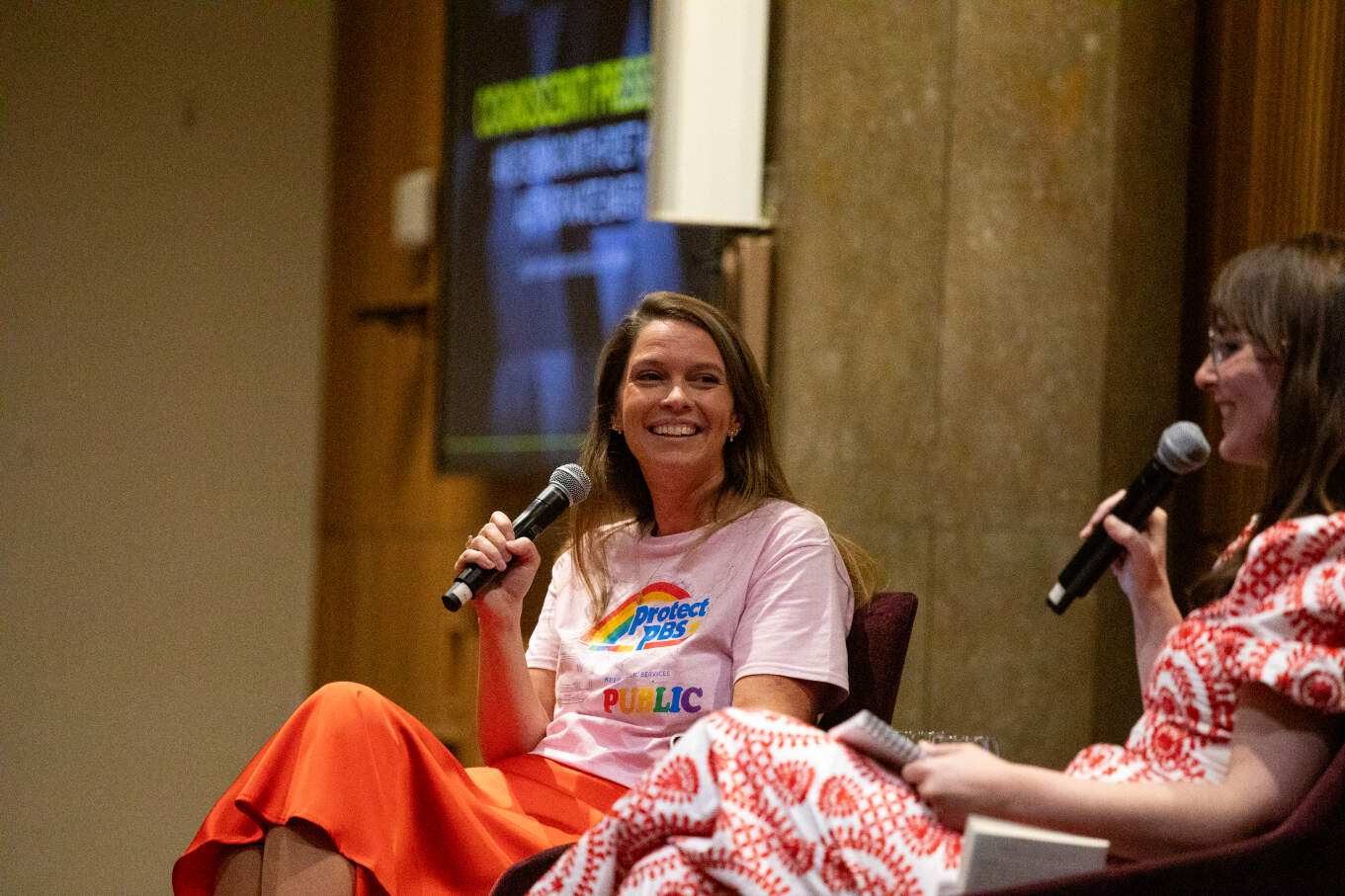
At WBUR, Kate was in conversation with Annie Hartnett, a best-selling novelist, and it was a joy to see them talk about writing and how engaging with the community around their work enriches their lives. It was also really something to witness the sold-out crowd demonstrate Taylor Swift-levels of excitement for a poet.
Here’s something else interesting: Kate and Annie had never met, in person, before this week. They first encountered each other through the written word. Annie was a fan of Kate’s work. And Kate loved Annie’s latest novel, “The Road to Tender Hearts,” so much that she invited her to share the stage. That’s reading bringing people together. Maybe there’s hope for us yet.