Support WBUR
Essay
Three seasons at Dog Mountain
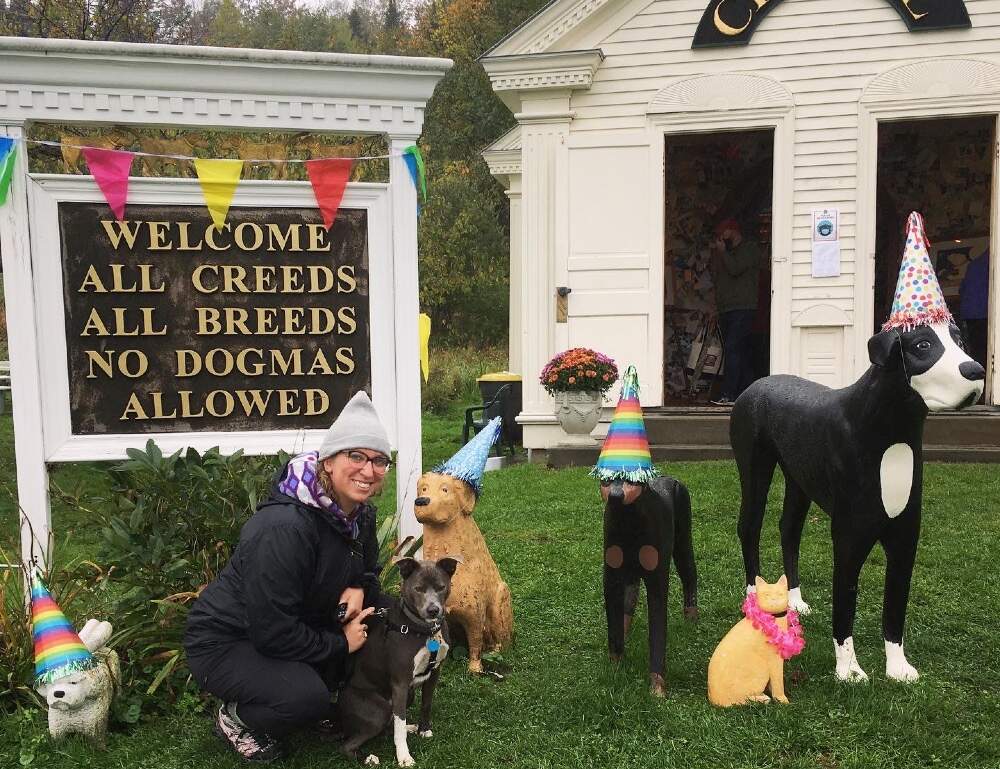
Richie and I brought home Seymour — a silver-gray 30-pound pit-bull-chihuahua-mix from Florida — on October 5, 2020. We’d been told by the shelter that Seymour had some anxiety and fearfulness issues, but after so many months of pandemic-induced depression, we were simply happy to have him. “Family hug!” Richie and I would shout, and Seymour would gallop over, jumping up to join in.
We took him on road trip adventures (even though he shook the whole time in the car), and we went on long walks through our neighborhood and local parks (even though he would lunge and bark at most other dogs). We cuddled on the couch while watching television and snuggled in bed together (even though he would growl and snap at us if we tried to pick him up when he didn’t want to be moved), and we spent hours doing training sessions with him (even though it didn’t help his intense prey drive or reactivity to trucks). Seymour was both a challenge and a love. And, for the time that we got to have him, he was ours.
Almost one year to the day we adopted Seymour, the three of us — Richie, Seymour, and I — drove to St. Johnsbury, Vermont, to visit Dog Mountain, a sprawling 150-acre canine paradise founded by folk artist Stephen Huneck. In addition to winding trails and ponds for swimming, there’s a little white Dog Chapel, where people leave tributes to their dead dogs. That crisp fall day happened to be one of Dog Mountain’s seasonal Dog Parties — there were food trucks, farm stands, live music and dozens of people and their dogs. Maybe due to some sort of Dog Mountain magic, our usually reactive Seymour was mostly calm and well-behaved as we walked the grounds and brought him into the Dog Chapel to be blessed by an Episcopal priest in honor of the Feast of St. Francis, patron saint of animals.
I had made the pilgrimage to the Dog Chapel once before. It was December 2018, and I dragged Richie with me on a research trip for my book. I had been studying pet death memorials and rituals for six years by then, and in all my research I kept reading about the Dog Chapel. I had to see it for myself.
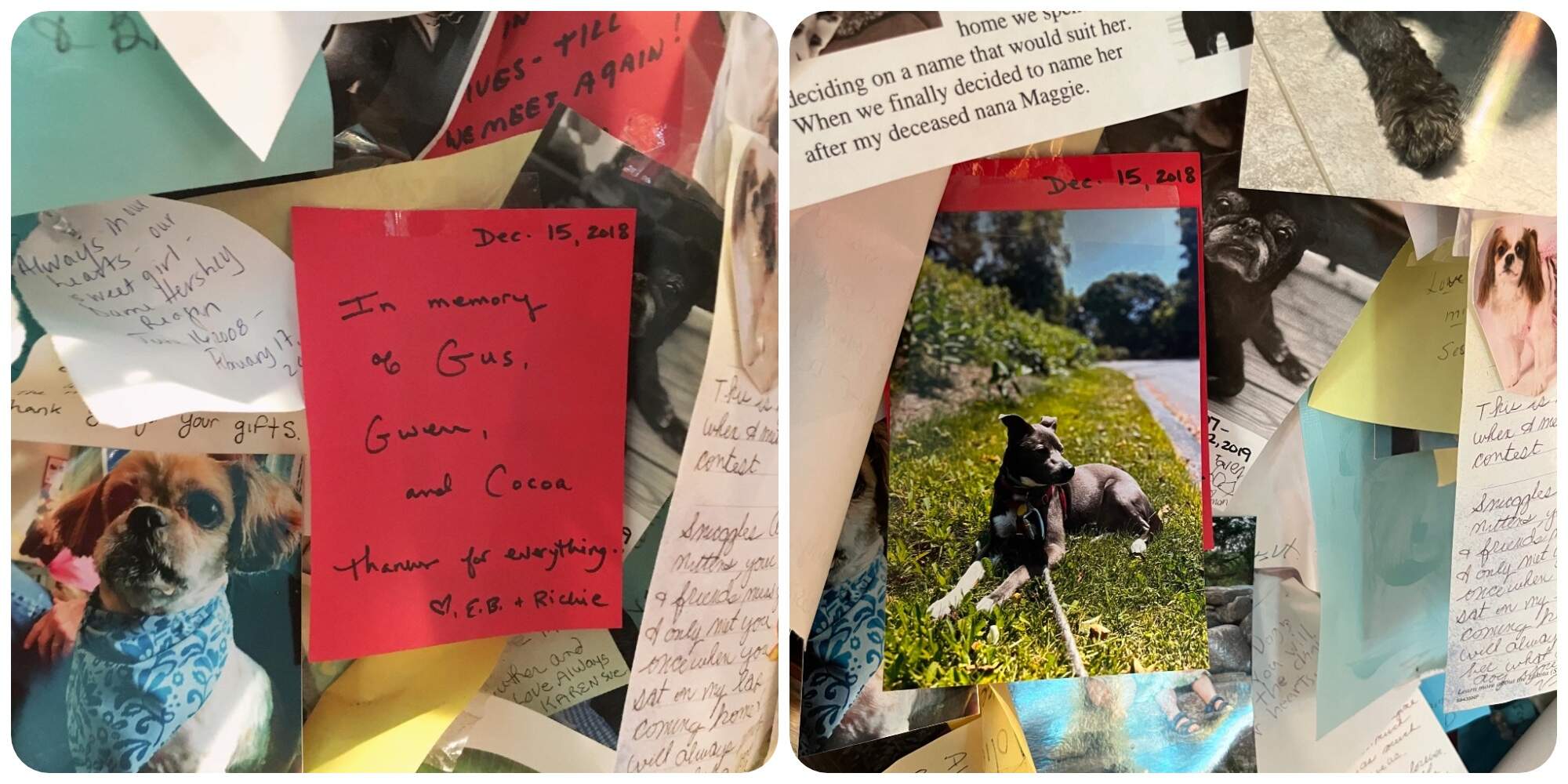
That first visit I was overwhelmed. Hundreds, thousands of photos and letters coated every surface of the Dog Chapel. I sat on one of the wooden benches, each flanked by carved wooden dogs, and warmed myself in the winter sunlight filtering through the stained-glass windows, which were patterned with the profile of a dog and a different canine value, like “play” or “love” or “trust.” I thought about the animals who had shaped my life, and felt so grateful for them. I located a red scrap of paper in my bag and used a black Sharpie to pen a message to my childhood dogs, Gus and Gwen, and Richie’s childhood dog, Cocoa. Thanks for everything, I wrote, before taping the paper up on the wall.
Almost three years after I’d written on that scrap of red paper, as Richie and I waited for Seymour to be blessed, I went over to the wall where we had left our note. It was still there, under a couple new layers. We smiled, happy to be back, now with a dog of our own.
But the third time I went to the Dog Chapel, I no longer had a dog.
Some of Seymour’s anxiety and fearfulness issues turned out to be untreatable. He had a tendency to bite when afraid, a behavior that had only gotten worse and more unpredictable. So many things made him so fearful, and when it seemed no amount of medication or training could help, we’d had to make the excruciating decision to put him down. Understanding the right time to euthanize a pet is never easy, even if they are physically sick or extremely old; behavioral euthanasia is an impossible choice. It was the hardest decision I’d ever had to make. In the year after, I cried more than I thought was possible to cry over a pet. I wasn’t sure anything could help.
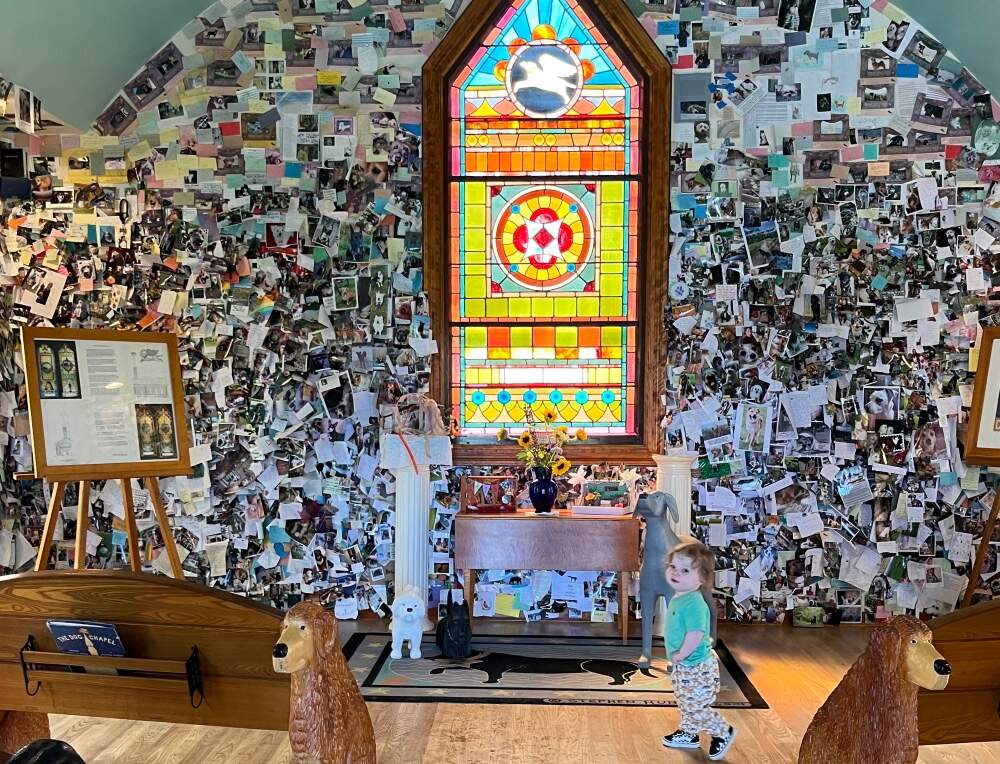
But last June, almost one year to the day that Seymour died, Richie and I drove to St. Johnsbury once again. And we were once again a family of three, but now it was me, Richie and our 17-month-old son, Luca. When we arrived at Dog Mountain that afternoon, again we found we had happened upon a Dog Party — dozens of people and dogs frolicking in the bright green hills, lit by the summer sun. Luca woke from his car nap, his eyes widening with delight: “Doggie!” he shouted and pointed. “Woof!” he said, smiling at labs and goldens, doodles and pit mixes, three giant wolfhounds and a tiny chihuahua.
We made our way into the Dog Chapel. As Luca toddled around, holding onto the carved wooden dog benches for support and patting the stained-glass window with his chubby hands, I took a photo of Seymour out of my purse. Richie and I took turns with a pen, writing messages to Seymour on the back of the photo, through tears. Luca continued to do laps, pointing at the photos: “Puppy!”
When we’d finished writing to Seymour, Richie and I located the red paper, still there, and taped the photo of Seymour on top. I kissed my fingers and pressed them onto Seymour’s face.
I thought about all that had passed between those pieces of paper. In the six-and-a-half years we’d been visiting Dog Mountain, Richie had transformed from boyfriend to fiancé to husband to dad. I’d gone from a pet parent to a human mom. We’d been a family of two, of three and of a different three. We’d seen the Dog Chapel surrounded by snow, red and gold leaves and bright summer sun. Maybe next time we visit St. Johnsbury it will be a muddy, wet spring day, a few years from now. Who knows what our family will look like in that season. Maybe we’ll even have another dog by then.
Seymour is gone, but he is not gone. He is still part of our family. He changed me, and Richie, forever, and I know I am a more patient, more empathetic, more thoughtful parent because of my years caring for him. And I feel comfort knowing that, at the very least, there is a photo of him tucked into a wall at the Dog Chapel. There he will live on forever.
They say nothing in life is constant except change itself — that, and Dog Mountain.