Support WBUR
Opinion
What prenatal testing can't tell you
For anyone who has paid any attention to prenatal screening, abortion and Down syndrome in recent years, it will come as no surprise that increased availability of prenatal screening leads to a reduction in the number of babies born with Down syndrome. A new study published in the American Journal of Medical Genetics offers a comprehensive report about the reduction in live births of babies with Down syndrome in 33 countries over the course of 30 years (1990-2020). They conclude that when women receive a prenatal indication that their fetus has Down syndrome, they are more likely to terminate their pregnancies.
I’m not interested in pressuring women to carry their babies with Down syndrome to term. I am interested in providing a counter-narrative about Down syndrome.
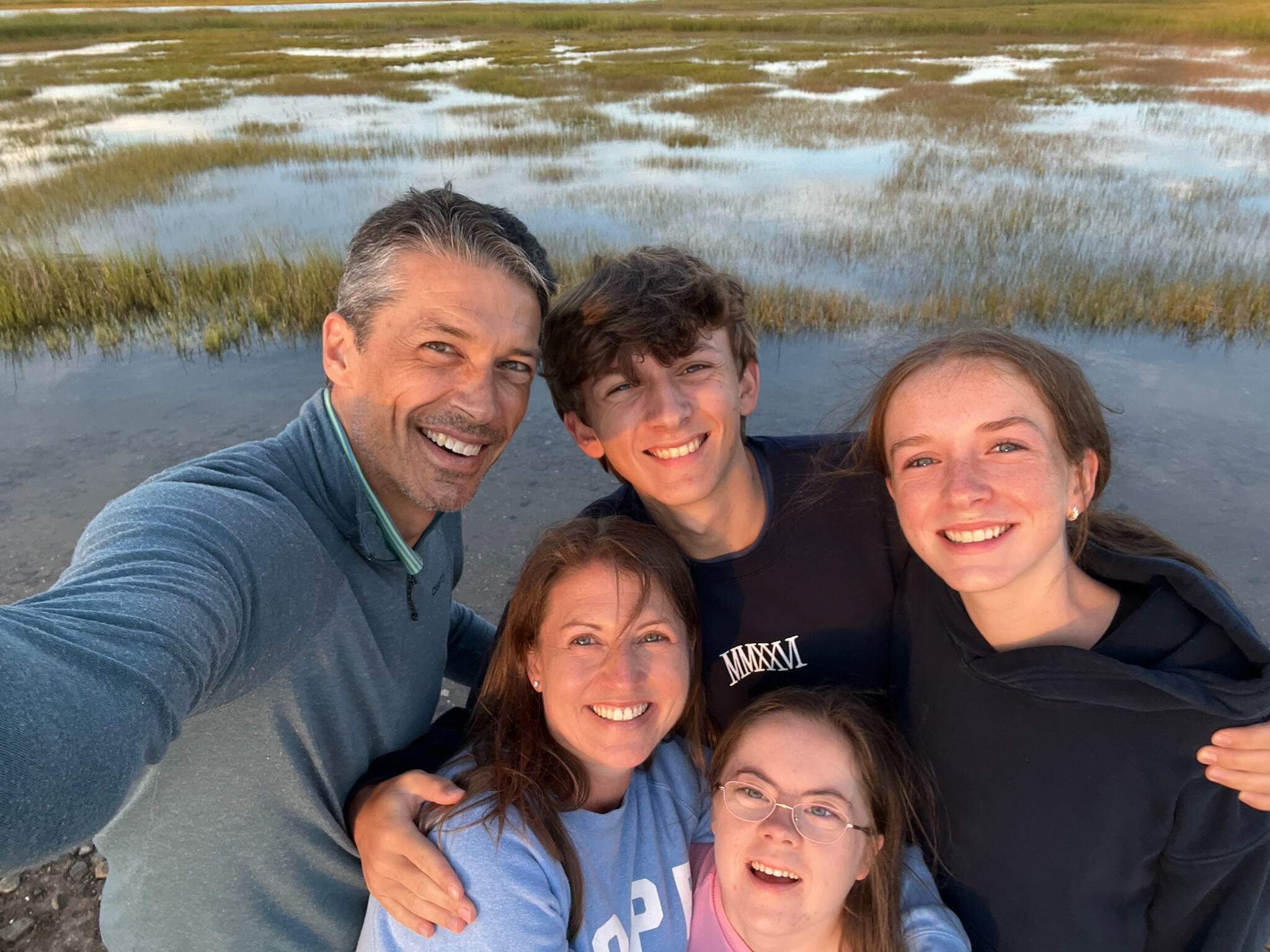
Our daughter Penny is 19 years old. The doctors told us they suspected she had Down syndrome a few hours after she was born. Penny was 2 years old when I heard on NPR that the American College of Obstetricians and Gynecologists (ACOG) decided that offering prenatal screening for Down syndrome should become part of the “evidence-based standard of care” for pregnant women for the first time.
I knew the vulnerable position of women receiving a prenatal diagnosis. I had felt fear and grief and guilt and shock with my own experience of postnatal news. I also knew that prenatal screening results present a sense of urgency — termination is not a decision to be taken lightly, and yet it is a decision that needs to be made quickly. For all these reasons, I knew that the ACOG announcement likely heralded a reduction in the live births of babies with Down syndrome. With two years of motherhood under my belt, I also knew that my own assumptions about who Penny would be, and what Down syndrome would mean for our family, had been categorically mistaken.
At that point, Penny was using sign language to communicate, giggling with me over Sandra Boynton books and taking wobbly steps around our apartment. She wore glasses, had tubes in her ears, had undergone a heart procedure and saw four different therapists each week. Penny was needy in ways our other kids would not be. She also invited us into a community of other parents of kids with Down syndrome who were learning alongside us what it meant to love our children for who they are and not what they accomplish. Penny, and her community, were setting us up to love our other future children well. She was setting us up to better understand and accept our own humanity. And I was beginning to realize that no measurement of milestones would ever account for all of us becoming more fully human.
Prenatal testing has advanced since then. Companies have created “prenatal cell-free DNA screening” (cfDNA)— a noninvasive, highly predictive blood test that can determine during the first trimester whether a fetus is likely to have Down syndrome (or other chromosomal conditions). Statisticians can use reports of maternal age to estimate how many live births of Down syndrome a society should expect, taking into account the chance of miscarriage. As the new report from the American Journal of Medical Genetics concludes, with the advent of cfDNA, the “reduction rate” in live births of babies with Down syndrome in the United States has increased to around 37%.
This new report also notes that patients' religiosity and their views on abortion do not predict a lower rate of termination. It informs us that women in countries with higher gross national income (GNI) have higher rates of termination, perhaps due to greater access to medical information and services, perhaps due to placing less value on the lives of people with Down syndrome. And yet the rates of termination still vary widely from country to country — despite access to abortion in all the countries surveyed. There must be some reason why some women choose to continue their pregnancies and others to terminate when they learn their babies will have Down syndrome.
A 2023 study from the Journal of Disability and Health found that American doctors giving prenatal screening results betray bias against babies with Down syndrome. They routinely offer insufficient, incorrect or negative information and rarely provide information about the life outcomes or supports and services available to parents who might want to help a child with Down syndrome flourish. In the United States, pro-life advocates often inadvertently reinforce the negative message around Down syndrome by inaccurately claiming that up to 90% of babies with Down syndrome are aborted. For anyone not radically committed to the pro-life cause, those numbers suggest that the expected course of action when facing this prenatal diagnosis is indeed to abort.
I’m grateful for the work of organizations like The National Center for Prenatal and Postnatal Diagnosis at the Genetic Support Foundation, which seeks to provide up-to-date and non-biased information to doctors and the women they treat. I want all Americans to know that adults with Down syndrome and their families report great happiness and satisfaction with their lives. Still, we need more than factual information to provide an accurate narrative about Down syndrome.
Having a child, and now a young adult, with Down syndrome in our family has been an irrational, unprovable good. No study can attest to the goodness of Penny’s life or the value of her being. No list of standards can defend her existence. In a world of increasing mechanization, measurement and merit, we need people with Down syndrome among us to return us to our humanity.
My love for my daughter (and for my typically developing son and daughter) is not rational. It is not based on information about her projected outcomes. It is not due to her potential. It is not efficient. It does not guarantee returns. It costs everything. It expects nothing.
To argue that people with Down syndrome are human beings who are worthy of love and attention barely begins to articulate a more comprehensive truth, but it is essential to the counter-narrative we all need to hear. At our core, we are not defined by our rationality, nor by our capacity to weigh information, but by our capacity to give love and receive it in return. If we continue to deny that truth, we deny the very thing that makes us human.