Support WBUR
Essay
Looking for pork jowl in Boston
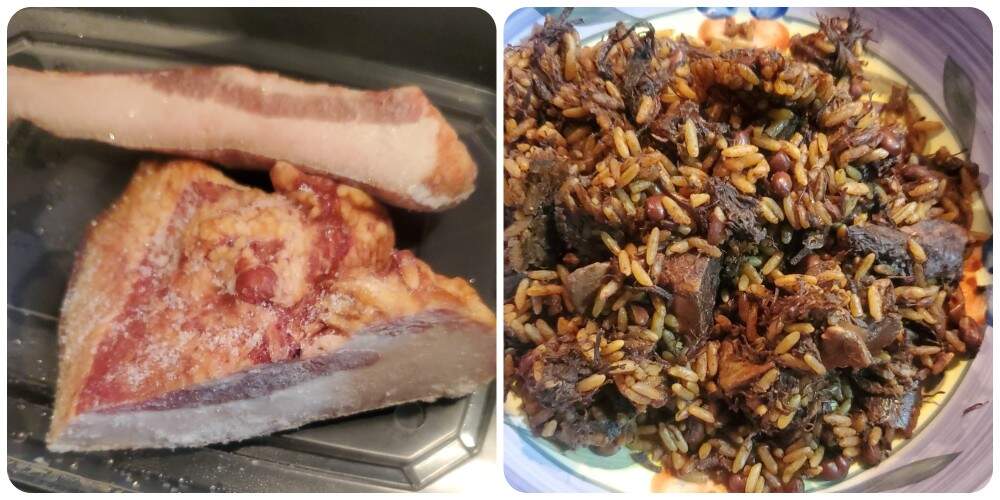
Hog jowl is not exotic. It is not trendy. It is not something you share a photo of, or a hashtag for clout. It is jaw meat — salted, smoked and stubborn. And it is one of the main ingredients of Hoppin' John, a New Year's Day dish eaten by African Americans for generations to call in luck, survival and continuity.
Hoppin' John comes out of the rice coast of South Carolina and Georgia, where my ancestors brought deep knowledge of rice cultivation and slow cooking. Cow peas, rice and pork were not simply ingredients; they were survival strategies. The peas symbolized coins. The greens, folded in on the side, stood in for paper money. The pork — often hog jowl — was fat, flavorful and proof that even the scraps could be transformed into something sustaining.
The broader ritual of eating black-eyed peas and rice on New Year's Day is still a cherished practice across African American communities throughout the country, with each region bringing its own distinctive meat seasoning to the dish. In the Mississippi Delta, cooks might use smoked ham hock. In Texas, it could be neck bones. In Chicago or Detroit, families who migrated north brought their own variations — salt pork, fatback or whatever cut carried the memory of home. The tradition adapts, but the meaning remains: prosperity, continuity and the turning of a new year rooted in our history.
Hog jowl mattered because it was cheap, available and powerful. It seasoned the entire pot. It carried smoke, salt and memory. But this year, my mother called me, frantic, and on the day before New Year's Eve, to tell me she couldn't find hog jowl at her local grocer. She said, "It's a shame. None of these stores carry hog jowl. They want us out of Boston."
Now, while you might smirk at me for being pressed about not being able to find my swine, this is bigger than that. When I set out to find hog jowl in Boston, I wasn't just shopping. I was looking for proof that parts of us still lived here.
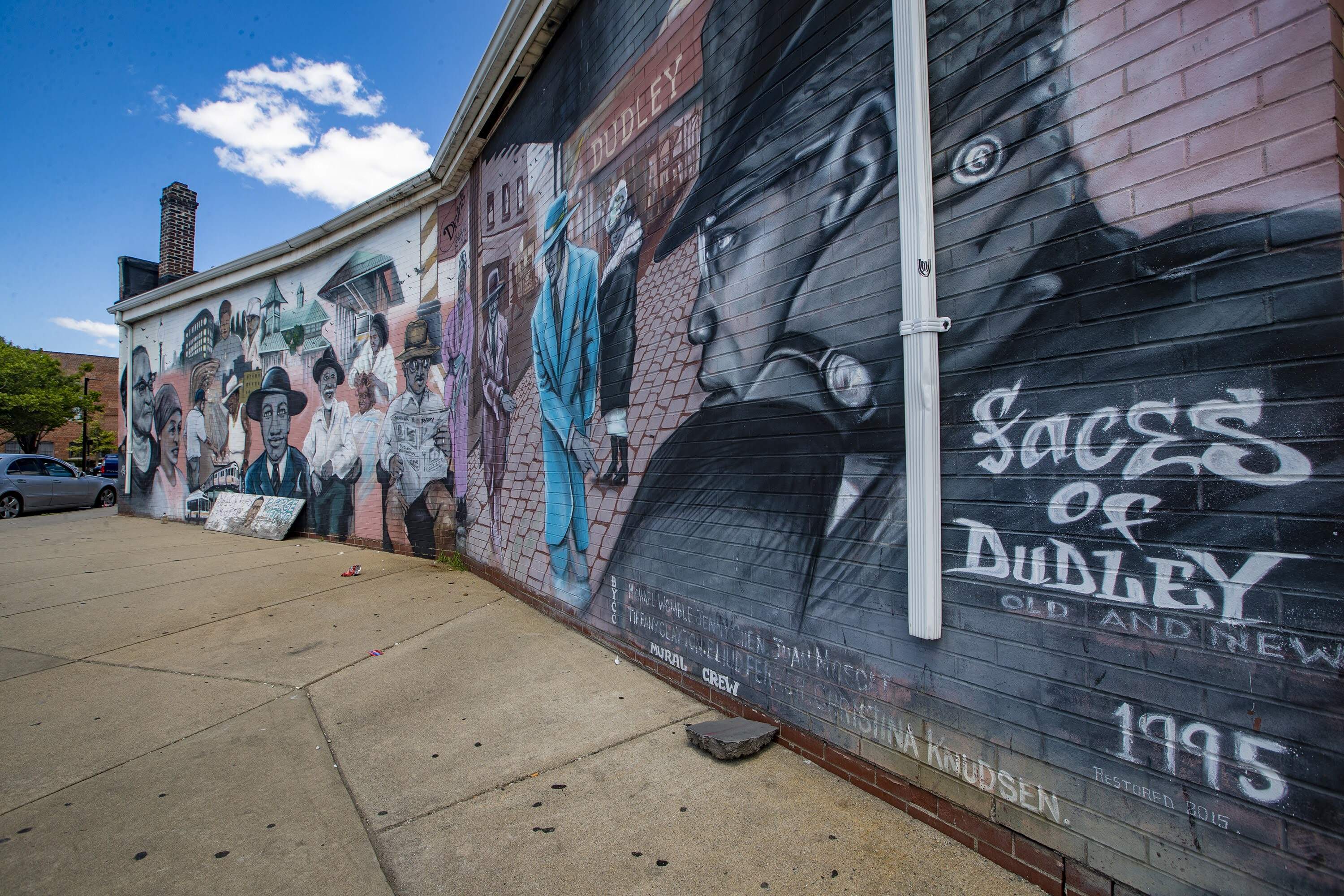
I was born in the geographic center of Boston — Roxbury all day — and when I was a small child there was a different kind of abundance here. Dudley Square, now called Nubian Square, was the center of African American life in Boston. Malcolm X strolled down Dudley in his Zoot Suit. Martin Luther King Jr., while attending graduate school at Boston University, led a march through Boston that began in Dudley Square. Back in the day, if you went down Dudley, you could find everything.
A Nubian Notion, where I bought books and hip hop mix tapes. Robell's Department Store, where people lined up on Saturdays. Beauty supply stores perfumed with hair grease and incense, record shops blasting soul and hip hop and churches with doors always open. You could find hog jowl at Carl & Eddy's on Blue Hill Avenue. You could find smoked neck bones, pig tails, chicken backs, crackling and greens still clinging to dirt back then.
That Boston has been dismantled. I’ve seen what people politely call "development" hollow it out. Rising rents, predatory policies and institutional neglect pushed African American families farther and farther from the city's center, and when a people are displaced, their food disappears first. Grocery stores stop stocking what only we buy. Butchers stop carrying cuts that don't move fast enough for profit margins built on someone else's taste. The loss isn't nostalgic. It's material.
I went to store after store. Nothing.
I went to Clinton's on American Legion Highway — a butcher shop that once lived in Roxbury before it was pushed out to the hinterlands. Clinton's once knew my mother by name, "Pearl." They once knew what she cooked. When I asked the butcher for hog jowl, he didn't hesitate. He said, "We haven't sold that since before COVID," like it was something that once existed, never meant to return.
Hoppin' John is not merely a "lucky" dish; it is a freedom dish.
I tried a Puerto Rican meat market — usually a reliable place for cuts that don't show up in Whole Foods or Trader Joe's. I got blank stares. I went to every Tropical Foods store within a five-mile radius. I saw every part of the animal that could be sold as novelty or excess — hog ears, heart, feet, nose, even hog testicles. But not the jowl.
Just as stores overflow with matzo, brisket and kosher wine before Passover, as Ramadan fills markets with dates, halal meats and sweets timed precisely to sundown, as Easter arrives with ham and hot cross buns on cue, and as the Lunar New Year guarantees whole fish, dumpling wrappers, rice cakes and red envelopes, stores in Boston should be fully stocked with hog jowl in late December.
My father says, "Boston still doesn't give a damn about the Black man or woman. Never did and never will.” Our traditions, are treated like folklore — optional, quaint, improvisational. Substitute salt pork. Make do. Adjust. But this isn't just about taste. It's about cultural survival.
What most Americans don't know — or choose not to remember — is that New Year's Day holds a deeper meaning for African Americans. January 1, 1863, was the day the Emancipation Proclamation took effect. It was the day enslaved Black people were declared free. That history lives quietly inside our rituals.
Hoppin' John is not merely a "lucky" dish; it is a freedom dish. The food carries a memory the country has buried; the pot remembers what textbooks minimize. So when hog jowl disappears from the shelves, what's being erased isn't just a product. It's a cultural memory tied to freedom itself.
I ended my search with salt pork instead — a small, overpriced piece of pork butt wrapped in plastic. I brought it to my mother, who had been patiently waiting. She looked at it, sucked her teeth and said exactly what she says when something sacred has been replaced by convenience: “Too much money. Too little meat. They really hate us now.”
But later that night — well past midnight — my phone rang. "I just thought of something," my mother said. "You might try the Warren Street Mall."
The Warren Street Mall is what remains: a strip mall that houses a Price Right, a Marshall's, the proverbial black woman's hair and beauty supply and other obscure businesses still holding on, quietly, stubbornly. "That Price Right will have it. They know we're still here," my mother urged, as if the Price Right in Roxbury was a refuge. Early New Year's Eve morning, I got up, got in the car and drove there.
And there they were. Two packs of hog jowl, sitting in the case like an offering, waiting for whoever still knew what to do with them. Waiting for whoever still understood that New Year's Day isn't complete without a pot of peas and rice seasoned right.
I didn't hesitate. I grabbed both packs and brought them home to my mother.