Support WBUR
Essay
'Heated Rivalry' lets us believe in anything
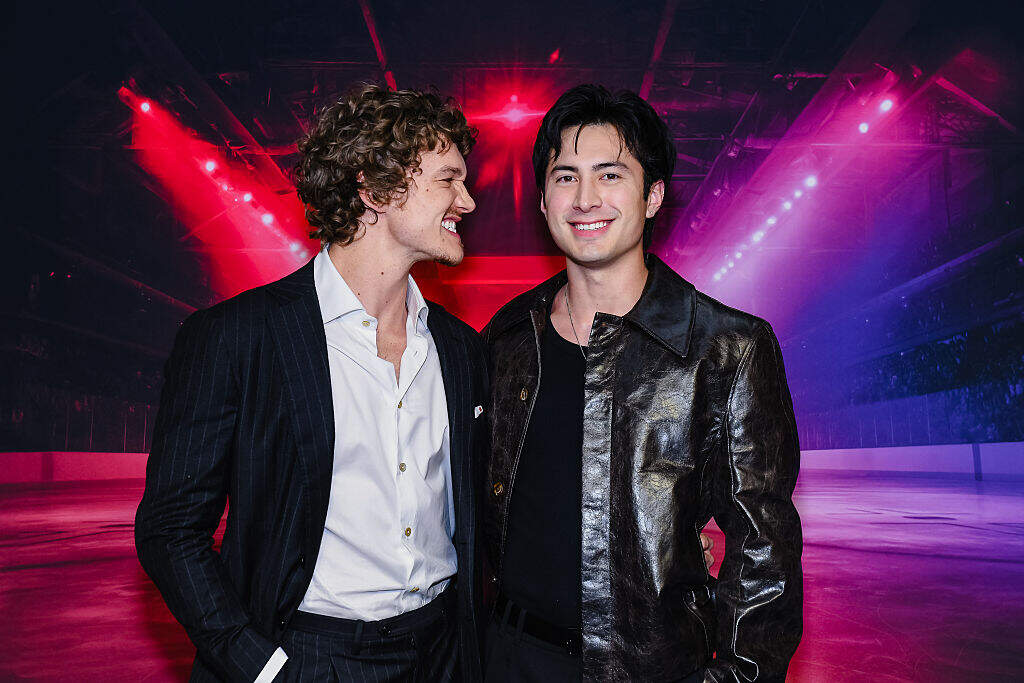
In early December I went to dinner with coworkers, and I said something along the lines of, “There’s this show I need to tell you about. It’s about hockey … kind of.”
Soon after, we all clocked out of the office for the holidays, and this show about two rival gay hockey players, well, it kind of took over my life. It’s called “Heated Rivalry,” and by now I imagine you’ve heard of it too.
The show tells the story of a decade-long affair between two closeted professional hockey players: Shane Hollander (Hudson Williams) and Ilya Rozanov (Connor Storrie). Shane and Ilya meet the summer before rookie season, and, as captains of their respective teams they’re aggressive on — and off — the ice, meeting in secret and navigating their growing feelings for each other. It’s Romeo and Juliet set in the hyper-masculine world of professional hockey — if Romeo was a brooding Russian with a wildly impressive glutes routine.
Writer and director Jacob Tierney adapted the show from romance author Rachel Reid’s bestselling "Game Changers" series, and while the hockey smut of it all is a selling point, it’s also a key part of character development, and it moves the story forward in surprisingly meaningful ways. Between Tierney and producer Brendan Brady’s vision for what the show could be, striking cinematography from Jackson Parrell and a soundtrack with original compositions by indie musician Peter Peter, I think this is what the hockey world calls a hat trick. I know what that means now.
Shot in just 37 days on a modest budget, “Heated Rivalry” was originally produced for a small Canadian streaming service called Crave, then three weeks before the show’s premiere, HBO signed on. The show caught fire as viewers like me, home from work for the holidays and looking for something to ease the end of a particularly tumultuous year, started to take notice. My algorithm exploded with shared clips from the co-stars' joy-filled press tour and close readings of scenes. Fans gathered in bars and coined the term “re-heating” as they watched episodes again and again. (Since its late November debut, the show’s amassed over 600 million minutes of streaming on HBO alone. That’s a lot of re-heating.)

I willingly, most ardently, stoked the flames with fan edits set to music and rabbit holes about fleece jackets, podcast interviews and episode recaps, scene breakdowns (ask me about a two-camera setup) and, yes, fine, the three-part audio story released by Quinn, voiced by the two leads. (If you’d told me I’d close out 2025 with two yearning fae princes from rival kingdoms in my AirPods? What a time to be alive.) I watched the finale, then I watched hockey podcasters live stream their reaction to the finale. As Storrie and Williams made their late-night debuts, Ottawa Tourism updated their profile to “Birthplace of Shane Hollander,” Tim Horton’s trolled Canada Dry Ginger Ale for not posting about the show, and, as if you need another reason to support your local public media station, This Old House is repping the cottage industry (IYKYK).
We — everyone and their grandmother, it seems — are all having a lot of fun. But just like certain scenes from the show, there’s more to it. We should all care this deeply about these characters.
Just like certain scenes from the show, there’s more to it. We should all care this deeply about these characters.
The good news is that this is a romance, and as any reader of the high-grossing genre will tell you, romance will not let you down. That, too, was Jacob Tierney’s intention. On What Chaos!, the first hockey podcast I unexpectedly found myself locked into, Tierney said, “That’s the whole appeal. That’s why I made it. What I wanted to put out into the world was queer joy: The idea that we’re allowed to exist, we’re allowed to have sex, we’re allowed to be in love, we’re allowed to live.”
Hudson Williams has spoken about receiving messages from closeted professional athletes since the show premiered. The show's being watched in Russia, where coming out publicly could still lead to incarceration. People are sharing their stories. The show is changing lives.
As for me, there’s this one thing in particular I keep coming back to, and it’s something else Jacob Tierney said in a What Chaos! chat, after the finale aired. There’s a scene in episode five in which Connor Storrie, as Rozanov, delivers a four-page monologue completely in Russian, a language he began learning just two weeks before filming. Emotionally, it leads us into a high-octane scene set at the fictional NHL finals, with shots cutting between two characters on the ice, and cameras circling Shane and Ilya watching separately at home, in Canada and Boston. It’s big and operatic, a rom-com grand gesture for the ages, and the emotional wallop works only and precisely because of all that’s led us to this very moment. And here, I don’t just mean narratively, or even how it all hinges on a song by Canadian band Wolf Parade that Tierney kept in his back pocket since the early 2000s.
Here’s what Tierney said: “As much of my heart as I can put into anything, and as much of my skill as I’ve been able to put into anything in my career … that was my years of doing this kind of adding up to be like, ‘I think I can make a moment feel like this. I really think I can, if I use all the stuff I’ve learned, all the experience I’ve had of what works, what comes together to do something.’” He said it’s the thing he’s most proud of in his whole career.
As a writer, an editor, a parent and a partner, I think a lot about stories. About how we don’t always know where we’ll end up when we begin something, or how our experiences today — successes, mistakes, all of it — inform what we’re able to do, as the people we become, years later.
Sometimes a love story takes 10 years. Sometimes a single scene is two decades in the making. It works, in the end, because of all that’s come before it. Stories matter. Good things can happen. I’ll believe in anything.