Support WBUR
Essay
An all-night outdoor party in the dead of winter? Yes please
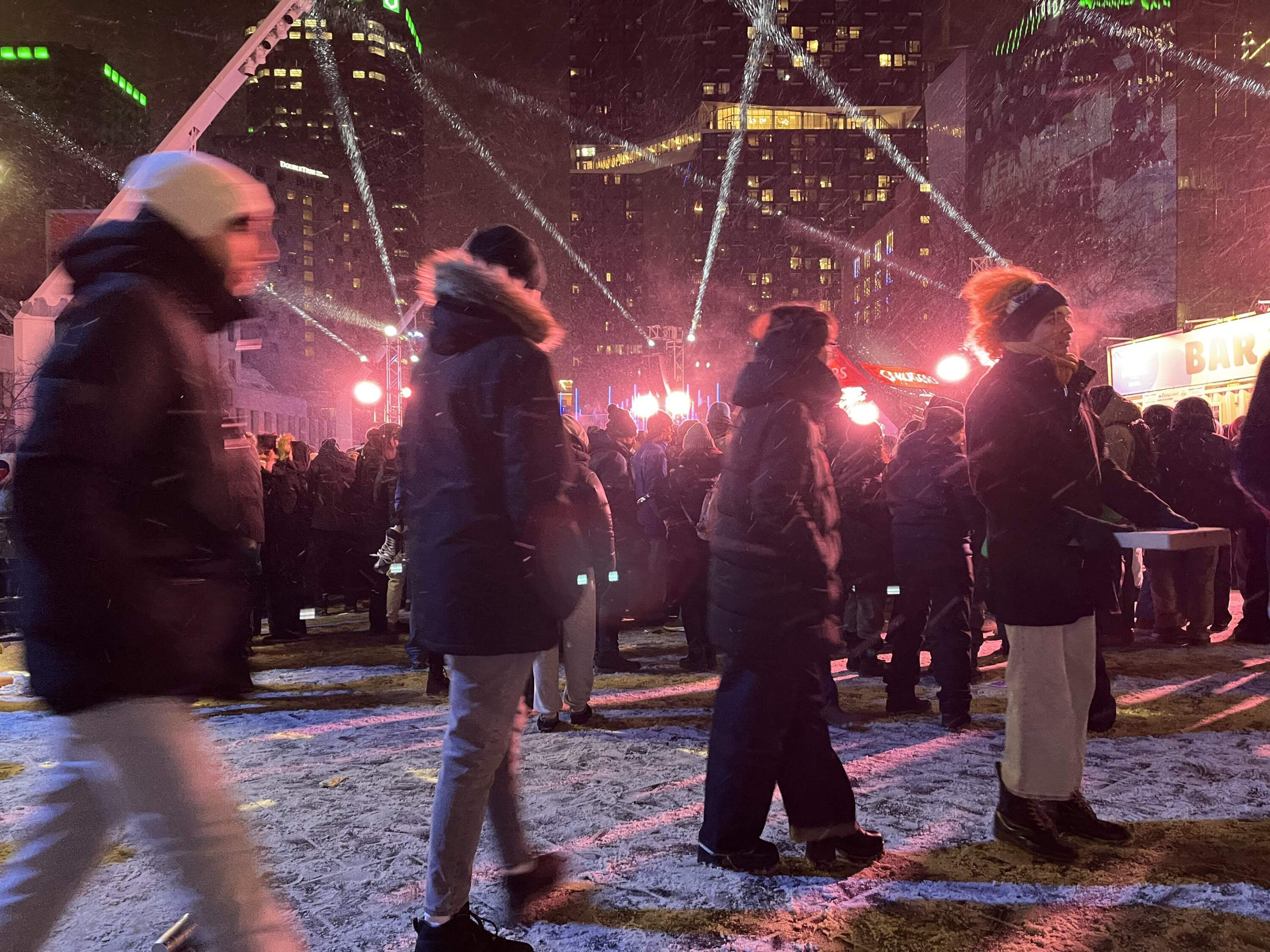
Last year, green laser beams illuminated the torrent of snow falling on downtown Montreal on the first night of March. Around me, hundreds of revelers of many ages, races and persuasions were dancing to Darude’s “Sandstorm” in front of a DJ stage, gliding along a popup ice skating loop trail lit by neon pillars. We were also drinking plenty of wine. It was 11:50 p.m. and I was wearing a hooded down jacket warm enough to protect me from the minus 18-degree windchill. But for how long? My night, you see, was only just beginning.
Once a year, the City of Montreal dares residents and visitors to embrace the totality of the night — to go out and stay out from sundown until the first rays of dawn.
Across eight city neighborhoods, clubs, museums, restaurants and artist lofts throw more than 100 free or low-cost parties and cultural events that are partially subsidized by the government. The subway runs all night to ferry people from one locale to the next, with a special “mystery train” decorated with artwork and neon lights that prowls the tunnels along with the regular trains. And at brunch the next morning, revelers’ hangovers are paired with adventure stories.
This is Nuit Blanche, aka the “white night” of Montreal. It’s a uniquely frost-nipped edition of a concept that took off in the early 2000s — an idea that the beauty and opportunity of the city, after dark, should be embraced. This year, the 23rd annual Nuit Blanch, will be held on Saturday, Feb. 28.
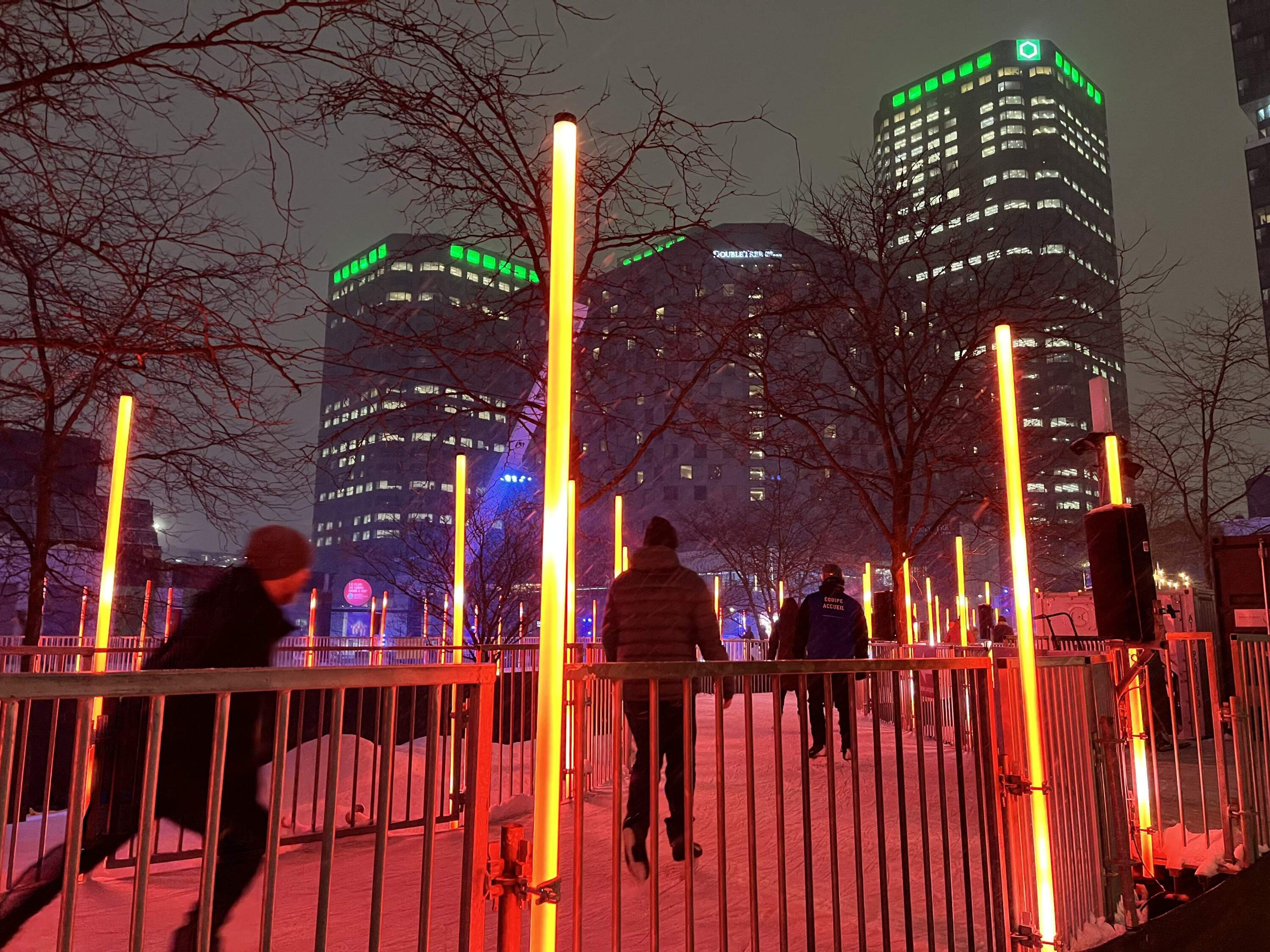
Today, cities around the world including Paris and Toronto offer their own interpretations of the white night during the summer. A mix of public and private funding makes it possible to transform each cityscape into a barrier-free, after-hours playground bright enough to turn out crowds and light up the night.
As a resident of Boston — a city where the lack of nightlife can feel like lingering Puritan superstition about what happens after dusk — I wanted to experience Montreal’s Nuit Blanche.
But even as I jumped in my car to drive north and set up basecamp at a hotel by Quartier des Spectacles — the city’s dedicated festival plaza and the epicenter of Nuit Blanche action — I failed to consider something important. The last time that I stayed up all night in a city was during my mid-20s, on a trip to Berlin that involved techno and leather short-shorts. I’m now 37, which some would uncharitably call “late-30s.” It wasn’t until I watched the sun sinking behind the ridgeline of Mount Royal at 5:00 p.m. when I felt a nagging hesitation. Was this a good idea?
And yet, I recognized the feeling too; like an old nemesis. It’s the lethargy that a lot of us who live in cities experience every night at sundown. Work is over, it’s dark, but the city is still alive. You could bundle up and venture out, meeting new characters, sampling new experiences, collecting stories to tell. And at the same time, going back into the elements can feel like work; especially if you have leftover lasagna in the fridge and an HBO mini-series waiting to be binged.
Nuit Blanche shows us how the human impulses to explore, share and celebrate can endure the nastiest weather.
But I’d made the trip. There was no lasagna or HBO. And the bustle of St. Laurent Boulevard was waiting outside my hotel. I slipped a fleece vest over my sweater, zipped up my Michelin Man puffer jacket, pulled on a woolen hat and stepped out into the night. I wondered where it might spirit me off to.
Nuit Blanche often begins as a group adventure. That was the case for me. I met up with friends for dinner, and just before 10 p.m. we hustled over to McGill University’s Redpath Museum of natural history for a truly dreamlike experience. For half an hour, we roamed the darkened exhibit halls with flashlights, illuminating the huge dinosaur skeletons that towered over us. All those childhood imaginings of what it feel like to get locked inside a museum after closing hours were brought to life, with a sense of communal joy. For me, it was a Proustian flashback to another literary landscape—the darkened halls of the Met, which served as a perfect hideout for the runaway kids in E.L. Konigsburg’s “From the Mixed-Up Files of Mrs. Basil E. Frankweiler.”
But after riding that wave of glee to the festival plaza, where the masses were dancing and ice skating, Nuit Blanche started pulling my friends and me in different directions. My comrades were leaning toward a 1 a.m. bedtime; I was intrigued by a collaborative perfume-making workshop being held in the neighborhood of Villeray, on the north side of Montreal. We parted ways, like the fellowship in “The Lord Of The Rings,” and I tossed back my last glug of cabernet before entering the subway.
Several hundred other folks had the same idea. We poured through the train doors. The crowd was so thick that I didn’t even have to grab a support pole. We were literally holding each other up. It didn’t take long for social barriers to crumble. I asked the people squashed up against me if, by chance, they were also heading to the perfume workshop. They weren’t, but our small talk caught the ear of a fellow traveler nearby who was interested. When we reached the St. Michel station at 1:30 a.m., a small group of us wandered down a quieter road to the loft where the workshop was being held.
White night celebrations like Nuit Blanche are a reminder that the nocturnal cityscape, for all its challenges, is also kind of a miracle. Each white night is a glowing demonstration of what’s possible when people who live and work in close proximity to each other are off the clock and free to explore more festive, creative and hedonistic impulses.
Sometimes these wanderings are solitary, as I experienced later that night around 3:00 a.m, while checking out some thumping downtown nightclubs that were steamy enough to fog my glasses. I was too fatigued to make new friends by that hour, but clearly, the younger, gregarious clubbers dancing around me had plenty of gas in the tank. And Montreal was kinder and more alive for it.
I made it ‘til morning. I caught the wispy flares of sunrise over the St. Lawrence River at 5:30 a.m. through my hotel window, seconds before flopping into bed. The understanding that all of us who braved Nuit Blanche had shared something special—and vital—carried me into the most restorative slumber I had experienced in months. I’d needed it. Not the deep sleep, but the elation of being out in the city with so many other people reveling in its charms, mysteries and weirdness—at a time when it feels like the world is on fire. If nothing else, Nuit Blanche shows us how the human impulses to explore, share and celebrate can endure the nastiest weather. On a dark, lip-crackingly frigid night, tens of thousands of us listened to this wondrous instinct.
As I drifted off to sleep, I wondered: When and where might we meet again? At another white night like the Winnipeg edition, which happens in September? Next winter in the Quartier des Spectacles? All I knew was that a tiny part of me did not want to go back to sleep.