Support WBUR
Inside the 'Passionate Mind' of civil rights leader Mary McLeod Bethune
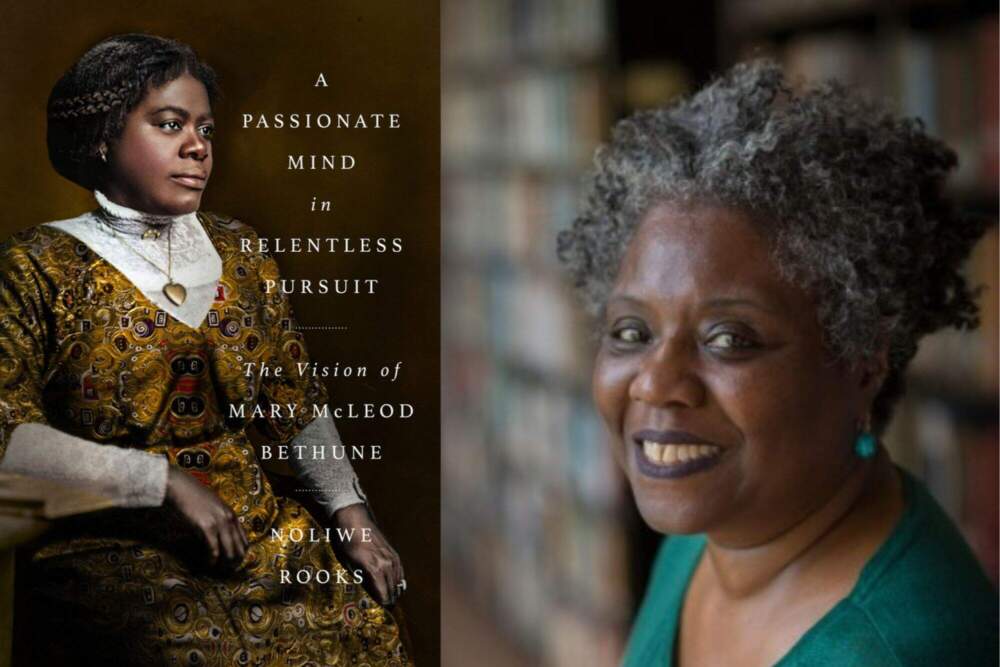
When Mary McLeod Bethune died in 1955, tributes flooded in. Mourners said that if there had been a Mount Rushmore of Black achievement, she would have been on it. Born to parents who were enslaved, Bethune was the first in her family to learn to read. She rose to be an advisor to presidents of both parties and an unstoppable force for change.
In the new book, “A Passionate Mind in Relentless Pursuit: The Vision of Mary McLeod Bethune,” author Noliwe Rooks discusses Bethune’s powerful legacy. Rooks is the chair of Africana Studies at Brown University and the author of several books exploring race and gender in the United States.
5 Questions with Noliwe Rooks
Why did mourners agree that Mary McLeod Bethune should be on the Mount Rushmore of Black achievement?
“Mary McLeod Bethune is this figure that many people, if you say her name, they know that she existed. They generally know that she was some sort of beloved educator and that she worked in the [Franklin D.] Roosevelt administration. But when you look at the trajectory of her life — by 1904, she opens her own school. She’s the first in her family to even go to school. But that’s not where it stops.
“She goes from there to working in the women’s movement and becomes the head of the National Association of Colored Women’s clubs. In that role, she meets the mother of Franklin Delano Roosevelt, the mother-in-law to Eleanor Roosevelt. From there, Eleanor introduces her to a series of presidents who are very taken with her.
“Now again, not that long ago, she was sharecropping with her family in South Carolina.
“The next thing you know, Calvin Coolidge is asking her to serve on a commission. Then, Herbert Hoover puts her on a child health commission, and this is the commission that comes up with vaccines for diphtheria and polio. After that, Franklin Delano Roosevelt, by 1938, makes her a part of a depression era group. And then, Harry Truman appoints her to be a part of the delegation for the group that is determining what the United Nations will ultimately be.
“So I think it’s the rise, it’s the influence, it’s the impact. And then, at every stage of all these accomplishments, she’s actually able to move the needle in terms of aligning federal policy in ways that support Black communities, rural communities, women and children in very particular ways that they had not before.”
Why was education so important to her?
“Education was so important to Bethune and Black people in general following the Civil War. The idea of reading, of writing, of thinking, of speaking freely in public about what you were reading was so embargoed, was so difficult for them to have access to, that it almost took on mythical proportions.
“So at 12 years old, she goes to school, she becomes the translator for her entire community. So all of the older adults, the kids, all of the folks who were not going to school, she would come home and they’d give her letters to read, or they’d ask her to write letters. She was reading newspapers to the entire community. All of the older folks would just come out and sit and she’d read the bible to them or she would read newspaper articles about what was going on.
“So her learning how to read, her becoming educated, she immediately saw it as a benefit to the entire community. And it stayed like that for her entire life. She dedicated her life to that kind of thinking about education that’s not just — ‘Let’s learn how to read. Let’s learn how to write” — but where you’re joining the idea of being educated to being of service to other people, to making sure that other lives are enriched.”
Could you list some of the highlights of her accomplishments?
“One of the things that surprised me was the number of organizations that she either founded, presided over, or served in the upper administration of. This would include the United Negro College Fund, for example. During her years in the Roosevelt administration, she was deeply engaged in thinking about how Black colleges could work together more closely, and in advocating for funding for them from the federal government.
“For the Urban League, another civil rights organization that still exists today, she served as president for a few years to think about how in northern urban areas, politics could be different from the Jim Crow South.
“She was the president of the National Association of Colored Women. She served as the president of the Florida chapter, and in 1927 became the president of the National chapter.”
What does Bethune’s will and testament, published in Ebony Magazine, reveal about her path and purpose?
“I think the thing that is consistent about Bethune that you see in this last will and testament, that is consistent throughout her life, is that we have to center our young people.
“We have to give young people the tools, the education, the vision, the inspiration, the love and support in order to pick up a torch and carry the struggle on. After one generation leaves, you have to train young people to be able to lead.”
This is a personal story for you – you say that researching this book was like learning to drive in the San Francisco fog. Why?
“People who grow up around foggy places understand that you have to slow down. You have to turn your headlights down. There’s all these kinds of counterintuitive things that happen when you’re driving in the fog. And I found that, because there’s so much information out in the world about Bethune, it’s easy to think that you know the destination, you know where you’re going, you can drive straight there. So many people have done the work for you. And, as I did more research, I was constantly saying to myself, ‘Why don’t I know this? Why didn’t anybody ever tell me this?’ It forced me to slow down, pay a different kind of attention, and learn to see through different eyes.
“Bethune’s balance between asserting rights for African Americans and balancing the role of women in American society makes me think of Vice President Kamala Harris, and some of the assessments and critiques we’re hearing. How did Bethune weigh those identities and those roles?
“Bethune always centered women and girls, what was best for them, what kind of support they needed. But, she also believed and wanted to train women and girls — and young people in general, and actually anyone — in what she called the burdens and responsibilities of citizenship.
“She wanted everyone to know what your rights are, what kind of bills are being discussed in your neighborhood. She thought that that should be a topic of conversation in homes, not just something for meeting houses, but that wherever you found yourself, you needed to be talking about what it took to make democracy strong, what was required of citizens to perform citizenship, and to think about what you could do to make America better. I think those things really connect with what’s going on with Vice President Harris.”
This interview was lightly edited for clarity.
Mia Giuliani produced and edited this interview for broadcast with Michael Scotto. Giuliani also adapted it for the web.
This segment aired on July 25, 2024.