Support WBUR
'The New India' explores the unraveling of the world's largest democracy
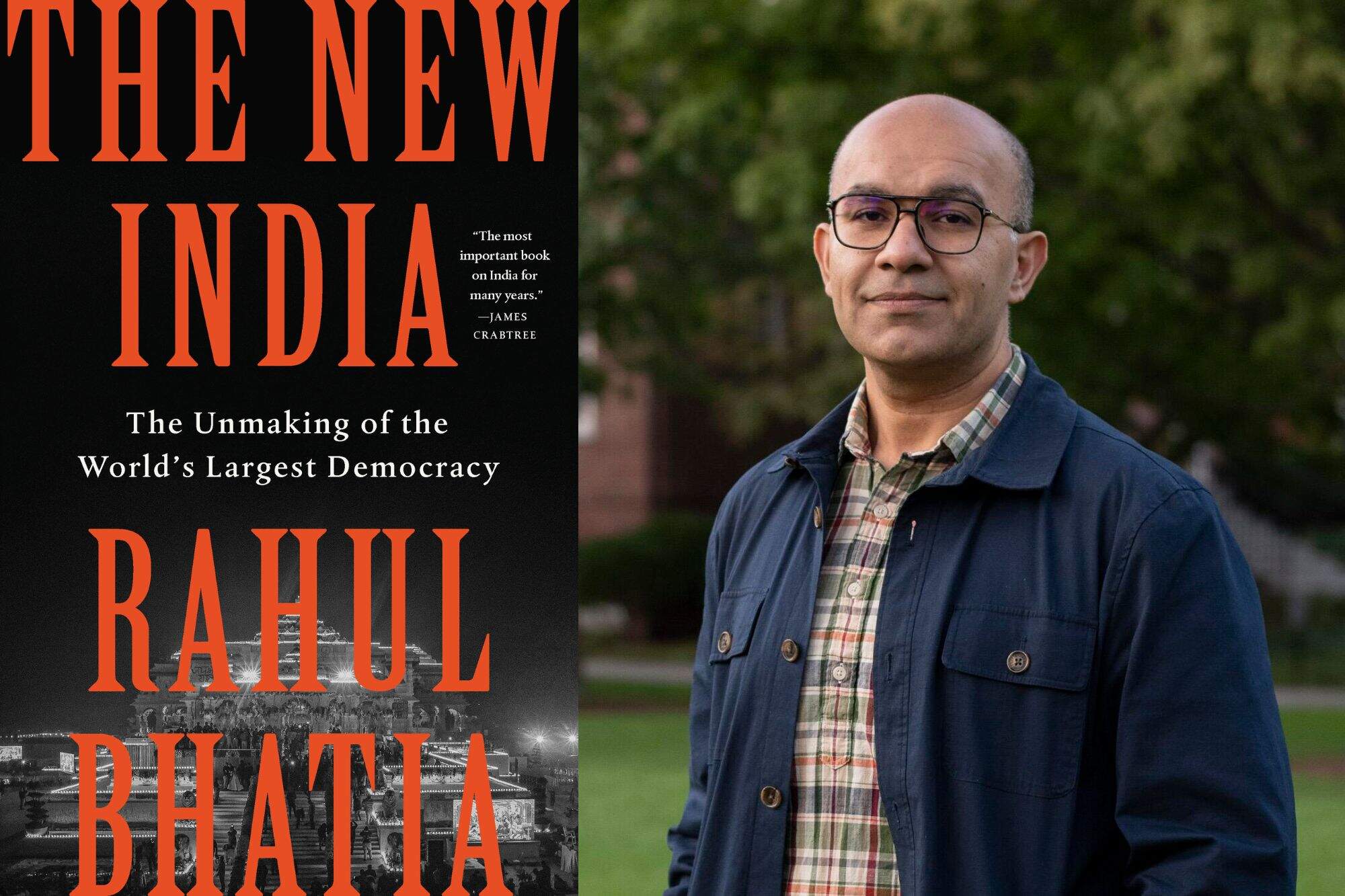
India is often called the world’s largest democracy. But 10 years of rule by Prime Minister Narendra Modi and his Hindu nationalist party have taken India’s government in an authoritarian direction, from crackdowns on free speech and the media to widespread persecution of Indian Muslims.
Here & Now's Deepa Fernandes talks to journalist Rahul Bhatia about his new book, "The New India: The Unmaking of the World’s Largest Democracy."
Book excerpt: 'The New India: The Unmaking of the World's Largest Democracy'
By Rahul Bhatia
A decade or so ago, people I loved began to go mad.
There was a man I adored, a relative, who was funny even when he stood still. He emerged from his bathroom every morning in a banian and towel, his large smugglerish face coated in shaving lather. Sometimes he wore sunglasses while he shaved, an act that made his brothers chuckle and his wife groan. Never could a straight reply be extracted from him, not about lunch, or where his children were, or what time he would return from the shop, or where the keys to the scooter were. I watched his stamina for turning everything into comic material in awe, and tried to match him, joke for joke, to establish our connection. So it was strange when he began to speak passionately about Muslims, arguing that they were less than human, and that India had to become a Hindu nation to save itself. Muslims had been absent from his conversations before, but now they were everywhere. He had decided he was oppressed, that he had been in hiding with his thoughts, and nothing could shake his conviction. Now he was full of dark notions whose paths led to danger, but he did not see it that way. The future he envisaged burgeoned with opportunity, and there was a jaunty optimism in his bearing that I recognised as triumphalism. He had aligned himself with the fortunes of a political party as if it was a sports team. His team was about to win the 2014 elections.
Before or after his man won – I cannot remember when – his smiley-faced jokes acquired a touch of arsenic. He sent me edited video clips and invented headlines that depicted the country in twisted ways I did not recognise at all. It was clear that secularism represented a past he wanted to break with; one that included generations of flawed and corrupting leadership by the Congress party; the traitorous behaviour of liberals; and a compromised media. Not just politics, he wanted the nation-state rebuilt.
He picked up disparaging words that had become acceptable by dint of their unthinking repetition, and took pleasure in the discomfort they caused. Bristling at one, presstitute, I brought to his notice that the phrase and its implications included me. I wondered if reminders of our bond would bring him back, but those were early days, before it became clear that the condition was autoimmune, emerging from within. He made sure not to speak the word in my presence from then on, but there were other words ready to channel the feelings he had kept to himself. The vocabulary seemed to have one purpose: to strip people, ideas and expectations of their language and join new meaning to them. And as he unveiled this unsettling lexicon in waves, it came to feel like a project of deconstruction. Week after week, as the extent of his transformation became clearer, I felt him pulling away from my memory of his previous self. It was not so much a descent into paranoia as much as his having found peace.
Then another person I was fond of, who had not yet found success in business, became obsessed with Ayodhya, the site of a mosque demolished by Hindu mobs in the nineties, when he was young. He could not be shaken out of the belief that a temple for the god Ram had to be built on that very spot. It had nothing to do with him, but he insisted it was important. Then a relative took to calling Rahul Gandhi, one of the leaders of the ruling Congress party, ‘Pappu’ – simpleton, or fool – a word that Narendra Modi’s supporters used gleefully about him. An aunt’s partner, a genial man who treated me to milkshakes and onion rings when I was small, told me one day to be wary of Muslims. ‘They don’t see themselves as Indians. Jaat hi alag hai.’ They are made of something different, he said. My aunt would join in: ‘You don’t know. They’re savages. I’ve seen what they’re capable of.’ Two thoughtful friends with kind hearts felt comfortable enough to talk about the howling from the ‘mozzies’ minarets near our home.
Eventually, this dispossession came closer. A relative who measured his life in the obligations he had fulfilled, who believed in carrying people along, who had never held any political opinions, much less strong ones, would tell me, when we met and talked sometimes, that the country needed a benevolent dictator, a strong leader. The phrases were interchangeable. Modi, then the chief minister of Gujarat, was the man he had in mind. I expressed reservations. ‘But India is a big country,’ he responded. ‘It’s not his fiefdom. Do you think he will be allowed to do what he wants if he becomes prime minister? It will not happen.’ His confidence came not from a faith in India’s institutions but from the belief that the country’s systemic slowness would restrain a leader’s worst impulses. We began to argue; I thought he was unwise, and he thought I was ‘extra-smart’ – a fool who thought himself wise. Once, during an argument, he became exasperated and said, ‘Why don’t you convert to Islam?’ We kept our distance from each other for some time.
This played out in other families, with other sets of friends. Acquaintances reported, in confusion, that they too had lost family members, including parents, to the condition. No one really knew what they believed in. Our elders had raised us with values that they had abandoned themselves.
Like moisture that warps paper, something unseen was changing us. Reasonable people said worrying things about democracy and minorities, and began to amplify the triumphant messages of Modi’s party. Trying to change their mind was pointless. For the Bharatiya Janata Party, to which Modi belonged, history was as much a priority as the present and future. It needed old injustices to remind its Hindu constituents of Muslim conquerors and the dangers they posed. That was where its power lay: in the narrative of eternal danger and vigilance. Our families heard these messages and made these concerns their own. Arguments would time-travel, hopping back centuries until a suitable villain, usually a Muslim, was found. It weathered my defiance. The people I loved were emboldened to reveal this new side of themselves all at once, armed with facts plucked from here and there, which they thrust like daggers in a fog. They had become true believers.
If it wasn’t for these transformations, this book would probably not exist. There would be nothing to unravel, no language and ideology to interpret. But a new kind of India was emerging, and the old norms of secularism and equality – however flawed their execution – were being cast off. This unfamiliar country had begun to justify even murder if the occasion demanded it. I did not understand it, and so I tried to.
This book is a reported elegy, an investigative memoir, an attempt to see the roots of Hindutva, the unbending ideology of Hindu extremism. It follows riot victims, perpetrators and police (some names have been changed to protect sources). It examines structural weaknesses that allow governance to be hijacked by religious and commercial interests. It pieces together fragments of history to bring the present into focus. It looks into the surprising origins of India’s identification project. It tries to find, as the book’s main character asks, where the poison is coming from.
Excerpted from "The New India: The Unmaking of the World's Largest Democracy" by Rahul Bhatia. Published by PublicAffairs. Copyright © 2024 by Rahul Bhatia. All rights reserved.
This segment aired on November 20, 2024.