Support WBUR
World's longest happiness study shows strong relationships are key to a fulfilling, healthy life

The longest scientific study of happiness began in 1938 and is still ongoing. It now tracks multiple generations, researching what makes a good life and what brings happiness and good health. Strong relationships stand out as the key.
And it's not just marriages and romantic partners, but friendships. Making connections with co-workers, neighbors, people in your community, and even strangers you encounter in daily life is vital to happiness.
Here & Now's Scott Tong speaks with Dr. Robert Waldinger — the director of the Harvard Study of Adult Development — about what the study shows about the importance of relationships, how they benefit overall health, and how we can improve our own personal connections at any stage of life. Waldinger is also a co-author of “The Good Life: Lessons from the World’s Longest Scientific Study of Happiness.”
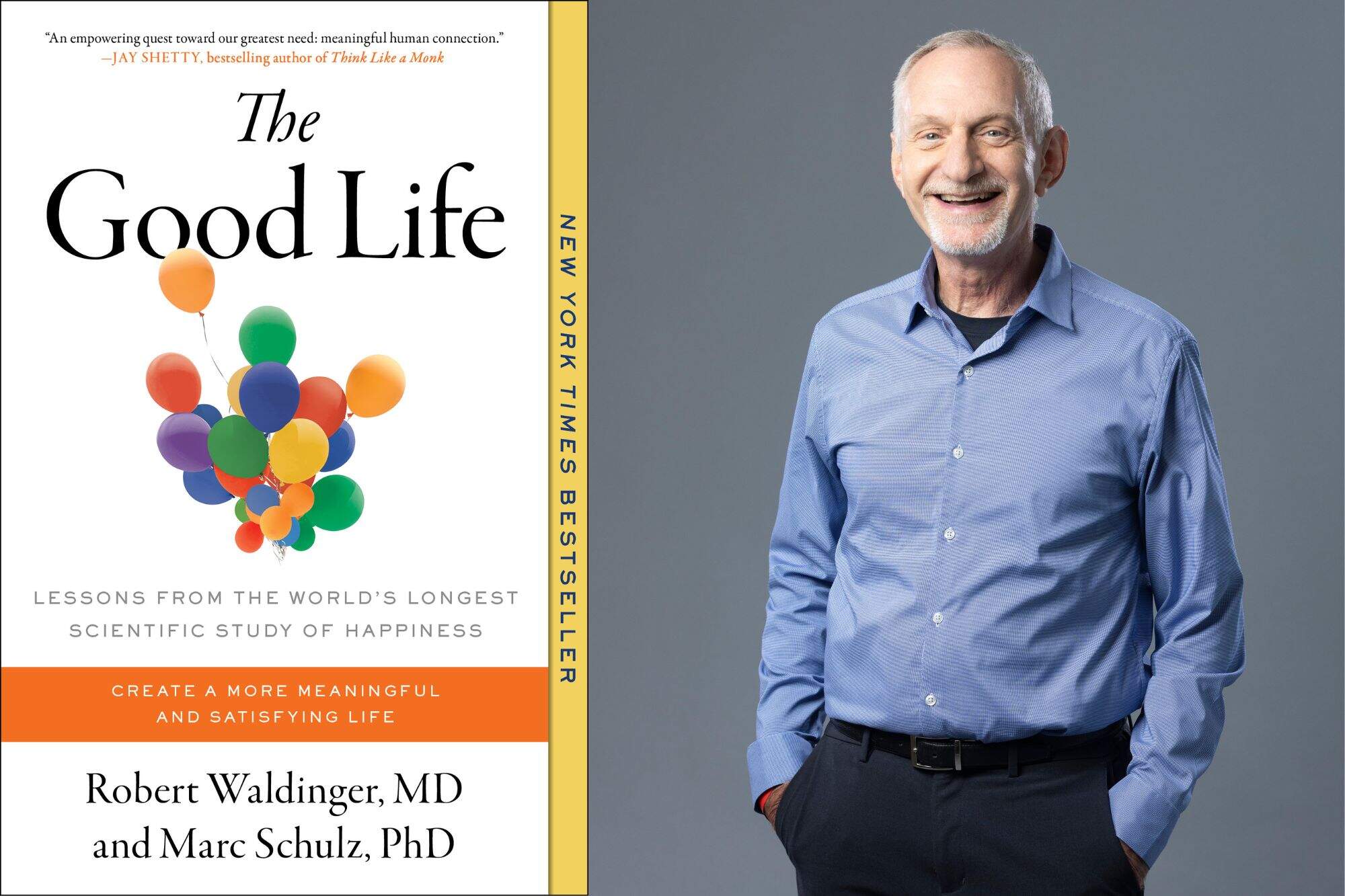
Book excerpt: 'The Good Life'
By Robert Waldinger and Marc S. Schulz
Chapter 1: What Makes a Good Life?
There isn’t time, so brief is life, for bickerings, apologies, heartburnings, callings to account. There is only time for loving, and but an instant, so to speak, for that.
Mark Twain
Let’s begin with a question:
If you had to make one life choice, right now, to set yourself on the path to future health and happiness, what would it be?
Would you choose to put more money into savings each month? To change careers? Would you decide to travel more? What single choice could best ensure that when you reach your final days and look back, you’ll feel that you’ve lived a good life?
In a 2007 survey, millennials were asked about their most important life goals. Seventy-six percent said that becoming rich was their number one goal. Fifty percent said a major goal was to become famous. More than a decade later, after millennials had spent more time as adults, similar questions were asked again in a pair of surveys. Fame was now lower on the list, but the top goals again included things like making money, having a successful career, and becoming debt-free.
These are common and practical goals that extend across generations and borders. In many countries, from the time they are barely old enough to speak, children are asked what they want to be when they grow up—that is, what careers they intend to pursue. When adults meet new people, one of the first questions asked is, “What do you do?” Success in life is often measured by title, salary, and recognition of achievement, even though most of us understand that these things do not necessarily make for a happy life on their own. Those who manage to check off some or even all of the desired boxes often find themselves on the other side feeling much the same as before.
Meanwhile, all day long we’re bombarded with messages about what will make us happy, about what we should want in our lives, about who is doing life “right.” Ads tell us that eating this brand of yogurt will make us healthy, buying that smartphone will bring new joy to our lives, and using a special face cream will keep us young forever.
Other messages are less explicit, woven into the fabric of daily living. If a friend buys a new car, we might wonder if a newer car would make our own life better. As we scroll social media feeds seeing only pictures of fantastic parties and sandy beaches, we might wonder if our own life is lacking in parties, lacking in beaches. In our casual friendships, at work, and especially on social media, we tend to show each other idealized versions of ourselves. We present our game faces, and the comparison between what we see of each other and how we feel about ourselves leaves us with the sense that we’re missing out. As an old saying goes, We are always comparing our insides to other people’s outsides.
Over time we develop the subtle but hard-to-shake feeling that our life is here, now, and the things we need for a good life are over there, or in the future. Always just out of reach.
Looking at life through this lens, it’s easy to believe that the good life doesn’t really exist, or else that it’s only possible for others. Our own life, after all, rarely matches the picture we’ve created in our heads of what a good life should look like. Our own life is always too messy, too complicated to be good.
Spoiler alert: The good life is a complicated life. For everybody.
The good life is joyful… and challenging. Full of love, but also pain. And it never strictly happens; instead, the good life unfolds, through time. It is a process. It includes turmoil, calm, lightness, burdens, struggles, achievements, setbacks, leaps forward, and terrible falls. And of course, the good life always ends in death.
A cheery sales pitch, we know.
But let’s not mince words. Life, even when it’s good, is not easy. There is simply no way to make life perfect, and if there were, then it wouldn’t be good.
Why? Because a rich life—a good life—is forged from precisely the things that make it hard.
Adapted from "The Good Life: Lessons from the World’s Longest Scientific Study of Happiness" by Robert Waldinger and Marc Schulz. Copyright © 2023 by Robert Waldinger and Marc Schulz. Reprinted by permission of Simon & Schuster, Inc. All Rights Reserved.
This segment aired on February 11, 2025.