Support WBUR
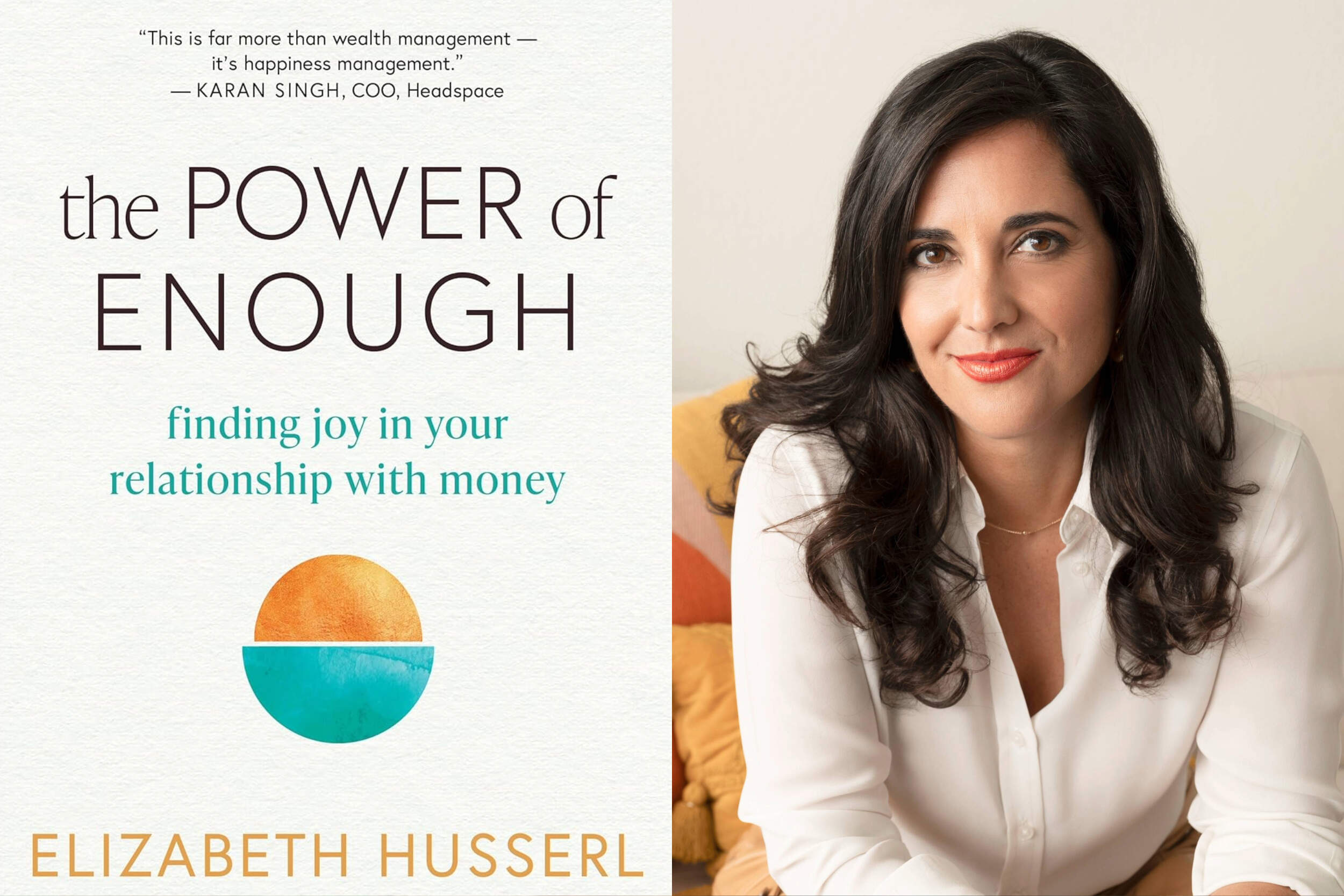
New book 'The Power of Enough' says wealth isn't only about money
Did you make a resolution this year to cut down on your spending, manage your budget or save more for retirement? And by now, has that resolution gone completely out the window?
A new book suggests that maybe you’re thinking about money the wrong way. In "The Power of Enough: Finding Joy in Your Relationship with Money," investment advisor Elizabeth Husserl says instead of seeing accumulating money as an end in itself, try thinking about money as something that can teach you about your life as a whole.
The book opens with an explanation of the time that Husserl lived in Oaxaca, Mexico, teaching indigenous women about microfinance. In Oaxaca, she observed that it’s a problem the way Americans let money define wealth.
“I was first kind of like confronted with the core problem that there is a difference between money and wealth and our issues with wealth is when we let it be defined by money,” Husserl says. “Working in these communities for two years just started to somatically change the way I was experiencing wealth. And so then I knew that my work wasn't in Oaxaca. My work was back in the states where people had so much and yet we continue to feel so poor.”
5 questions with Elizabeth Husserl
How did the people of Oaxaca think about wealth?
“I would constantly ask them what wealth meant to them, and their responses, to me, were wealth was community and ritual, and health was a big one. If they were healthy, they felt wealthy.
“And I would walk into their homes and there were dirt floors, and I could tell there was a lack of potentially material resources, but the experience and the connection, the intimacy and the vitality felt very different than some of the communities that I had been raised in the states or even in my college.
“I was like, ‘huh,’ there's a different experience of connection that is adding to their sense of wealth. Even though I was in the community trying to teach them a very tactical financial strategy to improve the financial stability, they had resources in all these other areas. And that's what they taught me. I was like, ‘Oh, wealth is so much broader than what I was taught in college.’”
In your book, you write, “Money is a mirror, one of our greatest assets and a teacher.” How does money teach us? Why are emotions involved?
“If we were to just kind of turn towards our relationship to money and start to kind of clear up the interference, we can see it for what it is. It is a tool. Right? It is a neutral tool that allows us to exchange things, that allows us to purchase things with money that we have or on credit. It allows us to engage in the material world, but it can't define us, and it can't define who we are or how trustworthy we are.
“And that's where it starts to get murky because we've lost a lot of those intimate connections that I would see in these communities in Oaxaca where everyone knew each other. So, people trusted you even if you didn't have a dollar in your bank account. That wasn't what was important. Here, we have lost a lot of those intimate relationships. We're going through an epidemic of loneliness, and so we use money to replace how we trust each other, and that's when it starts to get murky.”
What is behavioral finance?
"Behavioral finance is a study that looks at people's behaviors and attitudes and what is the underlying psychology and how people make money decisions. A lot of it is influenced by how we feel about things, how confident, our sense of security, our emotions around it.
“When we understand the underlying emotions in our relationship to money, we bring a lot more awareness to helping us create strategies that work with us or for us. So, for example, some people feel a lot of anger in their relationship to money or avoidance or entitlement or disgust. I mean, there's so many words that we can insert there, and we start to clear up the interference and recognize, ‘What am I really angry about? What am I really scared of?’ We start to really get clear. ‘Oh, yeah, that's what I can start to take agency and redesign and redefine in my life and not scapegoat money.’ Right? Because what happens is that when we scapegoat our relationship to money, we give our power away.
“When I'm working with clients, I help them create super specific strategies and their financial stability slice of the pie. But I define wealth so much more holistically to include 11 other aspects, right, that are based on human needs. And that's really important because I tell my clients, my job is only half done when we create a financial plan. Now let's turn to these other areas in your life that define your true experience of wealth and see how fulfilled are you. Are you feeling scarcity there? Is there poverty there? And let's get super clear on what strategies we're using with the use of money, and here more importantly, without using money, to break dependency that money is the only way that we can feel satisfied.”
Explain what you mean by ‘satiated’ in your book.
"The feeling of satiated is how we truly start to embody wealth instead of just accumulating it. And it's really important.
“We are wired to seek. Scarcity brain is a real thing because that's how our ancestors kept us alive and survival, but if you start to tap into how your body can viscerally feel fulfilled and the easiest example is we all know what a nourishing meal feels like versus empty calories. You're like, ‘That hit the spot,’ versus, ‘Oh my gosh, what did I just eat?’ And when you start to recognize the ways in which you feel fulfilled and allow those moments of meaning to compound inside of you, now you start to build a different wealth portfolio, right?
“We love compounding interest in our investment accounts. We can do the same thing in our experiences of wealth and start to get really savvy on how we're creating more of those. And again, sometimes without using money and we start to break the dependency of like, ‘Oh, I can only feel happy if I have more money.’ I argue that you can start to feel happier and more joyful in your life without adding one more dollar to your bank account.”
What could we concretely do if we are feeling unsatisfied right now?
" I think the easiest one, again — you don't even have to buy anything — is grab a piece of paper or a journal. And for the next 30 days, do a 30-day satiation journal. And at the end of each day, write three things that satisfied you, where you felt fulfilled. It could be a meaningful conversation, it could be something that you finished at work, it could be feeling the wind on your skin or a sunset and just start to recognize, how are you feeling satisfied in your life? Don't bring any judgment to it. Just write it down.
“After 30 days, go back and read them and be like, ‘What are the strategies that I actually already know how to employ and how can I start to bring those strategies to the end areas that I'm feeling lack?’ So bring the things that are working to the things that aren't working, and we start to open up new windows of possibility and that's what starts to give us agency and how we experience our relationship to money, but ultimately our relationship to wealth.”
Emiko Tamagawa produced and edited this interview for broadcast with Todd Mundt. Allison Hagan adapted it for the web.
Book excerpt: 'The Power of Enough: Finding Joy in Your Relationship with Money'
By Elizabeth Husserl
Reprinted with permission of the publisher. All rights reserved.
This article was originally published on March 03, 2025.
This segment aired on March 3, 2025.