Support WBUR
'Murder the Truth' describes movement to gut press protections from libel
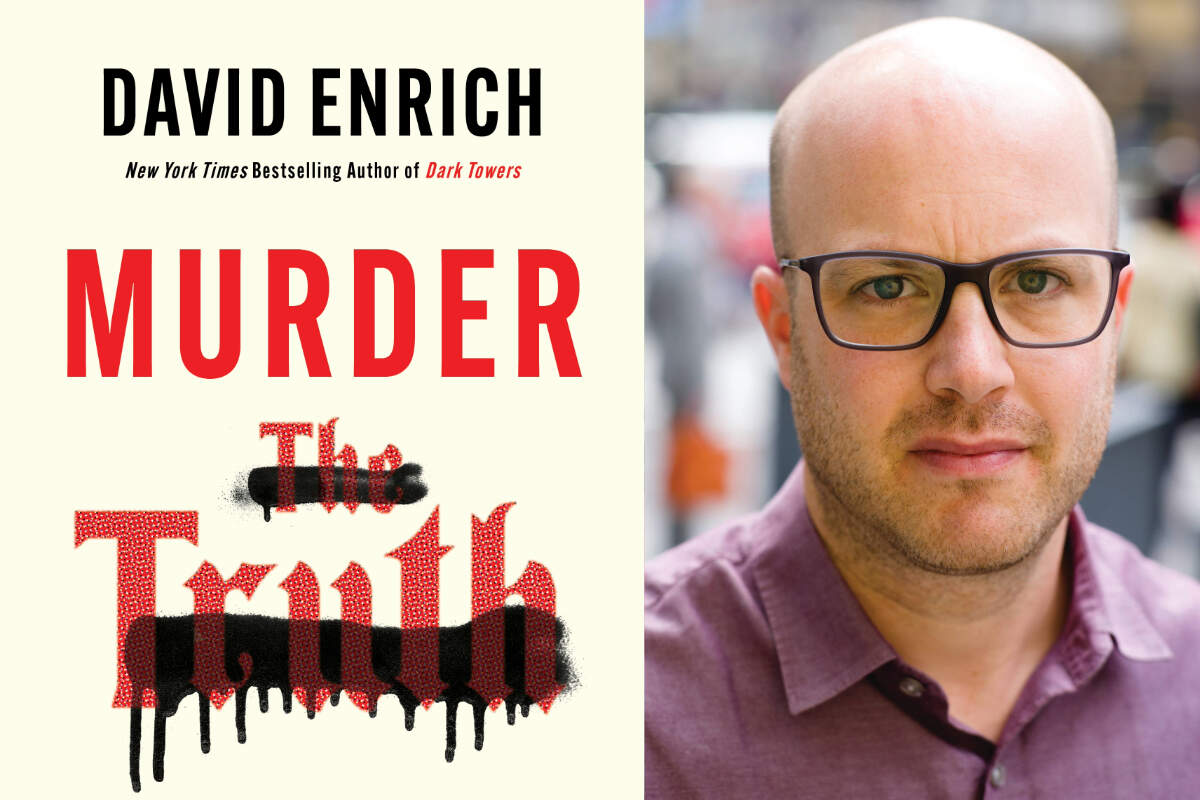
Author David Enrich writes about a building conservative movement pushing back against media freedom by trying to bring down the 1964 Supreme Court precedent that provides some protections for news organizations from libel lawsuits.
Here & Now's Scott Tong speaks with Enrich, author of "Murder the Truth: Fear, the First Amendment, and a Secret Campaign to Protect the Powerful." He’s business investigations editor for the New York Times
Book excerpt: 'Murder the Truth'
By David Enrich
This book is the story of a largely under-the-radar legal movement that is weaponizing the obscure field of libel law—a campaign whose growing momentum has closely tracked the country’s increasing flirtations with authoritarianism.
At first glance, libel law might seem an unlikely venue for a battle with high stakes for American democracy. Accusations of libel—publishing or writing something that injures someone’s reputation—are nothing new. For a long time, they were settled by duels and other forms of violence. In medieval England, libel was punishable by, among other things, cutting off the offender’s tongue. Gradually punishments evolved from mutilations to monetary and sometimes even criminal penalties. People’s reputations were at least as valuable as their property. Stealing their stuff was a punishable offense. So, too, should be impugning their characters through lies and deceit. Countless victims—ranging from businesses harmed by false news reports to poll workers or grieving families defamed by extremist conspiracy theorists like Alex Jones and Rudy Giuliani—were awarded money to compensate for the reputational harms they suffered. It was a mark of a well-functioning society that such grievances could be settled at a courthouse, not a dueling ground.
Yet long before a process server showed up at Guy Lawson’s house on behalf of a politically connected Albanian, businessmen, companies, and politicians had also been wielding libel lawsuits for a much less benign purpose: to muzzle their critics. What better way to deter people from speaking out than by making it crystal clear that such speech would be greeted with an overwhelming legal response?
Starting in the 1960s, the Supreme Court grew troubled by this dynamic and, in a series of landmark decisions, began making it harder for public figures to prevail in such legal actions. The court concluded that journalists and others shouldn’t be held liable when they accidentally got facts wrong about people in the public eye. (If someone was deliberately or recklessly spreading falsehoods, that was a different matter; nobody thought defamatory lies deserved protection.) The theory was that a vigorous, probing press was an essential safeguard of democracy, a key to holding the government and other institutions in check. If a public figure could seek debilitating damages every time a news organization made a mistake, the media would either start to censor itself or be sued into oblivion. Both scenarios ran counter to the
First Amendment’s guarantee of a free press—and the core American belief in the value of unfettered speech.
For the next half century, even as American politics grew increasingly polarized, there was remarkably broad agreement that the Supreme Court had gotten this right. Its string of libel decisions—beginning with its unanimous 1964 ruling in New York Times Company v. Sullivan—was generally regarded with reverence. As recently as 2010, Congress passed a law celebrating the country’s commitment to defending Americans from weaponized libel claims. In a barely recognizable act of bipartisan unity, not a single lawmaker voted against the legislation.
And then, in the space of only a few years, that consensus crumbled.
Donald Trump was a crucial catalyst. Beginning in 2016 and continuing through 2024, he relentlessly demonized the media as “evil,” “criminals,” and “the enemy of the people,” applauding violence, threatening to revoke TV networks’ licenses, and floating the idea of jailing reporters. There is a long history, of course, of politicians attacking the news media. What set this apart was not just Trump’s rhetoric but also his success. He convinced broad swaths of the public that journalism itself was illegitimate, that its articles, fact checks, and exposés were not to be trusted—a belief that was enhanced at times by some journalists shirking their roles as open-minded seekers of truth and instead donning the robes of ideologues. As this distrust took root among millions of Americans, it would become much easier to justify the curtailment of long-standing press freedoms and for politicians, business executives, and others to escape accountability.
But more subtle forces were also at play, including the emergence of a clique of high-powered lawyers who, motivated by a mixture of profits and politics, specialized in attacking journalists and others on behalf of Russian oligarchs, opioid-pushing executives, corrupt politicians, scandal-plagued celebrities, and many others who were the subjects of unfavorable media coverage.
The successes of these lawyers soon inspired hordes of copycats, ushering in a perilous new era in which those who criticized or even scrutinized the powerful often provoked a barrage of legal warfare. An onslaught of letters threatening litigation prompted news outlets to pull punches as they investigated deep-pocketed people and companies. It wasn’t just journalists. Members of the public who posted nasty restaurant reviews or complained about local construction projects found themselves in the crosshairs. Libel lawsuits, even those chucked out of court at an early stage, sometimes drove community newspapers and independent bloggers to the brink of bankruptcy. That, in turn, exacerbated a crisis in which thousands of newspapers have vanished and tens of millions of Americans now lack reliable sources for local news—a trend that has contributed to the spread of disinformation, the polarization of politics, and a new era of impunity for elected officials and big companies.
Excerpted from the book "Murder the Truth," provided courtesy of Mariner Books, an imprint of HarperCollins Publishers. Copyright © 2025 by David Enrich. Reprinted by permission.
This segment aired on March 27, 2025.