Support WBUR
'Enough is Enuf' book explores the centuries-long effort to simplify English spelling
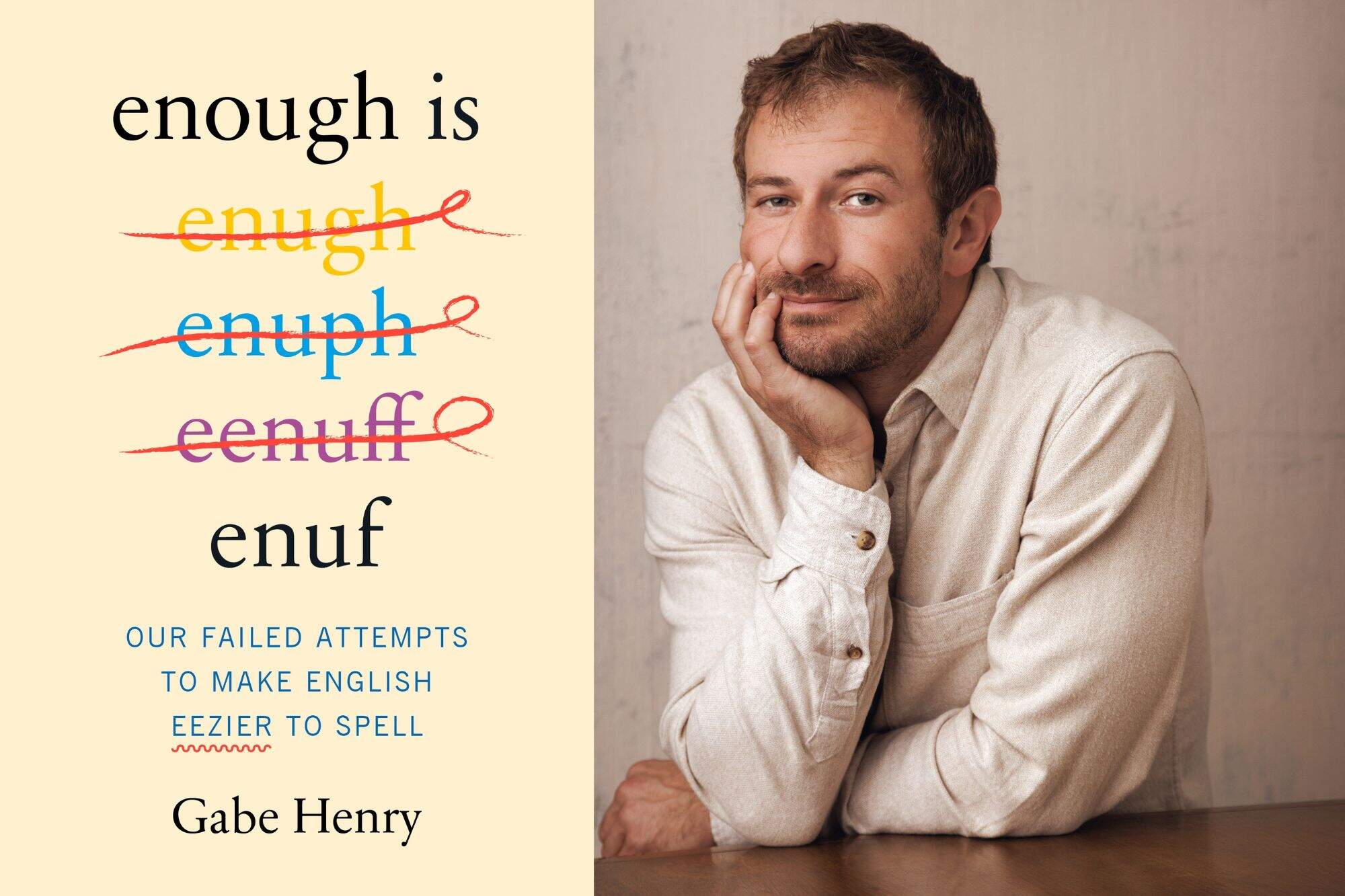
Ever since America was founded, there have been attempts to simplify how English is written.
Host Lisa Mullins talks about some of those efforts with Gabe Henry, author of the new book "Enough is Enuf: Our Failed Attempts to Make English Eezier to Spell."
Book excerpt: 'Enough is Enuf'
By Gabe Henry
Ol Men Are Created Ekwal
In the summer of 1859, a year before his election to the U.S. presidency, Abraham Lincoln received a curious letter in the mail. Addressed to “A. Linkon Esq.” and dated “Ogust 6,” it was written in the eccentric, phonetic stylings of the Simplified Spelling Movement.
“I trust u wil hav no difikulti in redin dis,” begins the letter. “U se it is ritn in de Fonetik Alfabet, and if u deturmin a letr in eni plas u deturmin it in evri plas.”
The sender, an impassioned Pennsylvania abolitionist named A.B. Pikard, urged the future president to join the anti-slavery cause, an issue Lincoln wouldn’t fully embrace until 1862. Citing the Bible (“luv di naber az diself”) and the Declaration of Independence (“ol men are kreated ekwal”)—with appeals to the “konstitooshn” thrown in for good measure—he challenged Lincoln to question not only his policies but his way of spelling, and, possibly, his very sanity.
Like most Americans at the time, Lincoln likely regarded “simplified spellers” (if he regarded them at all) as well-meaning cranks. While the nation teetered on the brink of war, these pedants fought the scourge of silent letters. They rebelled against our irregular English orthography—you know, the one that spells “mnemonic” with an m and “pneumonic” with a p—and proudly wrote busy as bizi, could as kuld, and enough as enuf. Recently, one overzealous reformer had even suggested replacing all vowels w1th n3mbers. They were the fanatical fringe—too silly to be taken seriously.
Yet buried beneath their linguistic antics was a deeper purpose—one that would, surprisingly, find common cause with the nation’s most urgent moral struggle. At its heart, simplified spelling was about more than just letters. It was about literacy, equality, and educational access. Naturally, these goals resonated with American abolitionists, and by the 1840s many had begun embracing simplified spelling as a tool to accelerate literacy among newly freed slaves. The cause of spelling reform thus joined with the movement for Black education—twin campaigns in the broader pursuit of equality—and in the years after the Civil War, spelling reformers and abolitionists alike would travel the South teaching freed slaves the principles of simplified, phonetic spelling.
One such reformer was Joseph B. Towe, a former slave himself from Norfolk, Virginia. Towe came from a musical background. After gaining his freedom in 1865, he traveled the South gathering and preserving spirituals, plantation songs, and other musical relics of slavery, which he would later perform for northern audiences. When and where he first encountered simplified spelling is unclear. Perhaps it was in the pages of the Wecli Fonetic Advocat (the local phonetic journal of “Sinsinati”) or in the American Fonografur (published out of “Nu-Yorc”). But by the time he returned to Norfolk, he was a convert. There, he opened a primary school and began teaching former slaves the basics of the new orthography.
Towe made a quick name for himself in the spelling reform underground. In 1876, he was an honored speaker at a convention of simplified spellers in Philadelphia. “Mr. Towe spoke for his rase,” read the proceedings of the convention, phonetically recorded in the official log, “and ov the great work to be dun in educating the colord peeple of the South. They…cannot be persuaded that silent letterz hav eny use.”
Also present at the 1876 convention was Eliza Burnz, inventor of “Burnz’ Fonic Shorthand” and founder of Burnz & Company, a publishing house that would print books about spelling reform well into the 1920s. (Burnz was so committed to phonetic precision that she named her own daughter Foneta.) Her state of Tennessee, just south of the Mason-Dixon Line, was the last to join the Confederacy and the first to fall to the Union. After the Civil War, it held one of the largest freed Black populations in the South, and Burnz would spend her postbellum years teaching former Tennessee slaves how to read and write. Like Towe, she found that the quickest path to literacy was through simplified spelling.
What did literacy mean, exactly, to a slave? Literacy meant survival. The ability to read and write offered not only intellectual independence—the ability to mentally escape while confined to the plantation—but also physical independence, as freed and runaway slaves relied on road signs and maps to navigate their environments. Even on the battlefield, soldiers understood the value of literacy for a life beyond bondage. “The spelling book was always carried with the rifle,” wrote the Southern Workman, reporting on Black soldiers in the Union Army, “[and was] often studied under fire.” After the fall of the Confederacy, many southern states would employ literacy tests to prevent former slaves from voting. Black voices were thus silenced in elections, and segregationist lawmakers remained in power to enact more policies of suppression, restriction, and control. Reading meant freedom. Literacy was life.
While Towe and Burnz were teaching simplified spelling to freed slaves in the South, Joseph Medill was editorializing for racial equality in the pages of the Chicago Tribune, the national newspaper that he ran from 1855 to 1899. Medill, a fervent spelling reformer and anti-slavery advocate, transformed the Tribune into the leading pro-Lincoln newspaper in the country, and in the years following the Civil War it was common to find Medill’s two targets of reform—slavery and spelling—woven together in op-eds, hailing “Linkin” and all that he had done for the great cause of “ablishun.”
The two causes came together most prominently in abolitionist literature. Angelina and Thomas Grimké, siblings from South Carolina, peppered their anti-slavery essays with simplifications like thro, tho, lov, pleas, believ, prais, deserv, purifyd, and qualifyd, and Cornelius Larison incorporated phonetic spelling into the fabric of the “slave narrative,” a popular genre of storytelling by and about African slaves that emerged in the late eighteenth century. Larison’s famous work is his 1883 biography Silvia Dubois (Now 116 Yers Old): A Biografy of the Slav who Whipt Her Mistres and Gand Her Fredom, about a six-foot-tall, 200-pound supercentenarian from New Jersey who escaped her “bо̆ndaġ” with a sharp right hook.
In the end, of course, simplified spelling never took hold. The movement dwindled, dismissed as eccentric or unnecessary, and America held tight to its archaic, jumbled spelling. Literacy tests emerged as a brutal instrument of Black voter suppression, barring countless freedpersons from participating in the democracy they had fought to join. Would simplified spelling have prevented that? Unlikely. But it might have loosened the grip of the gatekeepers, if only just a little—and let a few more voices in the conversation at a critical moment in history.
Lincoln—or Linkon—eventually replied to A.B. Pikard, but his response is lost to history. We don’t know if he challenged Pikard’s politics, or his spelling, or both. What we do know is that within a few years, Lincoln would give his full legislative support, and his life, to the cause of freedom. And whether inscribed in traditional or simplified English, the message endured: “Ol men are kreated ekwal.”
From the book 'Enough Is Enuf' by Gabe Henry. Copyright Ó 2025 by Gabe Henry. Reprinted by permission of HarperCollins Publishers.
This segment aired on April 15, 2025.