Support WBUR
Boston's Morning Newsletter
MBTA to close part of Red Line for 24 days this September — with plans for future 50 mph trains
Editor's Note: This is an excerpt from WBUR's daily morning newsletter, WBUR Today. If you like what you read and want it in your inbox, sign up here.
A quick programming note: WBUR Today will be off this coming Monday and Tuesday as our team works on some long-planned technical upgrades. We’ll be back in your inbox Wednesday.
Now, before you go peruse the new sand sculptures on Revere Beach, we have another busy day of news:
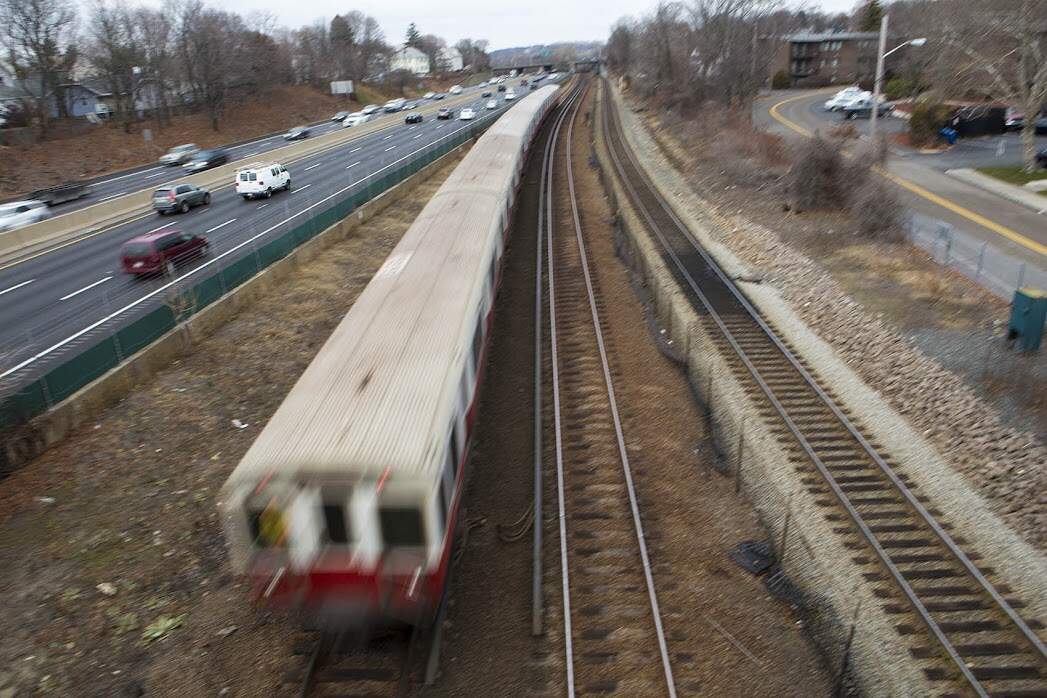
Your next big MBTA closure: While the greater Camberville area continues to slog through the current partial Red Line closure, MBTA officials are planning the next big diversion. The agency announced yesterday that they will close the Red Line’s Braintree branch for 24 days this September. From Sept. 6 to Sept. 29, there’ll be no train service at North Quincy, Wollaston, Quincy Center, Quincy Adams, and Braintree. (The T is still figuring out the shuttle bus plans.)
- Why? As South Shore riders are well aware, the Braintree branch has been the site of some of the T’s most stubborn, painful slow zones; several miles of the branch is restricted to 10 mph due to track defects. During the closure, the T say they’re aiming to remove over 20 speed restrictions and cut roundtrip travel times by 24 to 27 minutes when the branch reopens Sept. 30.
- The intrigue: T officials tell WBUR the track work will also lay “the groundwork” for their goal of running Red Line trains as fast as 50 mph on some parts of the Braintree branch. (The subway system's current maximum speed for trains is 40 mph.) Though the branch was designed for 50 mph speeds, the T says it’s been at least a few decades since they’ve been able to run trains that fast. Still, the timeline for returning to that 50 mph goal remains unclear, since the T says it will also require more planning and driver training.
- In the meantime: There are also a few shorter disruptions planned in August, including a 10-day closure of most of the Green Line’s B branch and a weeklong closure of the middle of the Red Line.
Heads up: A worldwide technology outage is affecting companies, hospitals and airlines this morning, including at Boston’s Logan Airport. Massport officials suggest checking on your flight before heading to the airport, particularly if you’re flying American Airlines or Delta. “Airport operations are still continuing for airlines that aren’t affected,” Massport spokesman Ben Crawley told WBUR’s Cici Yu.
- Mass General Brigham is also canceling all scheduled non-urgent surgeries, procedures and medical visits at its hospitals, health care centers and outpatient clinics today due to the outage.
- The MBTA says trains continue to run as planned, though the outage is affecting bus tracking and the commuter rail’s train location information.
What’s in the budget? Tuition-free community college for all Massachusetts residents. Online state Lottery sales. Free bus rides across all 15 of the state’s (non-MBTA) regional transit authorities. It’s all on the verge of becoming reality as part of the compromise budget deal State House leaders unveiled last night. State House News Service has more here on what’s in the $58 billion proposal, including free community college, which is slated to begin this fall.
- What’s next: The House and Senate plan to vote on the deal today, with the intention of getting it to Gov. Maura Healey’s desk before the weekend. (That leaves them just enough time to override any line-item vetoes before formal session ends on July 31.)
- Meanwhile: Both chambers also passed the newly unveiled gun safety bill yesterday, giving Healey 10 days to sign or veto it.
PSA: Massachusetts health officials have reported the state’s first confirmed case of measles since early 2020. The Department of Public Health said yesterday the infected person is an adult from Worcester County who recently traveled internationally. Dr. Larry Madoff, the medical director of the state’s Bureau of Infectious Disease, told WBUR’s Dan Guzman that teams are working to find anyone who had contact with the infected person to make sure they’ve been (or get) vaccinated against the disease. “If we hear about it in time, we can actually vaccinate people and prevent secondary cases,” he said.
- The big picture: Measles had once been virtually eliminated in the U.S. However, there’s been a dramatic jump in infections over the past year — both in the U.S. and worldwide. Officials say the rise in cases is largely due to declining vaccination rates.
- By the numbers: According to CDC data, 84% of the 167 measles patients identified in the U.S. this year were unvaccinated.
P.S.— What big project has a new timeline after getting a $1 billion federal grant? Take our Boston News Quiz and test your knowledge of this week’s stories.