Support WBUR
Boston's Morning Newsletter
Saint Anthony's Feast returns to North End with new rules after 'unruly behavior'
Editor's Note: This is an excerpt from WBUR's daily morning newsletter, WBUR Today. If you like what you read and want it in your inbox, sign up here.
Gov. Maura Healey is reportedly scheduled to get her moment in the spotlight tonight at the Democratic National Convention.
But first, the news:
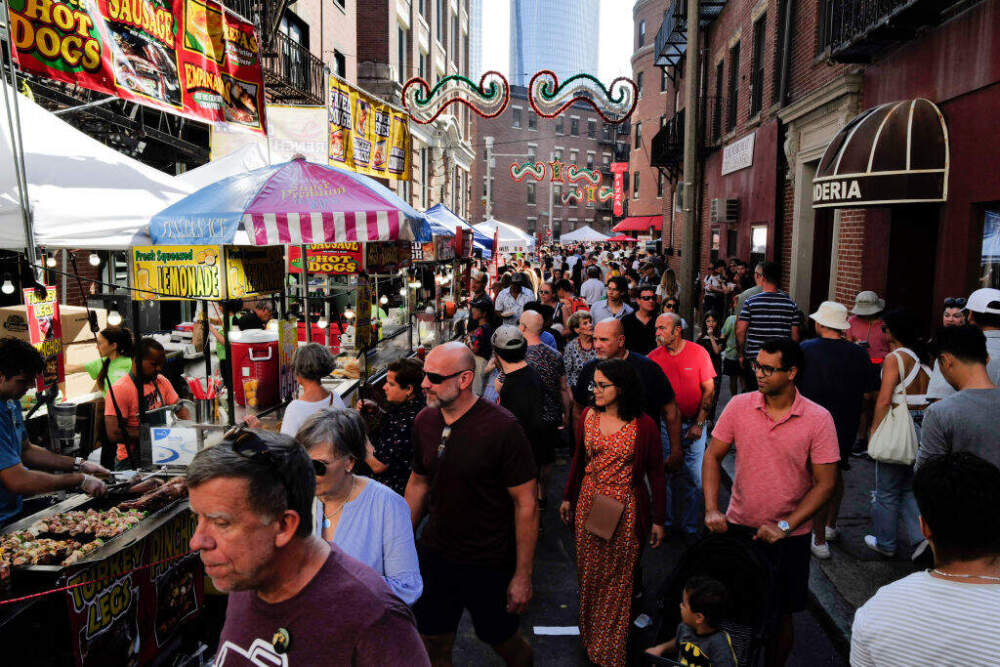
In the North End: Saint Anthony’s Feast weekend gets rolling tonight, a rare opportunity for outdoor dining in the iconic neighborhood. Organizers expect up to 300,000 people over the next four days for religious processions, live entertainment and lots of Italian food. However, there will also be new rules and restrictions to keep things family friendly and crack down on underage drinking. “It's in response to some unruly behavior by some underage folks over the past couple of years and at all of the other festivals in the North End this summer,” Saint Anthony’s Feast organizer Mike Bosco told WBUR’s Paul Connearney.
- For the first time this year, “anyone under the age of 21 will have to be accompanied by a parent,” according to Bosco. “The parent needs to stay and remain with them throughout the time that they're in the festival area,” he said. There’ll also be extra security monitoring the entrances.
- The feast will also wrap things up at 9 p.m. — two hours earlier than its 11 p.m. closing time in years past.
- Pro tip: Finding parking in the North End will be even more difficult than usual, so consider taking the T. Haymarket and North Station are the closest stops.
- Before you go: Check out the feast’s full schedule and scroll through all the vendors here.
After affirmative action: MIT is welcoming a less-diverse class this fall compared to previous years, and the university says it’s because of the Supreme Court ruling last year that ended affirmative action. Stu Schmill, MIT’s dean of admissions, told WBUR’s Dan Guzman that — as expected — the court decision led to a drop in students from historically underrepresented groups for the incoming Class of 2028.
- What’s different: In the last few years, 25% of MIT’s incoming students identified as Black, Hispanic, Native American or Pacific Islander. But for the Class of ’28, that dropped to 16%. (The same group makes up an estimated 45% of all K-12 students nationally.)
- What’s the same: The incoming class is not any more or less accomplished when it comes to the admission office’s “quantifiable characteristics,” like high school grades or standardized test scores. “Many people have told me over the years that MIT ought to care only about academic excellence, not diversity,” Schmill wrote in a blog post yesterday. “But every student we admit, from any background, is already located at the far-right end of the distribution of academic excellence.”
- Go deeper: Schmill said racial inequality is especially pronounced in STEM fields, because Black and Hispanic students are less likely to attend high schools where subjects like calculus, physics and computer science are taught. Read more here.
- What’s next: For decades, MIT has sponsored programs to expand K-12 access to advanced STEM courses. Last year, it also announced students from families making less than $75,000 a year would not be charged tuition. However, MIT President Sally Kornbluth suggested yesterday they must do more to increase racial diversity amid the new legal restrictions.
Trending down: Money isn’t flowing like it used to for Greater Boston’s biotech sector. A new report from the global real estate service firm Savills found that local investment was down through the first half of the year, even as the life sciences sector has seen an increase in funding nationally, WBUR’s Zeninjor Enwemeka reports.
- By the numbers: Investors have poured $3.7 billion into Boston’s life sciences sector so far this year. That’s down roughly 20% compared to the same time last year.
- Why? Chris Gorczyca, the head of the life science brokerage team at Savills, says local venture capitalists are taking a harder look at companies before investing. “VCs are really looking for founding teams that have sort of been there and done that before,” Gorczyca told Zeninjor. “And so I think the Boston market is just, you know, being a little more prudent with some of their investments.”
- The big picture: Greater Boston remains a top life sciences hub — and Gorczyca says he’s optimistic about future funding as big pharma companies continue to expand their footprint here.
Not again: There’s yet another delay to transition five Massachusetts hospitals out of the hands of the bankrupt Steward Health Care. WBUR’s Martha Bebinger reports a bankruptcy court judge was expected to review agreements today. However, the hearing has been postponed (again) until next Tuesday.
- Why? Martha reports that court filings suggest Steward, the hospital landlords and lenders can’t agree on how to split sale proceeds of four hospitals: Saint Anne’s in Fall River, Good Samaritan in Brockton, Morton Hospital in Taunton and Holy Family in Haverhill and Methuen. Meanwhile, landlords are challenging Healey’s attempt to seize Saint Elizabeth’s in Brighton.
P.S.— This week’s episode of The Common features a conversation with WBUR powerhouse reporter and interim Morning Edition host Deborah Becker. They talk all about her longer career and her long love of food. Listen to it here!