Support WBUR
Review
Louise Erdrich's 'The Mighty Red' is a tale of love, regret and second chances
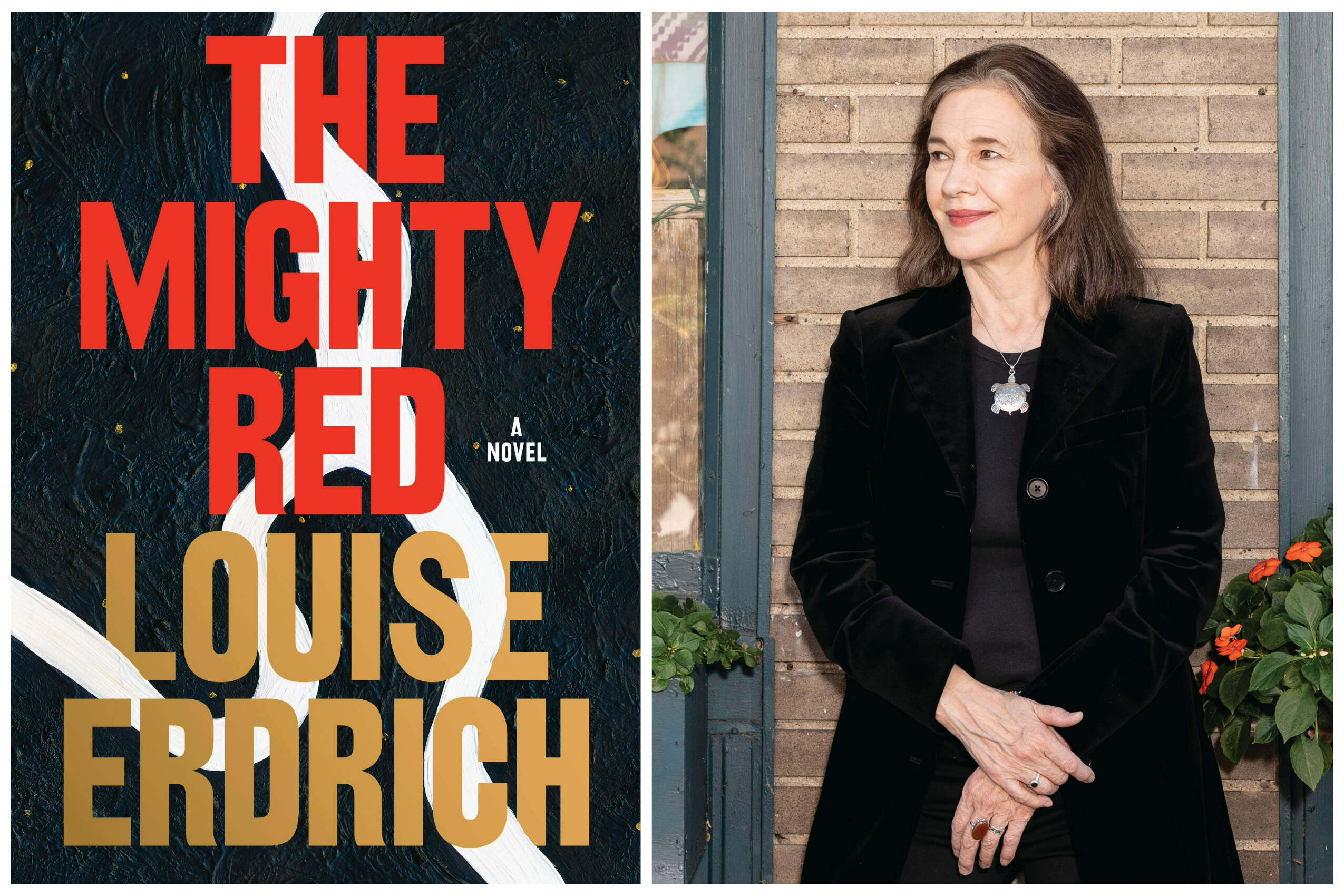
It’s a singular pleasure to read a novel that begins with the everyday struggles of ordinary people and steadily builds into something larger, linking the quotidian with the profound. That is the potent splendor contained in Louise Erdrich’s works, and it continues with her latest novel, “The Mighty Red.”
Set in and around the small town of Tabor in North Dakota’s lush Red River Valley during the Great Recession, this is a generous-hearted tale of competing loves, wistful regrets and second chances.
Erdrich, whose writing has garnered numerous prizes, including the 2021 Pulitzer Prize in Fiction for “The Night Watchman,” has set most of her novels in Minnesota and North Dakota. However, in the 1970s, Erdrich forged a literary connection with Boston that proved transformative: her stint as an editor for the Boston Indian Council newspaper, The Circle.
In an interview in the June 1991 Writer’s Digest, Erdrich said: “Settling into that job and becoming comfortable with an urban community — which is very different from the reservation community — gave me another reference point. There were lots of people with mixed blood, lots of people who had their own confusions. I realized that this was part of my life … and that it was something I wanted to write about.”
In this novel, heritage is less of a factor than the varying economic situations and subtle class divisions among the families highlighted. “The Mighty Red” is told in rotating perspectives by the principal characters in a way that enables you to not only understand what drives their actions but see how they are viewed by one another. An omniscient narrator provides histories of the region with a voice that is in turn wry and mournful.
Crystal Frechette works a night shift trucking sugar beets from Diz Geist’s vast family farm to the local processing plant. Her marriage to Martin, a traveling theater arts teacher, has long settled into a bland convenience. Their daughter Kismet, a serious-minded high school senior, is torn between Gary, the school’s popular, somewhat clueless quarterback and heir to the Geist fortune, or 16-year-old Hugo, who possesses an intellect as searching as hers and with whom she feels most like herself.
“The Mighty Red” highlights many kinds of love: the wildfire that is young love; older love’s layers of forgiveness; the complicated loyalties of friendship; an indissoluble bond between mother and daughter.
Though they’re barely adults, Gary is desperate for Kismet to marry him, convinced that only she can drive away the nightmarish images that have plagued him since a terrible accident on the frozen Red River.
The accident is a nebulous dark veil that floats through the story, shadowing Gary as well as his mother Winnie and his best friend Eric. For most of the novel, the details are murky and are more powerful for remaining so. When the tragic night is ultimately revealed in all its awful inevitability, Erdrich does so with a deep well of compassion for everyone involved.
Hugo, considered by his peers to be “a home-schooled genius,” looks and acts much older than his years. He works part-time in his mother’s bookstore, studying and saving up to head west to land a lucrative job in fracking. He’s playing a long game to win over Kismet. Hugo’s plans are madly speculative, and yet he is utterly believable, and highly entertaining, posing as a 20-something engineer.
It’s no surprise that Erdrich, who owns Birchbark Books in Minneapolis, utilizes books to buttress the narrative. Hugo sometimes feels he “had to read novels in order to understand the sensations that engulfed him when it came to Kismet.” Selections for the book club to which Crystal, Winnie, Bev and Kismet belong include “Eat Pray Love” and “The Road,” anchoring the story in 2008 and 2009 as distinctly as Kismet’s beloved pink Motorola RAZR phone.
At first, the recession happens far off, in distant large cities. Then it arrives all at once in the form of a cataclysmic event: all the funds in the church’s large renovation portfolio, managed by Martin, are completely gone. And so is Martin. (A failed but talented actor, Martin had convinced the priest that “he was an investment guru who drove an old car like Warren Buffet.”)
His disappearance unleashes a series of disruptive, page-turning events that threaten to upend the town’s stability, his wife’s financial future and his daughter’s romantic decisions.
Again and again, Erdrich shows how one person’s actions, often years in the making, spark consequences that reverberate through the lives of others. Personal dramas play out against the rich landscape of the Red River Valley.
As in Erdrich’s previous novels, the main characters are all in some way connected to the land. But “The Mighty Red” incorporates the long-term effects of humans on the earth as an integral part of the story.
Diz considers farming to be war, which he wages with ever-stronger herbicides and pesticides, even knowing the dangers they pose to well water, wildlife and humans. His oldest friend Bill, a fellow farmer, has eschewed chemicals in favor of planting diverse crops; to the surprise of Diz and other farmers, Bill’s fields are slowly yielding stronger topsoil and welcoming back birds and beneficial insects.
Erdrich depicts time passing fast and slow, backlighting the rush of current events with the immense, slow turning of the earth. At his fracking job, Hugo analyzes dirt samples taken from thousands of feet below ground and is awed by seeing in these layers “the earth’s deep time.” It’s impossible to miss the irony of Hugo’s appreciation of the earth even as his job helps to deal mortal blows to it.
Alongside expansive histories of the sugar beet industry, fracking, and the migration of families to the Red River Valley, Erdrich can craft a sentence that sharply captures an entire saga, as when Martin considers his and Crystal’s heritage as Turtle Mountain people: “Their ancestors had hunted on horseback, then settled down to plant gardens and beg help from the Blessed Virgin.”
With multiple connected storylines set against sweeping histories of North Dakota and surrounding lands, “The Mighty Red” is at once a tender coming-of-age story and a wise tale of older love. The ever-afters here are scarred but hopeful, born of difficult choices and mercy for what can’t be undone.
Louise Erdrich will give a keynote presentation on "The Mighty Red" at the Boston Book Festival on Saturday, Oct. 26.