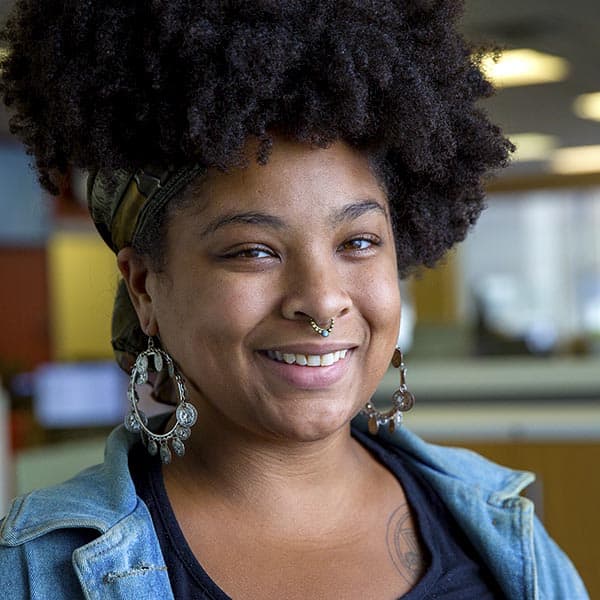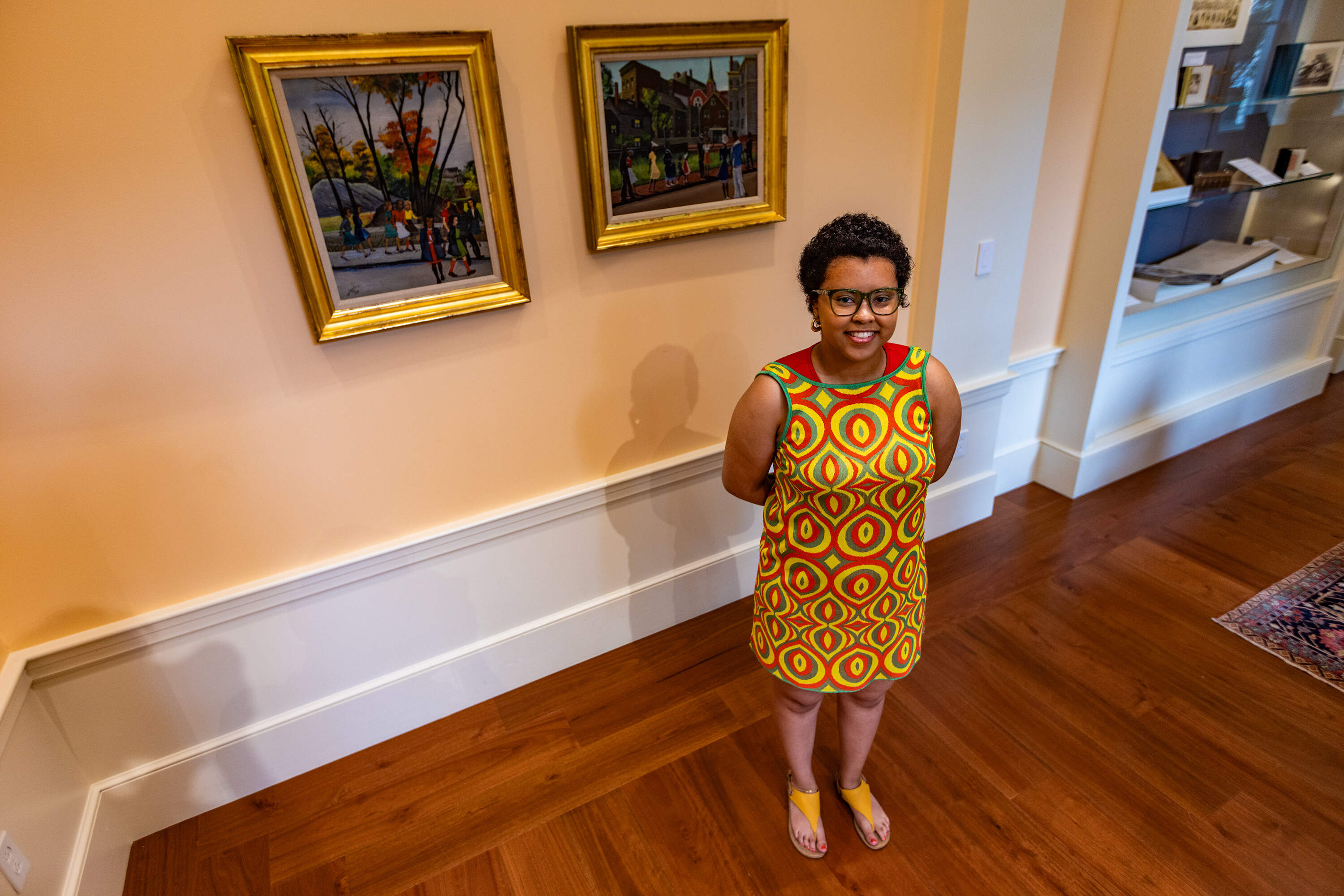
Curator Chenoa Baker uplifts artists of color while sharing her own story
Independent curator and writer Chenoa Baker has a picture of her great-great-grandparents. It’s a precious item for her and many other Black Americans — photographic evidence of ancestors can be rare.
“It's my great-great-grandfather sitting down. He's wearing a suit, darker skin, Black man,” Baker described. “Then you have my great-great-grandmother, who's actually standing, and she's wearing this hat and you can see how long her hair is and it's braided down her back”
Their faces are stoic, as was typical of photos of that time. But there’s deep meaning behind it. Her great-great-grandparents freed themselves from slavery. “I think that, in and of itself, is very powerful,” said Baker, adding that her grandparents' story has shaped how she approaches her curatorial work. “Being a free agent the same way that they were not only influences my practice but also is a factual part of my family line.”
Baker has worked with a number of artists and institutions, including Gio Swaby at the Peabody Essex Museum and Simone Leigh at the Institute of Contemporary Art/Boston. At the latter, she served as a fellow in the education and curatorial departments, and contributed to monographs and wall text for both the retrospective at the museum and for the U.S. Pavilion at the 2022 Venice Biennale.

“Most of the work that I do is actually in the background,” she said. “It's almost like the top of an iceberg. The show is what the public sees but a lot happens behind the scenes.”
The 24-year-old has a deep interest in contextualizing art produced by people of color. Born and raised in Syracuse, New York, Baker was surrounded by art growing up — her father was a photojournalist. “I was a little kid playing in his studio and seeing his camera set up and meeting different people that he interacted with,” Baker recalled.
But that experience didn’t necessarily catalyze her interest in the arts. She went to a small liberal arts school in Pennsylvania and knew that she wanted to find a way to create dialogue about issues like poverty, climate change and global inequality. She chose political science because she initially thought she’d go work for a big think tank. But after taking an introductory art history course, things changed.
“I found art to be an approachable way to talk about a lot of these issues,” Baker said. Her school also had a collection of African art from the 18th to 20th centuries. Being able to interact with it influenced her trajectory, and a burgeoning interest soon became a passion.
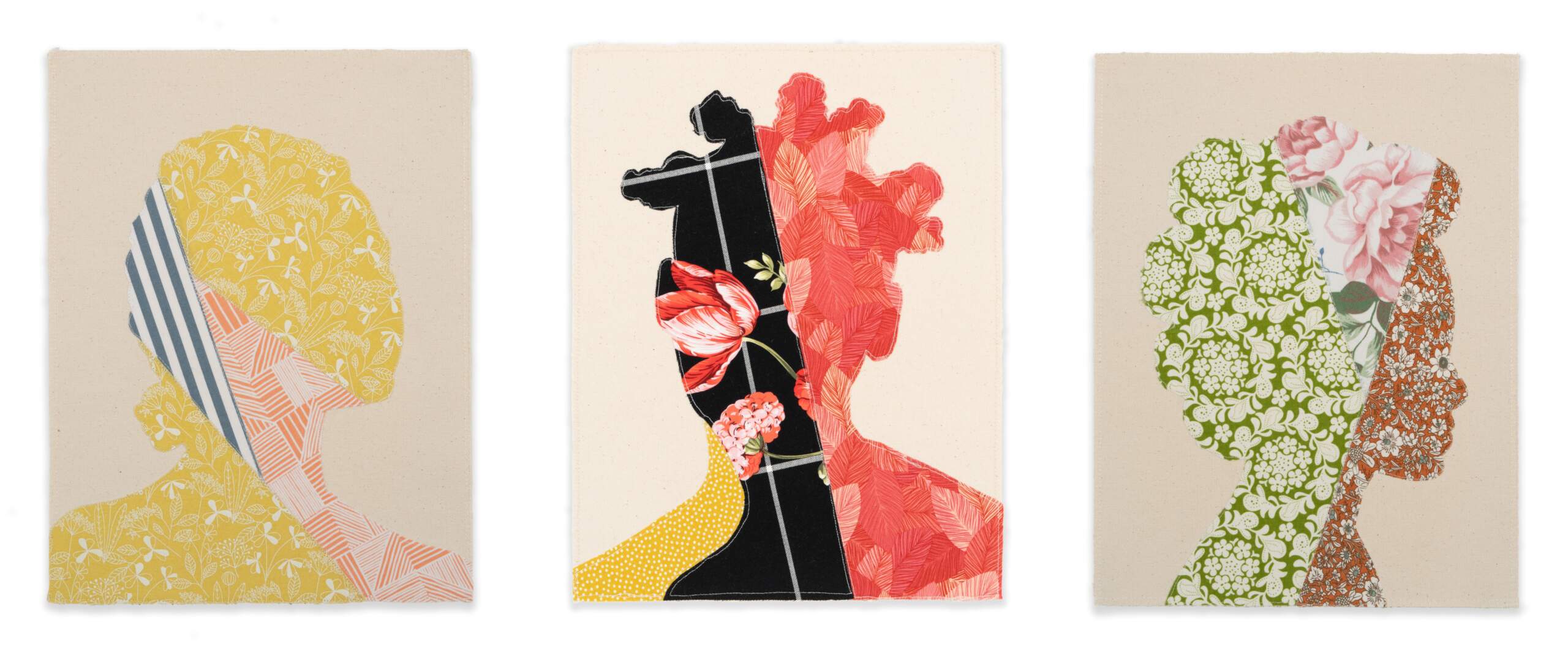
An internship at the Museum of Fine Arts brought Baker to Boston in 2021. There, she worked with Michelle Millar Fisher, the curator of contemporary decorative arts, who noticed Baker's unique approach to curation. “She thinks a lot about her inheritances from her family, from ancestors, from the ways in which she has cultural strands that she brings forward in her work,” Millar Fisher said.
The curator pointed out that, for young art professionals, it can be easy to fall in line and not question the way things work. But Baker brought a different point of view to the MFA. “I think she was really invested in and very thoughtful about institutional critique, or the ways in which institutional bureaucracies work,” Millar Fisher added.
During Baker’s internship, a 1970 document penned by local Black artist Dana C. Chandler resurfaced in the museum. In it, Chandler challenged the MFA to directly support Black artists and Black arts institutions. For Baker, this manifesto was a reminder of all of the things that needed to change in certain art spaces.
“I began to sign my emails, ‘Yours in Black (Art) Power,’ which is how Dana C. Chandler signed those documents,” she said. “Kind of like a wake-up call, like ‘Remember this.’”
Art institutions continue to grapple with problems like pay inequity, racism and the underrepresentation of artists of color in museum collections. According to a 2022 Mellon Foundation survey, only 27% of curators in the country are people of color.
Though the number seems low, it’s not necessarily indicative of how many people of color are actually performing the role of curator. “I think people who are doing the work may not necessarily take on that title for a number of reasons,” Baker said. “The reason why I'm here is because of their legacy, of their carving out that pathway.”
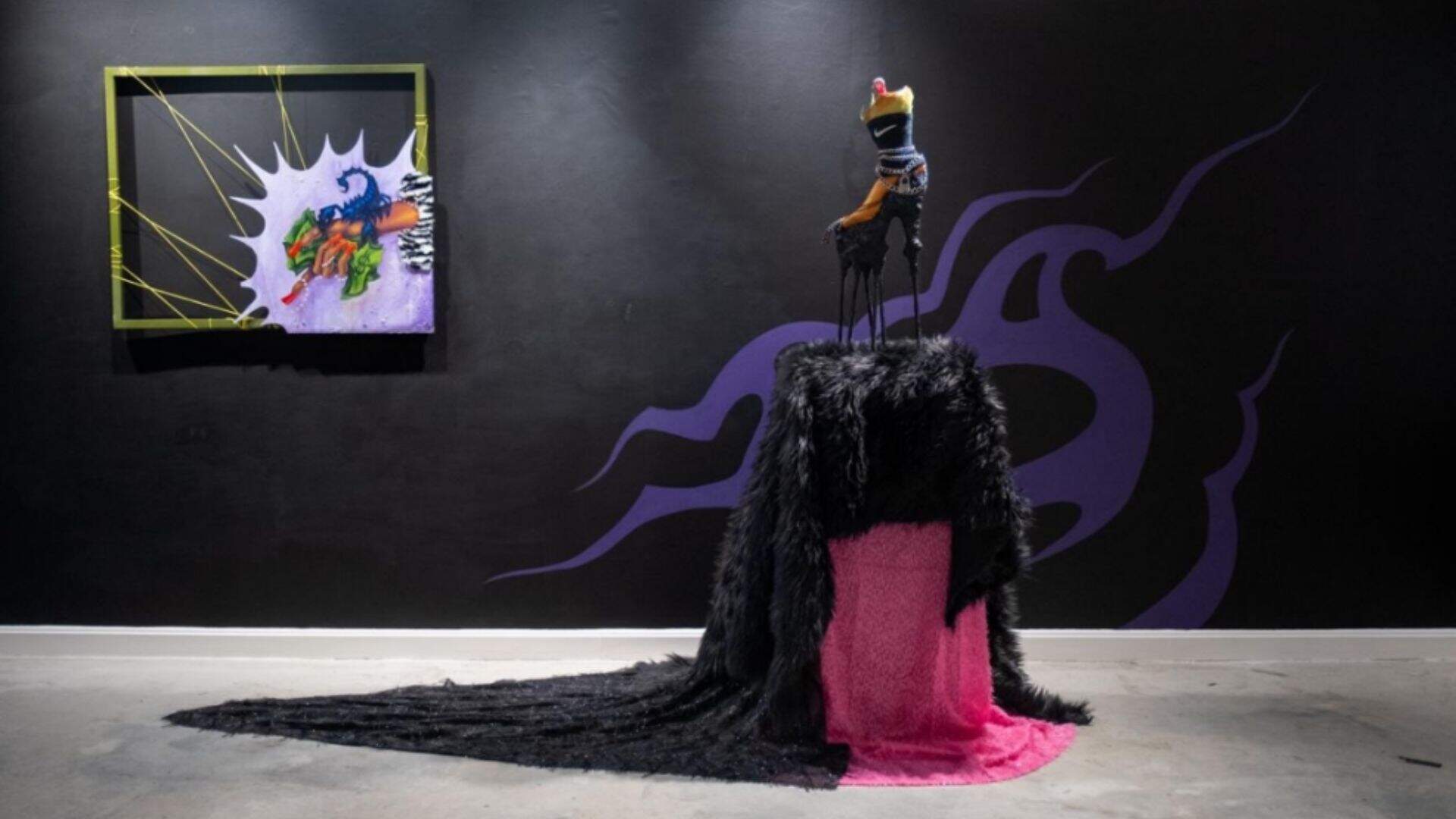
Working at museums offers an opportunity for Baker to see how the system works and challenge it. But curating shows that highlight artists of color is what makes her feel the most at home. It allows her to build relationships and develop community. She worked on three exhibitions this year at ShowUp Gallery — “Extra,” which featured artists Rixy, Wavy Wednesday and Ja’Hari Ortega, particularly encapsulates who Baker is as a curator and creative.
“I was able to be in that space, be Black, be queer, be femme, wear my bamboo hoop earrings,” she said. “Every part of me was there and represented.”
As a Christian, faith plays a large role in Baker’s approach to her curatorial and creative practices. “I work micro to macro and start with the individual first,” she said. “I sincerely hope that every move I make and how I treat people is a reflection of my faith in a higher purpose.”
"I'm a descendant of self-emancipated people. Because of that legacy, liberation is so much a part of everything that I do."
Chenoa Baker
Baker is currently working on several projects in the Greater Boston area, including a zine collaboration with painter Szu-Chieh Yun and a sensory garden exhibition that will open in 2025 at the New Arts Center in Newton. As a writer, Baker is editing for organizations like the Boston Public Art Triennial and penning fiction pieces in the Ujima Wire.
“My curatorial practice, my editing work, my writing work — it's all kind of an ecosystem that feeds the other thing,” she said. “It's not like I'm one or the other, I'm all of those things at the same time.”
No matter which artistic avenue she pursues, it all goes back to that photo of her great-great-grandparents.
“I'm a descendant of self-emancipated people,” she said. “Because of that legacy, liberation is so much a part of everything that I do.”