Support WBUR
New book lays out optimistic possibilities for climate future, asking 'What if we get it right?'

You don't have to look far to find evidence that climate change is having a drastic impact on our environment. You can see it before your eyes in the intensity of storms, floods and wildfires.
And experts say the outlook for our planet in the not too distant future is dire if industrialized nations don’t rapidly transition away from fossil fuels and restore ecosystems already damaged by the changing climate.
But Ayana Elizabeth Johnson turns the gloom and doom on its head in her new book focused on climate solutions, "What if We Get It Right? Visions of Climate Futures." She's a marine biologist and co-founder of Urban Ocean Lab, a policy think tank focused on coastal cities. She's also the Roux Distinguished Scholar at Bowdoin College.
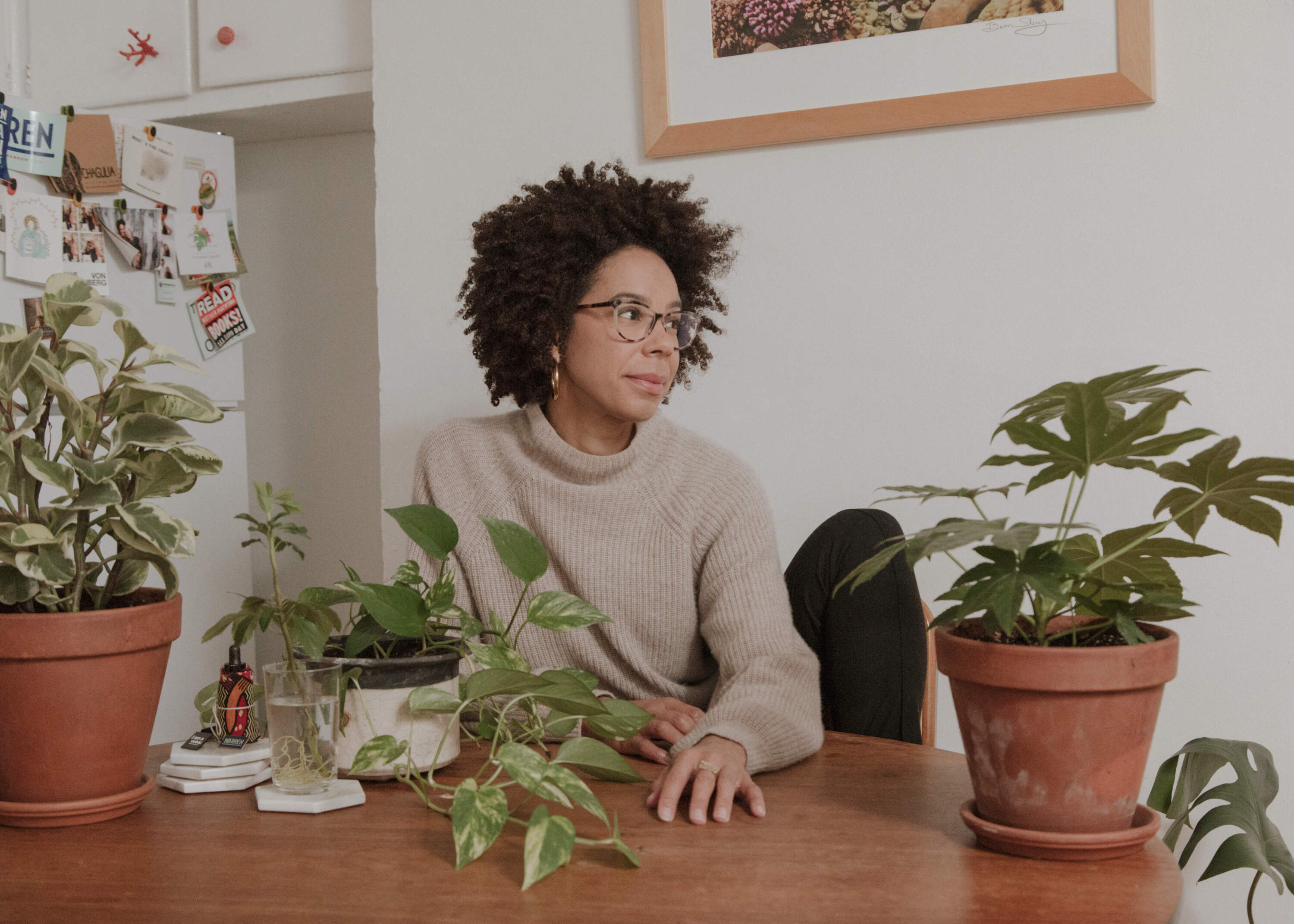
Johnson will be at the Brattle Theater in Cambridge on Oct. 23 to talk about the book, which is a trove of ideas from environmental stakeholders she interviewed — sprinkled with poetry and Johnson's own expertise and reflections — about what things could look like in the future if we take the right steps in terms of climate action and solutions.
She spoke with Lynn Jolicoeur on WBUR's All Things Considered.
Interview Highlights
On what she means by 'get it right':
"There are innumerable possible futures that we could have, and that depends on which one we work for and aim for and how many people we can welcome into being part of climate solutions. ... We have all the solutions we need. We already know how to switch to clean energy. We know how to green our buildings. We know how to improve transportation and our food systems. And we know how to protect and restore ecosystems and take advantage of the fundamental magic that is photosynthesis. So the question is really, 'How quickly and how justly will we implement solutions?' There's no need to wait for some fancy new technology ..."
On some of the big concepts and ideas brought forth in the book:
"There's a conversation with the environmental journalist Judith Schwartz, called 'First, Nature.' And in that chapter, we talk about the carbon cycle, but also about the water cycle, which doesn't get nearly the same amount of attention. But water vapor is also a greenhouse gas. And our water cycle, just like our carbon cycle, is wildly out of balance.
"So we're talking about protecting forests, because forests actually help to seed the rain. We're talking about wetlands absorbing potentially five times more carbon than the rainforest. There are all these ways in which ecosystems, when they are healthy, can help to rebalance all the things that humans are throwing at them. ... We're always looking toward technology or something like that, instead of thinking about the ways that plants and animals are part of this cycle that can be supported as part of addressing our climate crisis."
On one potential different future for New England, described in the book:
"That's from a conversation with Brian Donahue, who was a professor at Brandeis University for many years and now is both a farmer and a forester. And he makes the case that we need more young people going into farming. ... We have a food system that has become so globalized that it is fragile. And New England historically produced most of its own food. And he's arguing that we have an opportunity to go back there again to revitalize small towns that have been hollowed out by globalization ... and sourcing not only our food, but also our timber.
"The question is not whether trees are getting cut down, it's whether [the best way is] clear-cutting forest in the Southeast and shipping that timber up to New England. That's the current status quo. So it's not that we are going to stop using wood, necessarily. I mean, trees are sucking up that carbon. We can cut them down and put them into buildings and carbon is sequestered in that way. But we have to think about forestry differently — as selective instead of clear-cutting. There's a right and a wrong way to do forestry, for sure."
On climate mitigation strategies, including environmental justice efforts, that should be emphasized in coastal cities including Boston:
"One in five Americans live in a coastal city. This is absolutely not a coastal elite issue. And if we zoom out to the county level, 40% of Americans live in a coastal county. So addressing these ocean-climate-specific challenges is certainly critical. ... 60% of coastal city residents are people of color. ... 50% are renters, and 60% are living in poverty. And all these are higher than the national average.
"If people are renters, they don't qualify for flood insurance, etcetera, sometimes. They don't qualify for some of the relief that would come from FEMA for homeowners. People who are living in poverty don't have the resources, oftentimes, to evacuate in the case of a storm. So there are all of these ways in which justice is intertwined with the crisis of climate change.
"But also, I mean, a lot of times we don't think about ecosystems in cities. We don't think about seagrasses and wetlands and oyster reefs, but those ecosystems can dramatically reduce the impacts of waves and storm surge. Urban Ocean Lab is actually doing a project with Stone Living Lab and the city of Boston, trying to understand better how the coastal ecosystem restorations and protections can be a part of that."
On climate change not being a prominent topic in the presidential campaign:
"I think we're seeing the lack of discussion about climate because we don't have a very strong [portion of the] electorate focused on climate. It is not polling in among the top issues that voters are concerned about. And when candidates want to win elections, they're focusing on what they think will get them votes. So there's a little bit of a chicken and egg problem. And the environmental movement has a massive voter turnout problem. ...
"I absolutely wish there were more climate discussion happening now. But the decision at the presidential level, despite the lack of discussion on climate, couldn't be more stark. I mean, we have one candidate who pretends it's not even happening. And another candidate who was part of leading the largest investment ever of U.S. government money — of our taxpayer dollars into — climate solutions ... and kick-starting the clean energy revolution in this country, with battery manufacturing, with creating this whole new sector for offshore wind energy based on executive action under the Biden-Harris administration. ...
"But the elections are not the only time we get to push our elected representatives. So I hope that people who are listening, who are concerned about the politics of climate change, will push their elected officials all year round after this election, no matter who is in office."
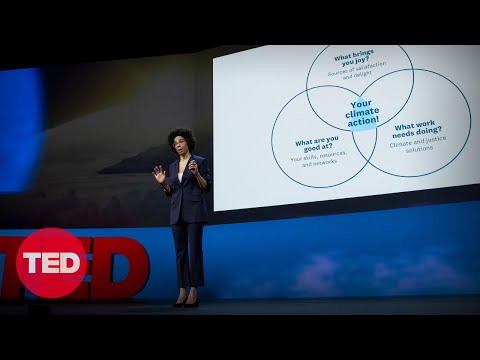
On the Venn diagram she encourages people to make to determine their climate action:
"So there's three circles of simple questions. The first is, 'What are you good at?' So what are your skills, your resources, your networks? ... The second one is, 'What is the work that needs doing?' ... There are hundreds, if not thousands, of climate and justice solutions to contribute to.
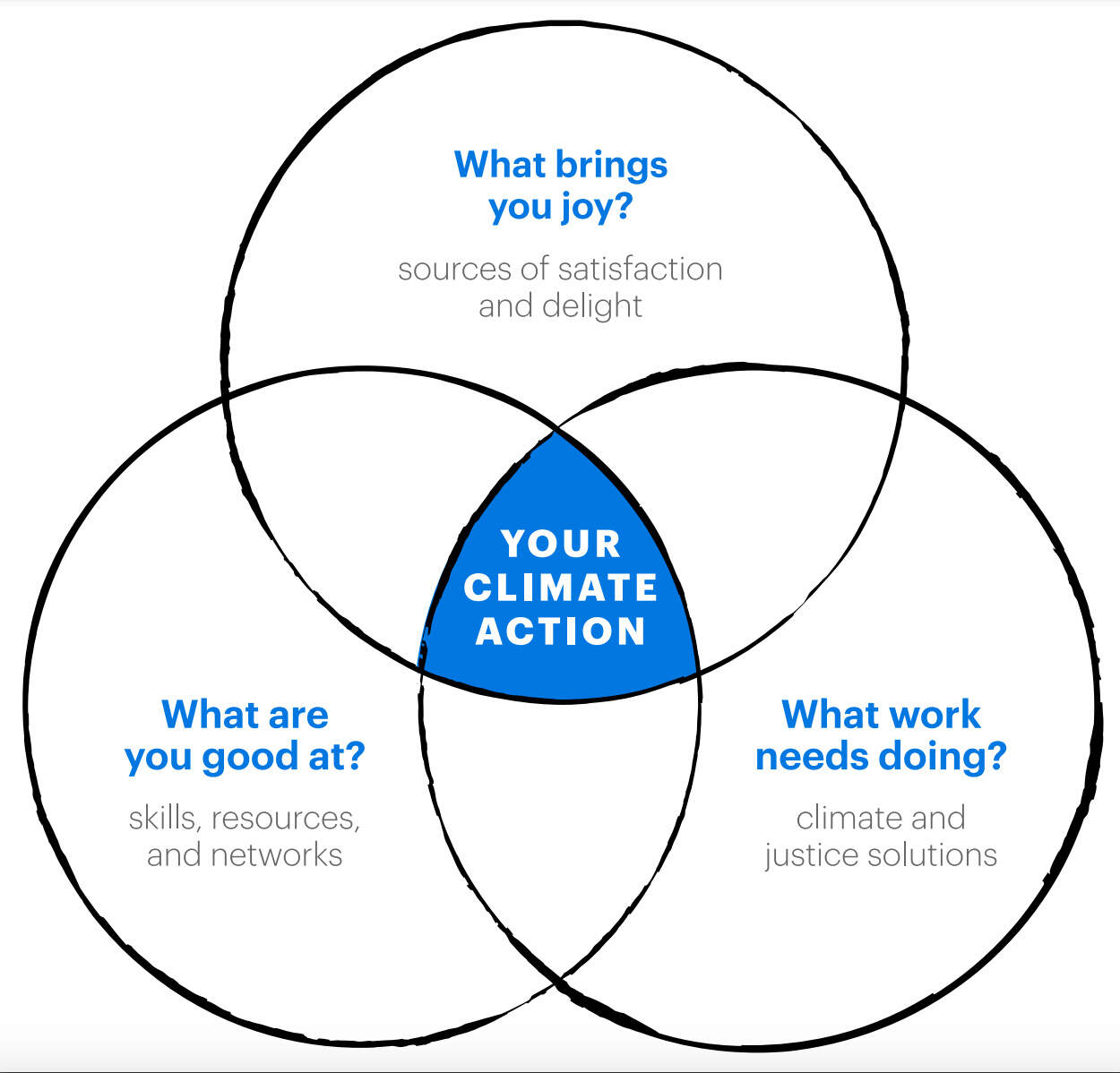
"And the third circle is, 'What brings you joy?' ... I think it's important to remember that there's not a time when we're just going to be done with addressing the climate crisis, so choosing things that enliven and energize you is going to be critical. And then if we each find our way to that sweet spot, the center of our own personal climate Venn diagram will be leveraging all of our strength towards implementing solutions. And I think that's the best way to get as far as we possibly can making all these possibilities of good climate futures come to be."
This segment aired on October 17, 2024.