Support WBUR
With more people living on the streets in Lowell, city bans camping on public property
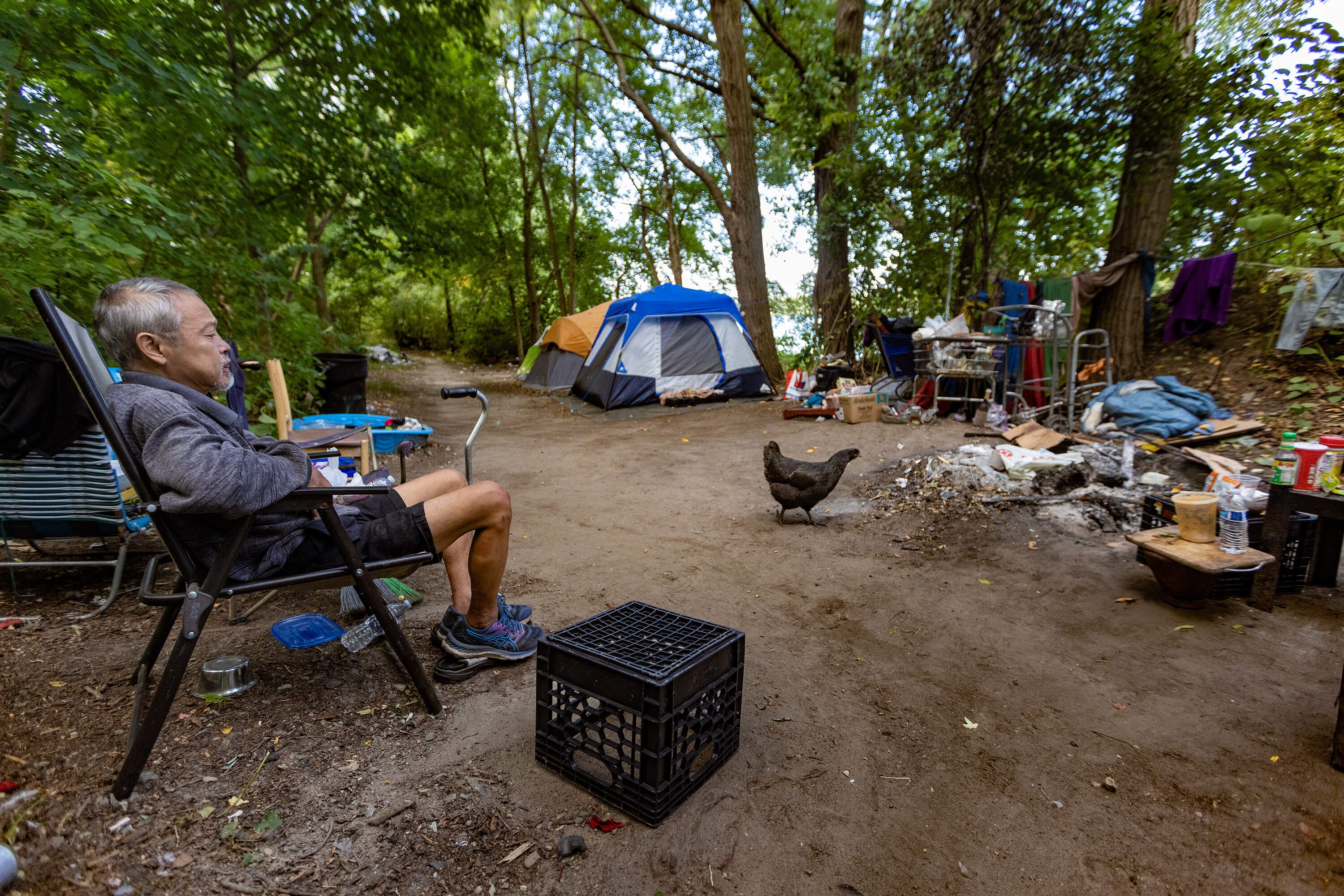
Next to a park in Lowell, a path through some thin woods leads to a secluded community.
Small clusters of camping tents stand along the Merrimack River, with a few worn chairs set up next to them. Used food containers and other garbage rest atop crates and plastic tables. Some of the trash has been burned in campfires.
On a recent day, a man sat in a patio chair, his upper body trembling.
The 67-year-old said he’s "sick the whole day" from a heart condition and the mental effects of what he experienced in 1970s Cambodia under the regime of dictator Pol Pot. He was one of many refugees who came to Lowell in the '70s and '80s. He said he splits his time between a tent along the river and his sister's house.
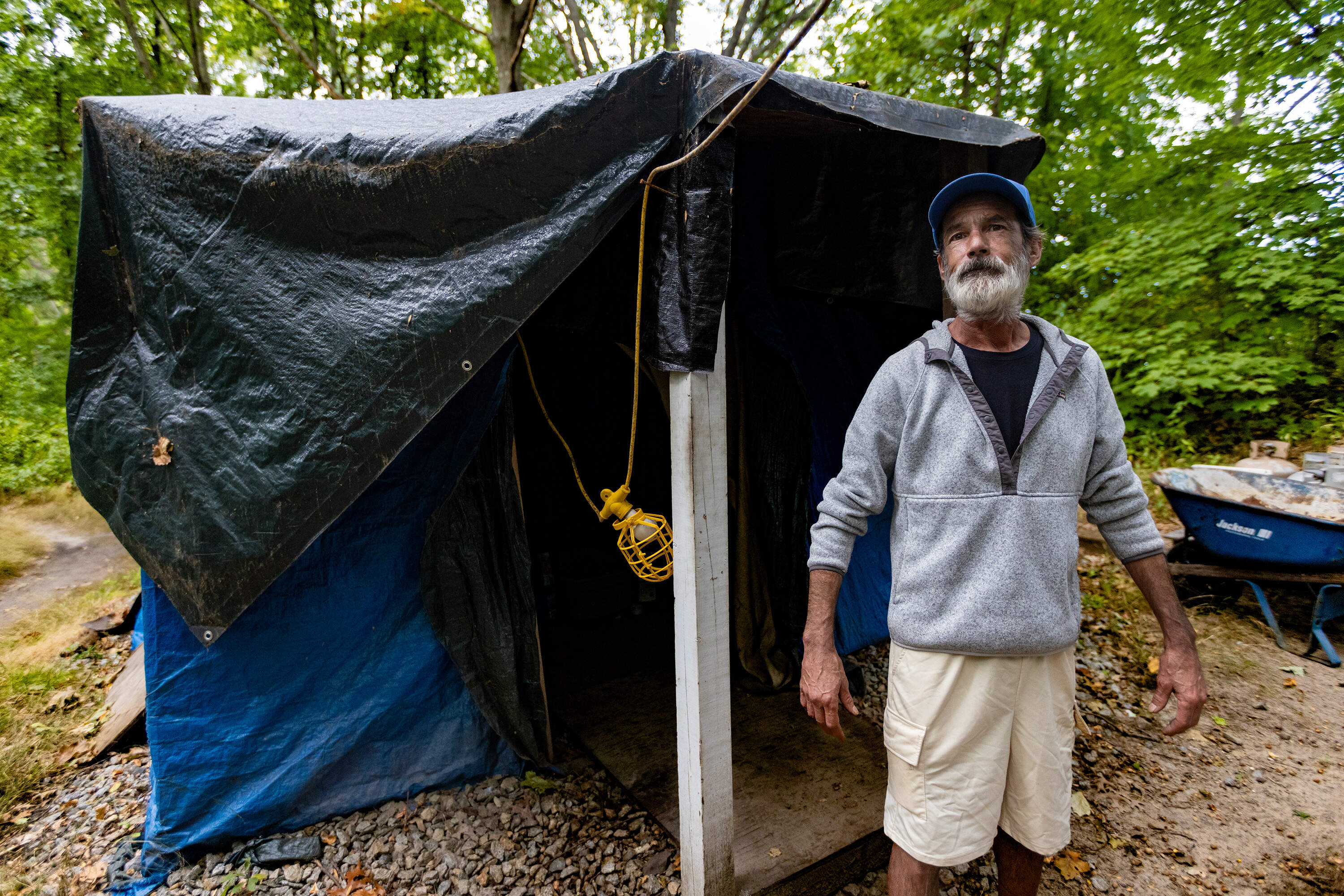
Michael Mello, 59, was hanging out here, too. He lives farther down the riverbank in a tarped shack he said he built five years ago when a heart problem ended his career in underwater construction demolition. He said he was forced to give up his condo.
"I couldn’t afford it," he said. "Unemployment shut off."
A Lowell police officer and a Middlesex sheriff's office employee appeared on the path and greeted the people there. They regularly do outreach in the camp. Officer Bill Martir said there'd been some violence elsewhere in the encampment.
At another cluster of tents, a couple played with their dog, Diamond. A Jesus statue and a wooden sign with the "Love is patient, Love is kind" Bible verse stood outside one of their tents.
Neva, 38, and Francisco, 31, said they've been together for six years. WBUR isn't publishing their last names because they're concerned they could face discrimination as they look for housing and work. Right now, they said, they work for a landscaping company.
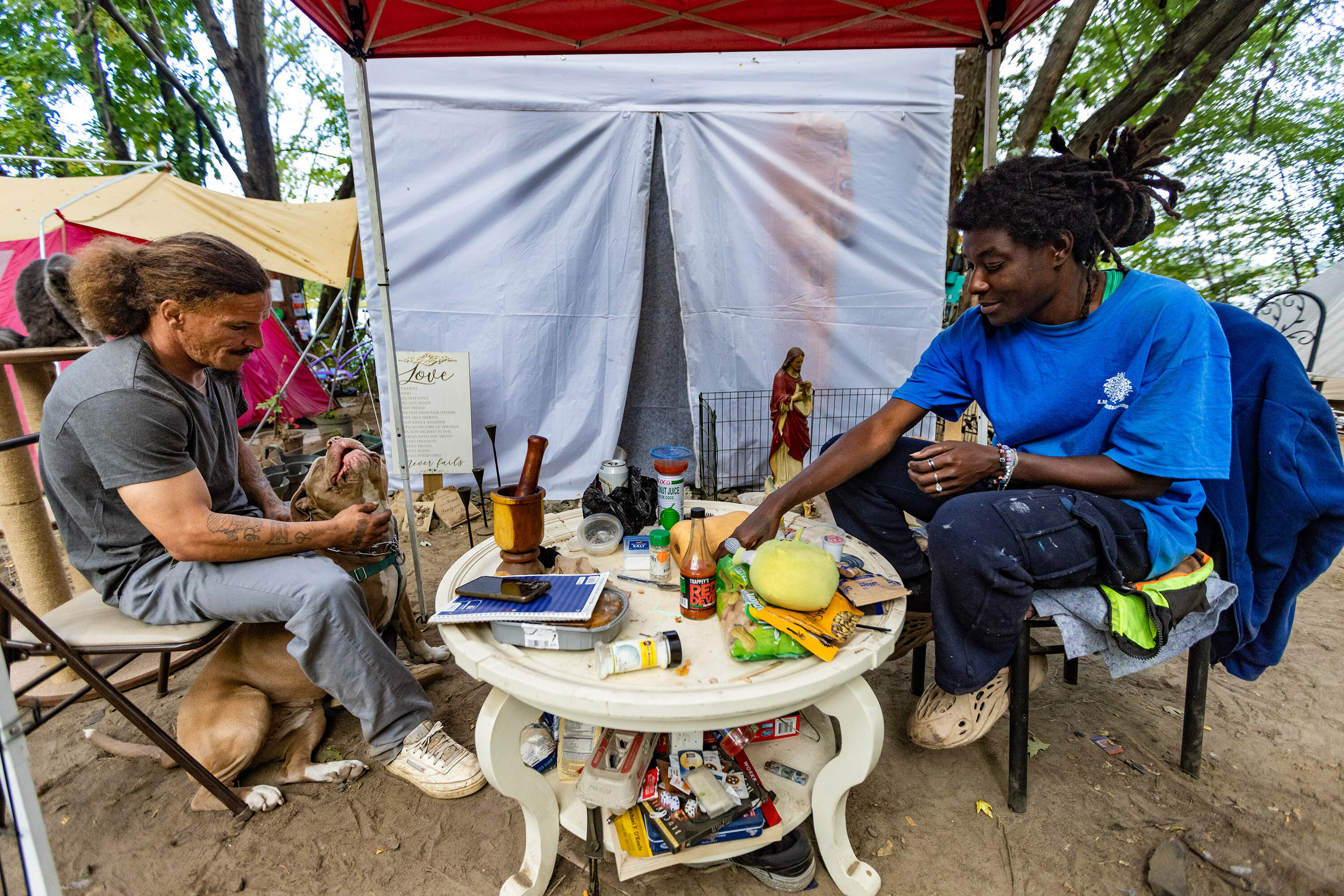
They came to Lowell not long ago from Boston, after they said state and city crews removed their belongings from under bridges and other places they stayed.
"The little bit of money that we do get, we'll end up buying a tent. We'll go somewhere for, like, a doctor's appointment ... and when we get back, everything is destroyed and lost," Francisco said. "So we got to keep switching addresses and paperwork. ... It makes it harder for us to get out of this hole."
"We need more people to help instead of pushing us off like we're nobody, and that's how it feels," Neva said. "It feels like we're being pushed away, like we're not important. We're humans, too."
They're working with advocates in Lowell to find permanent housing.
How Lowell's homeless crisis has grown
Lowell has been overwhelmed by a growing population of people living outside on the streets since the pandemic faded. Tensions around the issue have dominated public conversations as the city has grappled with how to respond.
Data from the city's annual homeless census in January show the number of people living outdoors in Lowell almost doubled since early 2020. The one-night count, required by the U.S. Department of Housing and Urban Development, found more than 150 people were unsheltered.
Lowell City Manager Tom Golden pointed to a steady influx of unhoused people from other Massachusetts cities as a key factor in so many people living out in the elements in Lowell.
"We're taking folks in[to shelter and housing], taking them in and off the street ... and it seems that more people come," Golden said. He said the efforts have put a strain on city resources.
“The stress that’s putting on my police department, health and human services department, my CO-OP team and city resources is getting to the point of — it’s probably broken by now," he said in September. "But we’re holding it together.”
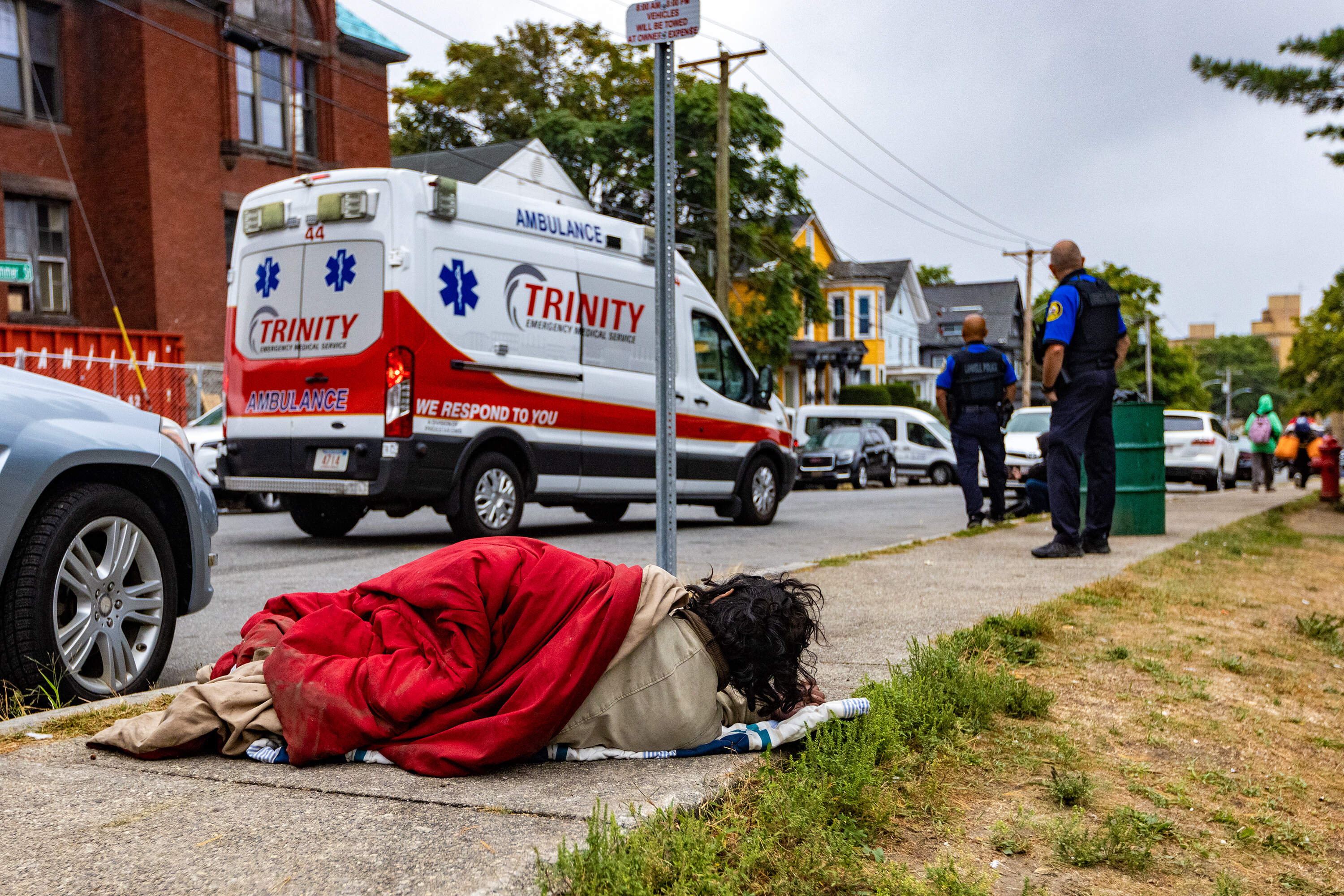
And now the city has what officials think is another tool to address the problem: a ban on camping on public property, which takes effect Wednesday. Police can fine and arrest people who violate the ban.
Joko Thomas, who has spent many nights sleeping in Lowell's South Common park, said so far, he hasn't seen anything make a difference in the city's struggle.
"I've never seen an influx of homelessness in the city for this long, as long as I've lived here for almost 29, 30 years. ... I've never seen this this bad," Thomas said.
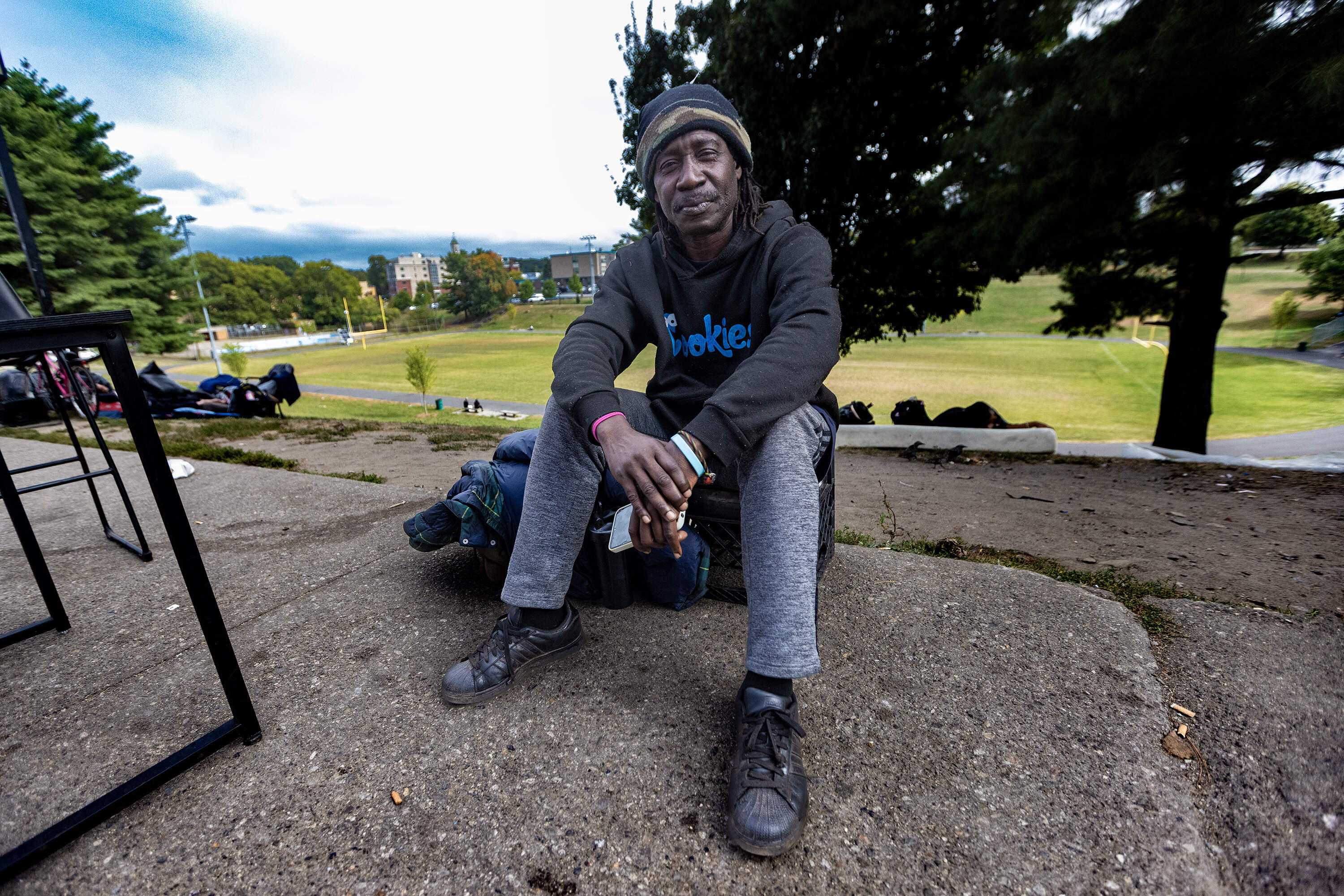
As he played dominoes with a friend on the sidewalk, he explained that he became homeless about four years ago, when his partner lost her place. He said he's on the long waitlist for state public housing.
"I'm 60 years old now," he said. "Imagine how long it's going to take for me to get a little studio, at least, to rest my head."
In the past two years, the city put more than $2 million of its federal pandemic relief funds into new permanent housing with support services for people coming out of homelessness and a future women’s shelter, Golden said. The city manager called on more communities to provide shelter and housing services.
"It's always considered a city problem, which is wrong," he said. "... It's high time that all 351 cities and towns ... start to take a serious look at this to say this is not going away."
The number of unsheltered adults statewide jumped 20% from early 2023 to the beginning of 2024, according to the nonprofit Massachusetts Housing and Shelter Alliance. During this past winter's homeless census, more than 1,600 adults were staying on the streets.
The organization's CEO, Joyce Tavon, said so-called Gateway Cities, in particular, have seen a dramatic rise in people who are unsheltered. Those are small- to mid-sized cities, including Lowell, Revere, Fall River and Fitchburg, that were once thriving industrial centers and now face significant economic issues.
Tavon said a "perfect storm" of factors is to blame.
"We know we have a housing crisis, and that housing shortage is just continuing to get worse," she said. "So that means we're also hearing from shelter providers [that] people are staying longer."
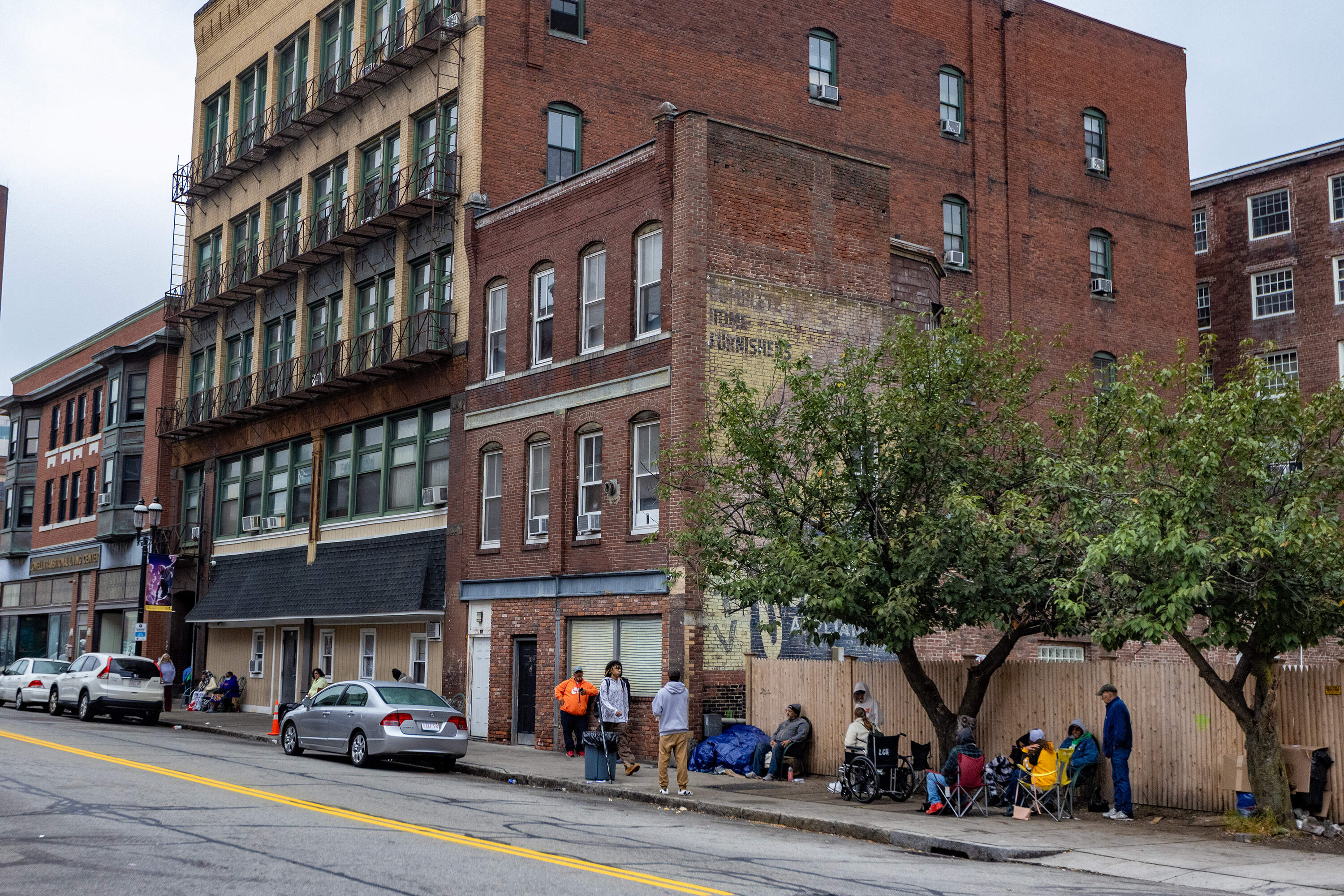
The one large homeless shelter in Lowell — the Lowell Transitional Living Center, which is run by South Middlesex Opportunity Council — is generally full. But city leaders said the shelter tries to not turn anyone away. It has 90 beds and is adding 60 floor mats for the cold months.
A day center at Eliot Presbyterian Church serves about 150 people a day — triple the number it was helping a year and a half ago, according to operations director Charly Ott. The center provides food, housing assistance and clothing. It was recently in danger of closing due to budget strain.
"As a result, the staff agreed to take a 25% pay cut. The hours of the operation are 25% less, and we are tightening our belts," Ott said.
Before the camping ban
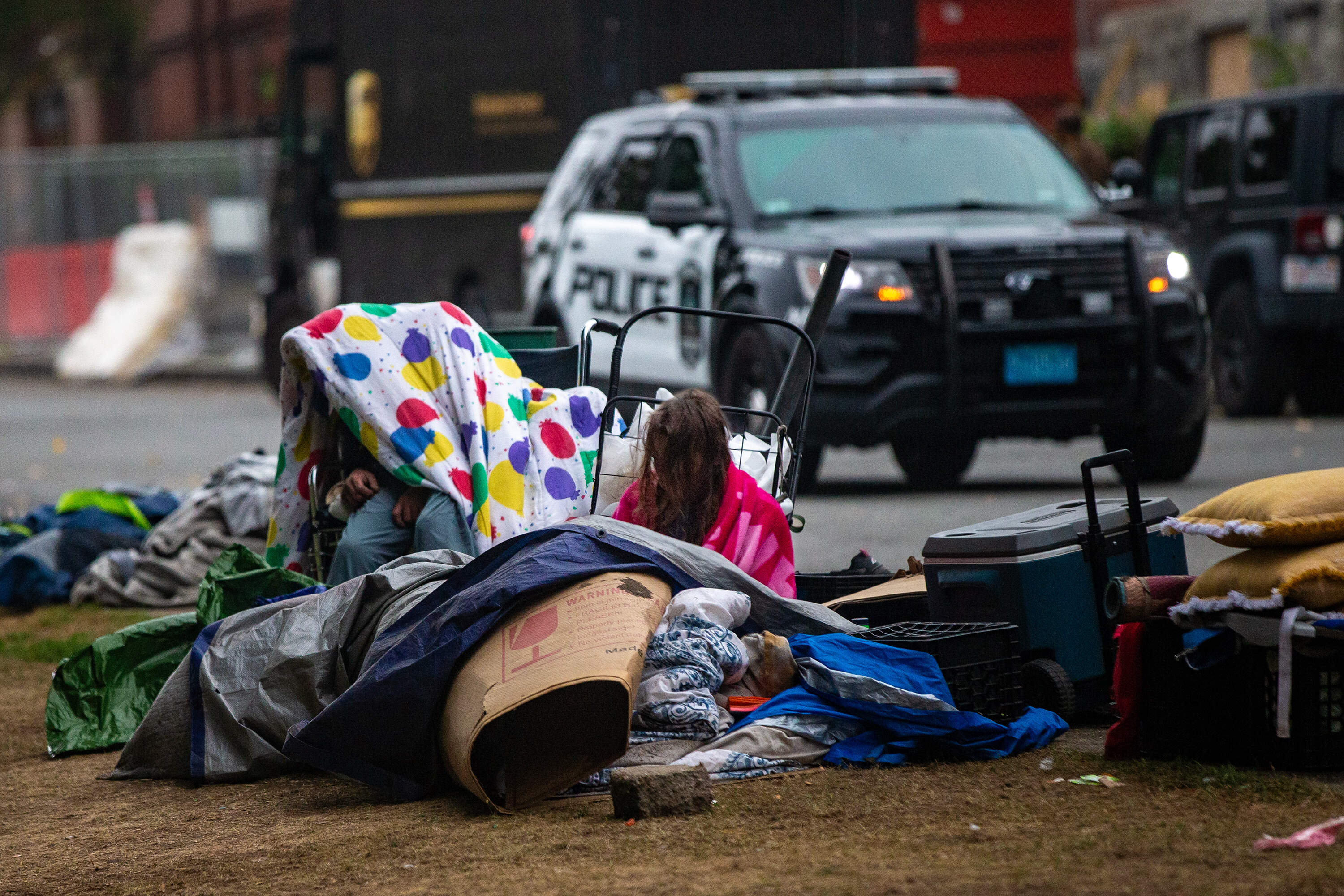
South Common became the epicenter of the city’s homelessness crisis last year, after local officials carried out sweeps of several other encampments around Lowell.
City leaders said there were illegal guns and drugs in one, people camping on environmentally toxic ground in another, and health risks because of accumulating garbage. Many of the people from those encampments migrated to the park, where some people who were unsheltered had already congregated.
The controversial idea of banning camping on public property first came up a year ago, when some city councilors discussed possibly following Boston's lead in doing so.
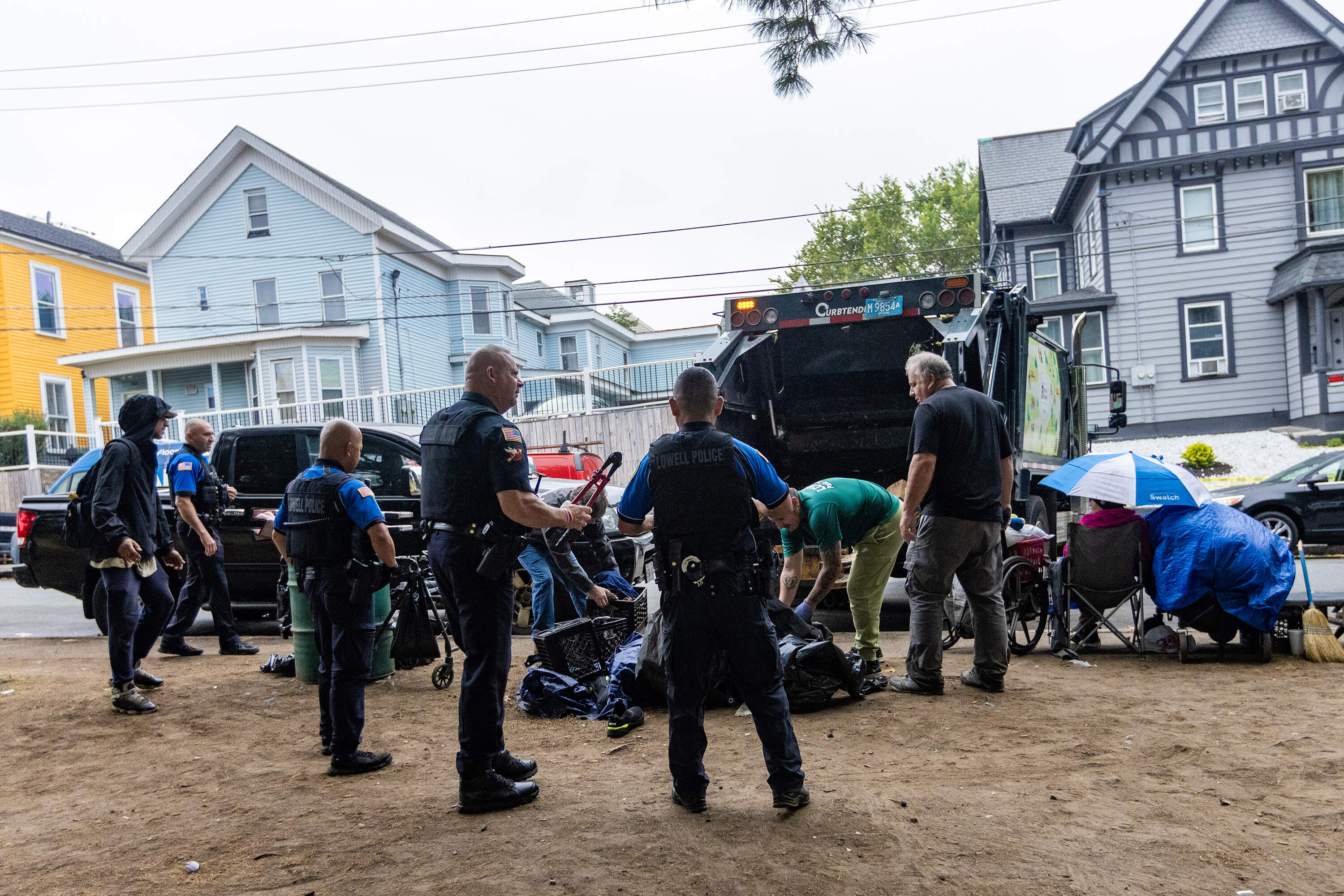
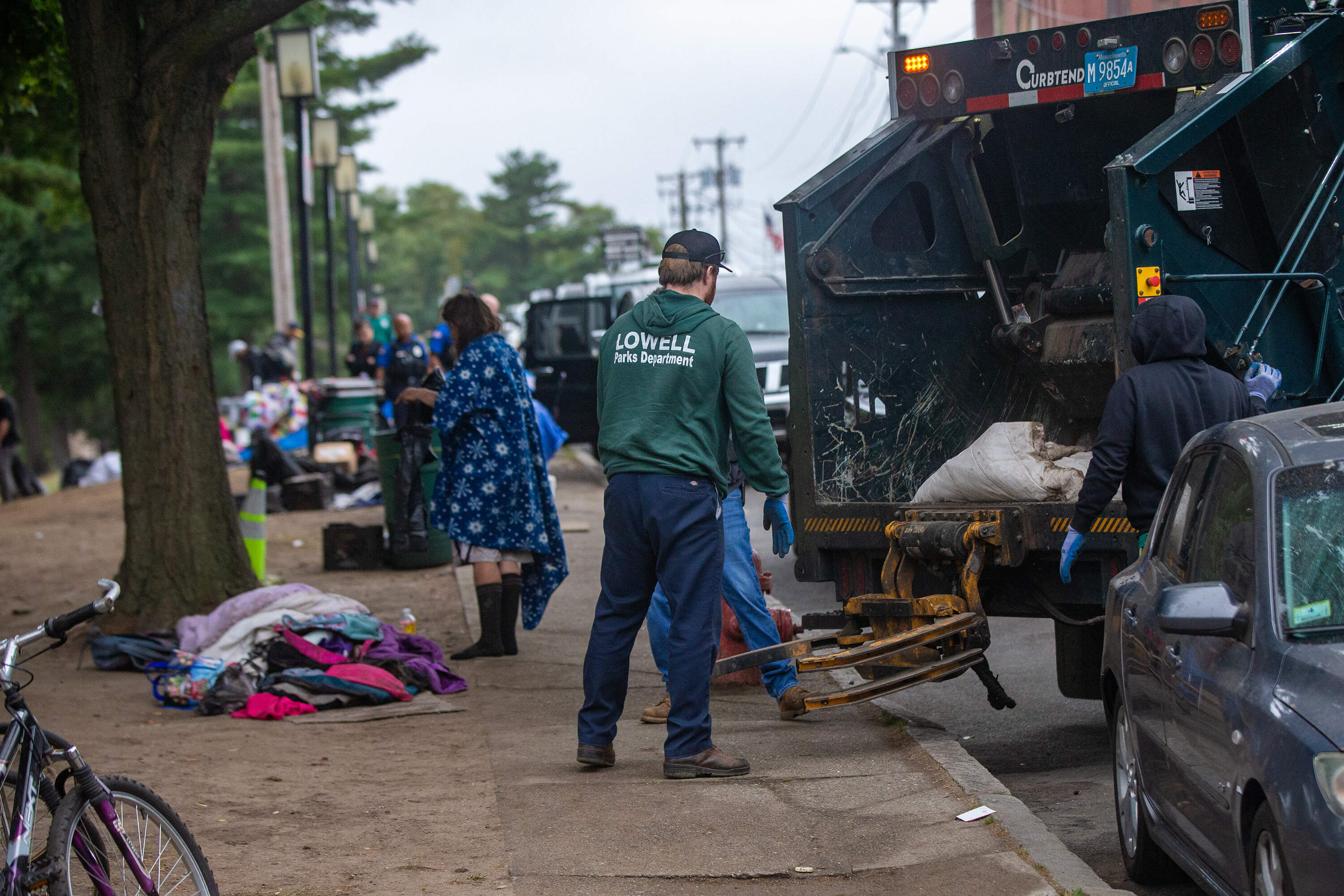
One September Friday this year, a crew from Lowell's parks and police departments threw blankets, clothes and other items in the South Common encampment into a garbage truck. It was the city's latest weekly clean-up of the area, though local officials had been allowing people to sleep there.
A man yelled at the workers, saying they were taking the belongings of a woman sitting nearby in a wheelchair, her legs amputated. He offered to bag her things so they wouldn't be taken. One of the workers agreed.
"A lot of people think we clear out encampments because, you know, we're just trying to sweep people away. And that's not the case," said Maura Fitzpatrick, the city's director of homelessness initiatives. "It's imperative that we keep encampments clean because of transmittable diseases, public health issues."
Fitzpatrick, along with a city social worker and members of Lowell's Community Opioid Outreach Program (CO-OP) team were on scene to ask people about their needs and try to connect them with resources, including shelter. A nurse and EMS team were also on site.
The crisis reached a boiling point less than two weeks later. In early October, City Councilor Erik Gitschier called for the city to draft an ordinance to ban camping within 1,000 feet of any school, due to the park's proximity to a public K-8 school.
“From needles in school playgrounds, drug use, prostitution, filth from body fluids, trash ... open space once used for exercise, science projects, field days and so much more, can no longer be used as an asset," Gitschier said at the Oct. 1 council meeting.
Some local business owners expressed concern about the impact of the unsheltered population on their livelihood, and some residents expressed fear for their safety due to the situation around the park and along the river, videos from city council meetings show. Some residents said they'd been harassed by people living in the park.
The measure quickly evolved into the ordinance to ban camping on all public property. Its passage at the Nov. 12 council meeting placed Lowell among dozens of cities around the country, including Fall River and Brockton, that have adopted such bans in the wake of a recent U.S. Supreme Court ruling.
Opponents of the ban outnumbered supporters at the hearing, calling it cruel and saying it will make people's lives more difficult while doing nothing to solve problems that contribute to homelessness.
Under the Lowell law, like in Boston, someone can only be cited or arrested if shelter is available and the person continues to camp on public property. Authorities are required to let them know about available shelter beds.
Ban is up against barriers
But Lowell's efforts to get people into shelter and housing show what the city is up against.
"Every person that you would run into has been asked [about moving into a shelter]," Golden said. "I will stand by that 100 percent."
Among them are two people Fitzpatrick approached during the Sept. 20 clean-up of South Common.
Lamar Keith Hughes, 55, sat on a walker with wheels. He said he's disabled from a bad injury he suffered five years ago. He also had a black eye, explaining he was assaulted while sleeping in the park. He said he'd struggled to find a place to live.
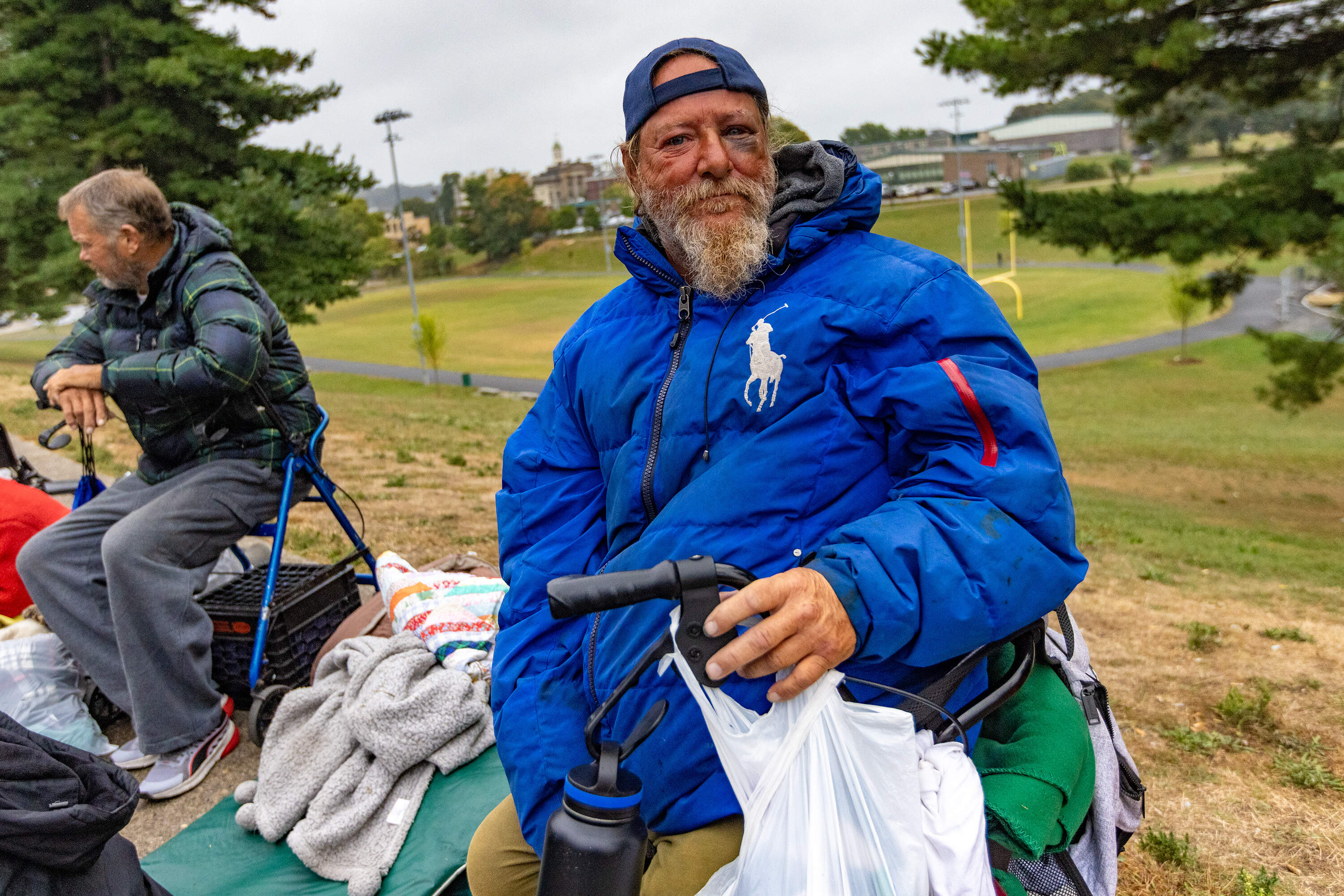
"I've been on every list. I've tried and tried," Hughes said. "I've been made promises over and over."
Fitzpatrick pointed out Hughes previously had to leave a hotel shelter program. Hughes said that was because he didn't want to sign an agreement to allow staff members to enter his room for random inspections and safety checks, and that he's a responsible person who doesn't want anyone else running his life. Fitzpatrick responded, saying such rules are meant to protect everyone living in shelter.
But, she added, many people who live on the streets do not wish to give up independence or privacy to enter a shelter or transitional housing program. (Within a month of their exchange, Hughes secured permanent housing.)
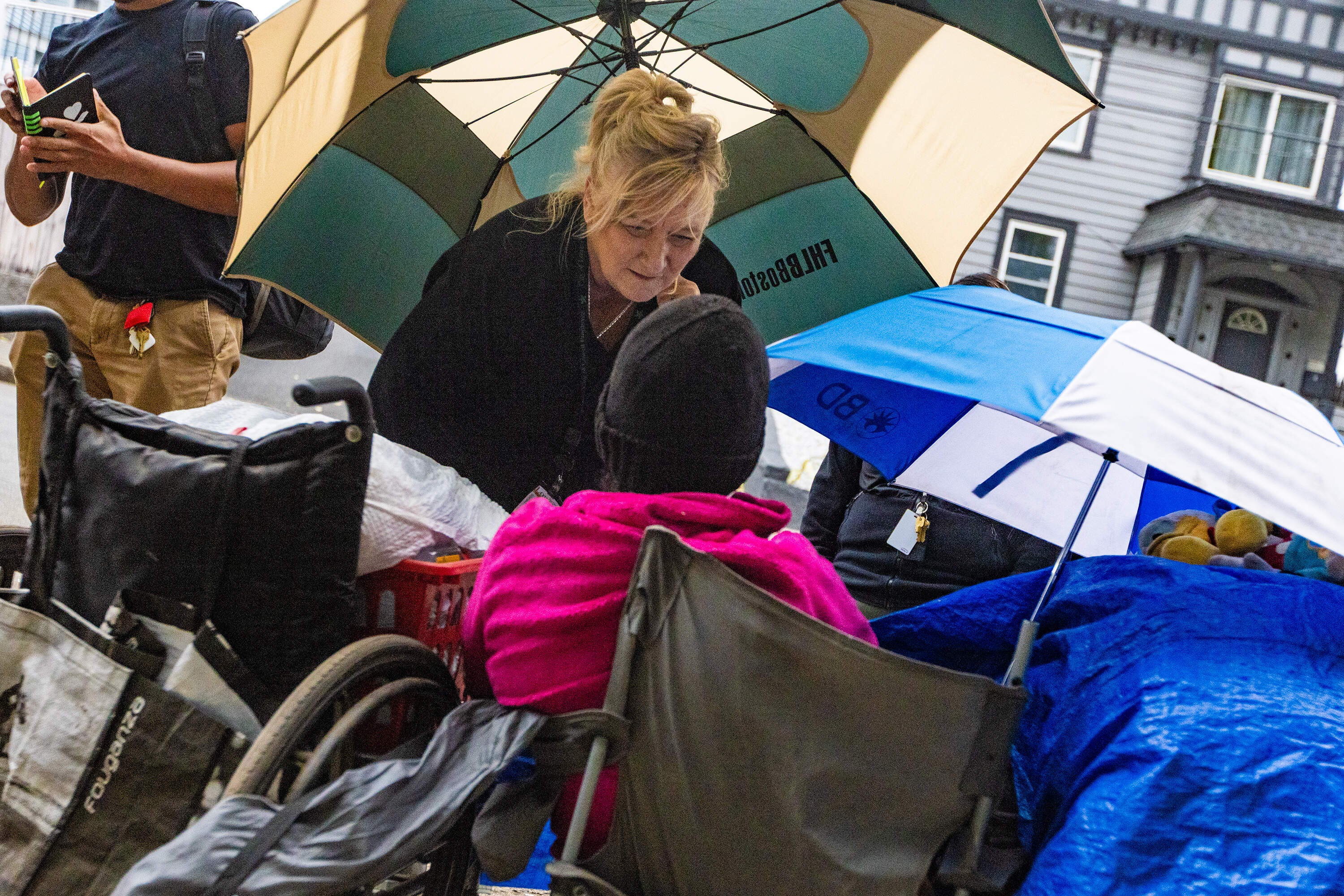
A short time later, Fitzpatrick leaned in close to talk with Jessica Morasse, who was huddled under an umbrella and seated on a camping chair with belongings stacked around her. Fitzpatrick knew Morasse and asked if she was ready to enter detox for her alcohol and drug addiction.
"I know you can do it. You know I know you can do it, right?" Fitzpatrick asked.
Morasse said yes and that she desperately wanted to be with her children and her grandchildren. But the pull of addiction — and her community on the streets — was so strong.
"I need these people just as well as they need me, and doing for them and taking care of them kind of fills that empty void that I have inside," Morasse, 47, said. "And if I abandon them, then what?"
She said she had seven years sober, and had a career and home, before her alcohol addiction led her to start using heroin this year.
"This is my bottom — sleeping in a park," she said. "I never thought I'd sleep in a tent or in a park. ... I thought I had a bottom before. That bottom had a trap door."
This segment aired on November 19, 2024.