Support WBUR
Old foe, new job: Why Healey is less fiery about opposing Trump
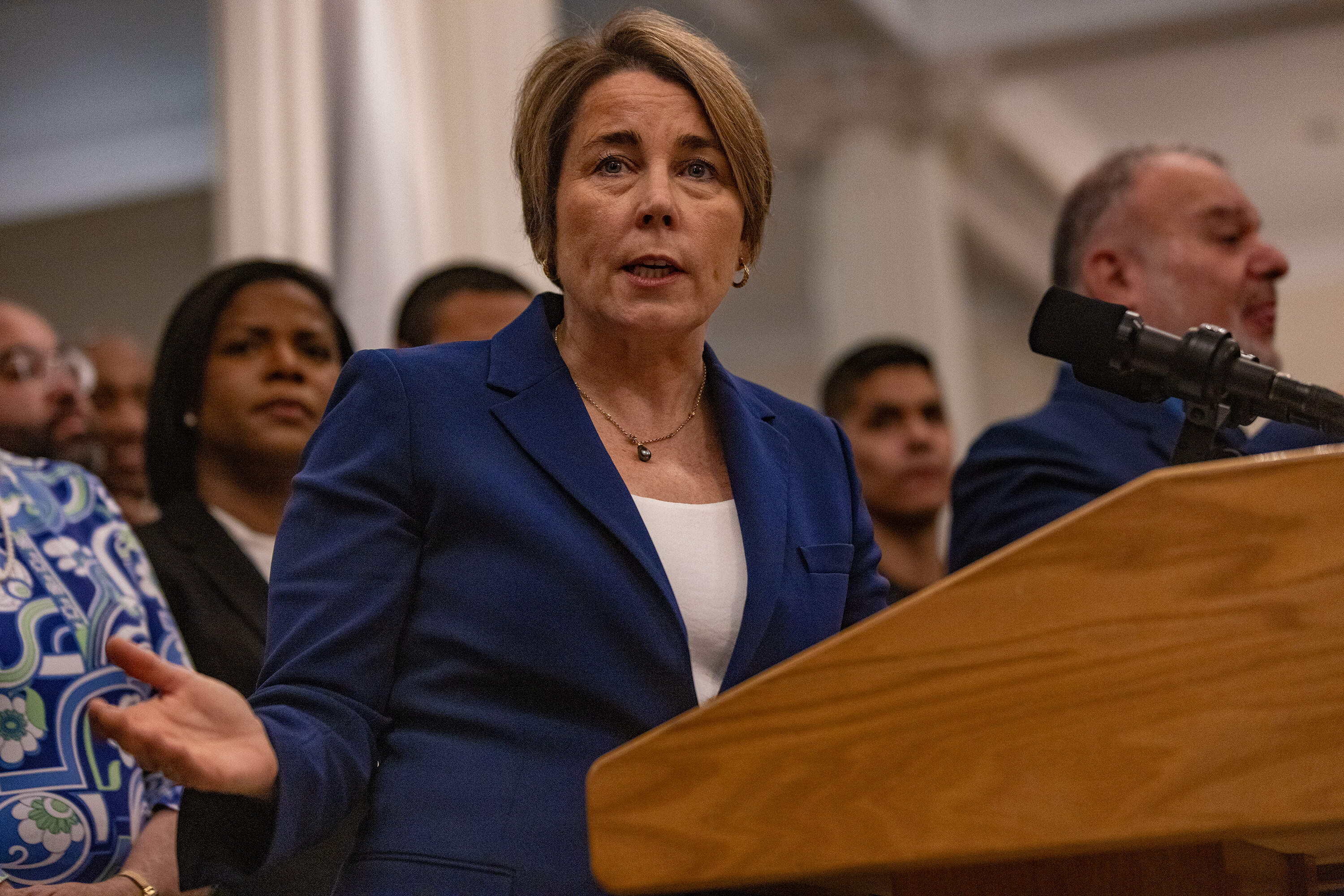
Massachusetts' political leaders are bracing for a second Trump administration. Nobody more so than Gov. Maura Healey, for whom Trump represents a challenge both familiar and new.
Healey has been here before: In 2016, after Trump shocked the nation and won his first race for the White House, she was the state's attorney general. Back then, she vowed to do whatever was necessary to block Trump's efforts at rolling back protections for civil rights, immigrants, health care and the environment.
"We may do it through litigation, we may do it through our own litigation, we may do it through enforcement of our own," Healey told an audience in Arlington at the time.
She made good on that pledge, suing the Trump administration more than 100 times. Politico dubbed her and like-minded AGs "the shock troops of the Democratic resistance." Halfway through Trump's first term she told WBUR that while the work was important, she hoped to move past it.
"I would really like to see a day when we didn't have to sue the federal government," she said.
But as Trump prepares to return to power in Washington, he's promised to redouble his efforts on many of the same policies that had once had Healey charging into the courthouse.
"Donald Trump is now the president-elect," a visibly subdued Healey said the day after the most recent election. "Whoever you are, whoever you voted for, know that we're going to continue to work together and move forward."
Gone was the pledge to resist and litigate. In its place: a promise to represent all of Massachusetts — including more than a million citizens who voted for Trump.
As governor, Healey faces a balancing act — to stand firm in her most strongly held positions, while also protecting the broad interests of Massachusetts, including billions of federal dollars for education, health care and transportation. Instead of provoking Trump, she is keeping her public comments trained on the economy, lowering costs and expanding housing.
"Being the governor means something different," said Evan Horowitz, director of The Center for State Policy Analysis at Tufts University. He said it makes sense that Healey would shed the label of resister-in-chief, and "not return to that lane."
"She can't do that again because she's not the attorney general," he said.
That job now belongs to Andrea Campbell. In her first press conference after Trump's victory, Campbell sounded a lot like Healey did eight years ago, pledging to use her office to protect democracy, racial justice, reproductive freedom and more.
"We have been working to identify prospective threats under a Trump administration as well as strategies to best address those threats should they arise," she said.

According to Campbell, Trump has made it clear what he intends to do when he reaches the White House. That includes a promise to launch "the largest deportation operation" of undocumented immigrants in the nation's history. To execute that policy, Trump has nominated a border czar, Tom Homan, who was the architect of the so-called family separation policy during the first Trump administration. And he has pledged to move aggressively against sanctuary states like Massachusetts.
"Some of these Democratic governors say they're going to stand in the way," Homan said recently on Fox News. "If you're not going to help us then get the hell out of the way because we're going to do it."
So far, Healey is being cautious. For example, she has not agreed to join a new group called Governors Safeguarding Democracy. She may be in good company; the group's founders, Illinois Gov. JB Pritzker and Colorado Gov. Jared Polis, have said they would recruit both Democratic and Republican governors, but thus far have declined to name any who have signed on.
Healey also said she hopes the new administration and Congress will pass a bill to secure the border and provide relief for states like Massachusetts that are struggling to accommodate a wave of migrants.
Even so, Healey told WBUR that she will oppose Trump "should he take steps that harm our residents," including infringing on their right to access health care and abortion. "We will certainly fight that," she said.
While Healey may not be the anti-Trump standard-bearer in Massachusetts, others in the state are already poised to battle the Trump administration. Along with Campbell, they include Oren Sellstrom, litigation director with the Boston-based Lawyers for Civil Rights.
Sellstrom said he's prepared to challenge Trump's mass deportation plan, his promise to end the 14th Amendment's birthright citizenship, and threats to defund sanctuary cities, among other initiatives — many of which he opposed during the first Trump administration.
"We certainly know that he's going to attempt many of those moves again," he said.
Carol Rose, executive director of the ACLU of Massachusetts, is also ready for a familiar set of battles. Nationally, the ACLU sued the last Trump administration more than 400 times and is prepared for round two.
"The ACLU was geared up then as we are now to challenge any effort to undermine people's civil rights and civil liberties," Rose said
While there is a feeling of deja vu for people like Sellstrom and Rose, Healey suggested that resisting Trump could be more complicated this time. One big reason: the courts have changed.
"Donald Trump was able to appoint a number of justices, including three to the United States Supreme Court," Healy said, noting that the high court granted the president an extraordinary degree of immunity.
"We don't know and can't predict how courts will rule, but that's the difference," Healey said.
It all adds up to what could be a challenging time for a governor who has battled Trump in the past — but whose job now is to protect the state in a period of uncharted political waters.
This segment aired on November 19, 2024.