Support WBUR
5 takeaways as firefighters battle widespread wildfires in Mass.
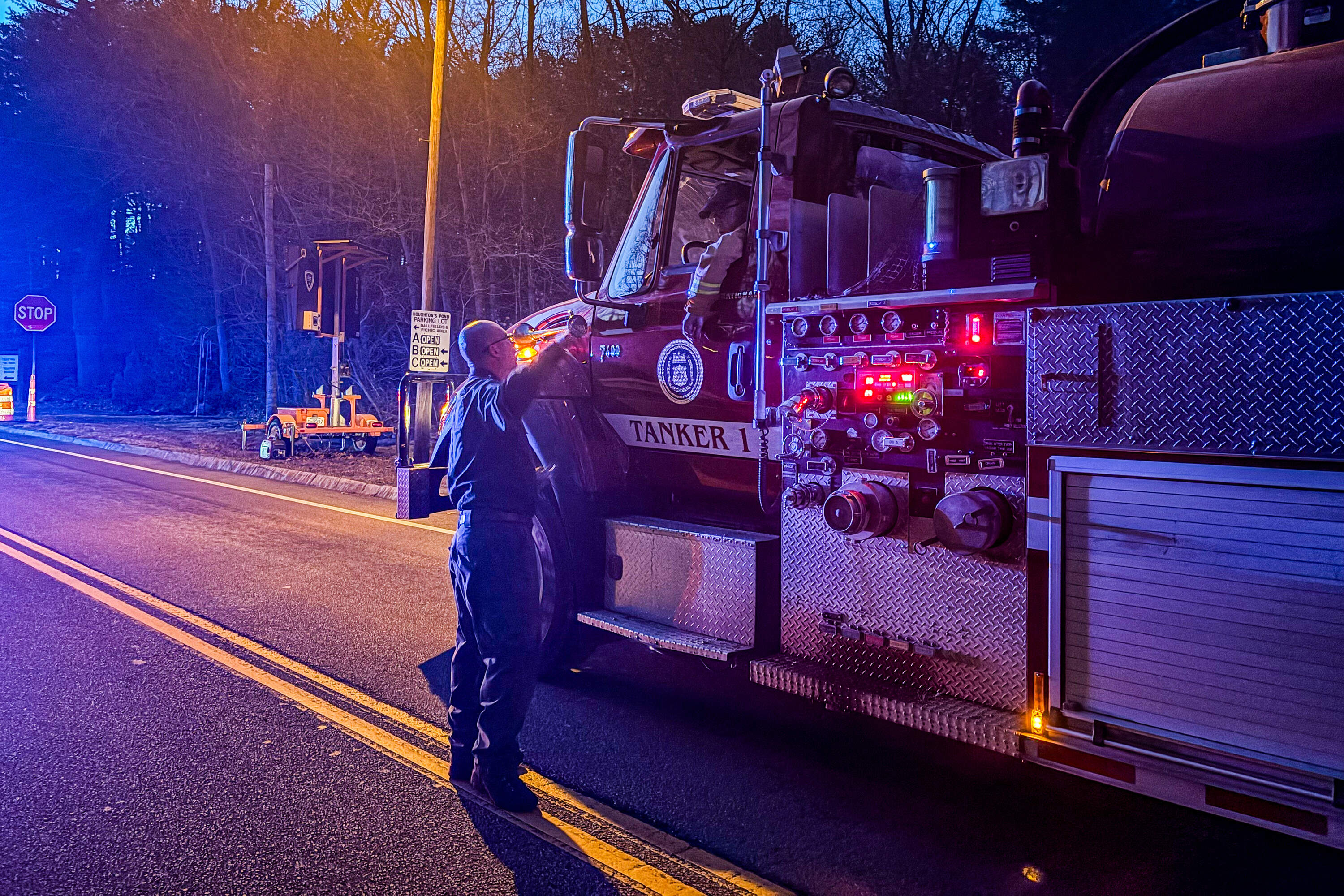
Crews from about two dozen agencies have battled a wildfire that burned down more than 40 acres of the Blue Hills Reservation in Milton. The fire was contained by Tuesday night, with a few firefighters staying behind to monitor the smoldering remains.
The Blue Hills fire was one of hundreds that have flared up across Massachusetts since October. Officials are anticipating some much-needed rain later this week, as a significant drought has taken hold across the state.
A record-breaking season
Alex Belote, spokesperson for the state Department of Conservation & Recreation, told WBUR there have been more than 20 fires since Monday, with at least 300 acres burned.
He called this a “record-breaking season.”
“All these fires — over 200 in October and nearing 300 in November already — they're all human-caused,” Belote said. There has been no lightning, which is typically the natural source of fire, he said.
On average, humans cause nine out of 10 wildfires nationwide, according to a 2023 congressional report.
Fighting a wildfire is harder during a drought
The state’s drought has increased the risk of wildfires forming and spreading. And the dry weather conditions make it harder for firefighters to do their job.
Belote said it was so dry in the Blue Hills Reservation that the fires burned trees below the ground and into the roots.
“We've had a lot of trees coming down,” he said. “It's really a ‘watch out’ situation. Dangerous for firefighters, dangerous for the public if they come into these fire areas.”
It’s an issue they’ve been running into statewide, he said.
It's possible to fight fire with fire
Firefighters employed a tactic called a “burnout” to stop the fire in the Blue Hills Reservation from spreading, Belote said.
That entails setting ablaze “fuels,” such as dry leaves and branches around the perimeter of a wildfire, usually on hard-packed roads.
“That gives you a nice clean edge and a nice place to hold the fire off of,” he said. “It's a really great tool in the arsenal to fight these fires. Makes it a lot safer, and a lot more efficient.”
Hikers, stay away. Homeowners, rake your leaves
Belote urged hikers to stay away from areas that recently burned, and to be careful with what they bring in to wooded areas.
“Avoid having anything that could ignite out in the woods right now. Any cigarette, anything that has dropped will start a wildfire,” he said. “It's been that dry."
Those who live in or near areas at severe risk of wildfire may want to take some precautions too. Clear your gutters, pick up any loose leaves or pine needles, and be very careful with a grill or campfire, Belote said.
“Most houses that ignite from a wildfire will be from embers thrown from the fire,” he said. “Removing the flammable materials from right around your house can do a lot to protect your house.”
Nearly half of the state's homes are in or near areas at severe risk of wildfire, according to the Massachusetts Division of Fisheries and Wildlife.
This isn’t California
Massachusetts doesn’t usually get the kind of sustained, dry heat that's so common in California, where wildfires are a much bigger issue. But the commonwealth does have a lot of what Belote called “volatile fuels,” such as pine, oak, litter and brush.
“We don't get those single-digit relative humidities,” he said. “But then we get in situations like this, where we do have very dry conditions, so we definitely have the potential for serious fires here.”
With reporting by WBUR's Simon Rios.